Quality of hatchery-reared juveniles for marine fisheries stock enhancement


Share
นามธรรม
The potential for stock enhancement by release of hatchery-reared juveniles continues to be a topic of interest to researchers and fisheries managers. While, in many studies, the focus has tended to be on the technology for production of juveniles, the need for a more multidisciplinary approach is now becoming accepted. Ideally, this includes studies of population dynamics and recruitment-limitation of wild stocks, environment–stock interactions, habitat availability, genetic studies of wild and released stocks and integration with appropriate fisheries management. While it may be relatively straightforward to culture large numbers of seed animals, the quality of hatchery-reared juveniles may limit the effectiveness of any release programme. The quality of juveniles may be defined either by their ability to attain the age and size to recruit to a commercial fishery or their fitness to survive to contribute to the spawning stock. Many factors will inevitably influence batch–batch variability in the viability of hatchery-reared juveniles and their ability to recruit and compete in the wild. Some effects of nutrition and environment in the hatchery are well-known or at least recognised and their manipulation offers the potential for improvement of survivorship of juveniles post-release. The choice and utilisation of broodstock also represent a crucial stage in enhancement programmes, and considerations of bottleneck effects arising from reduced effective population size due to skewed parental and family contributions must be given careful consideration. A broodstock design that encompasses sufficient numbers of animals that reflect the genetic, and preferably ecological, identity of the stocks to be enhanced should be adopted. In addition, environmental conditions and husbandry practices within the hatchery as well as broodstock and larval nutrition can all influence the quality of offspring. Further conditioning and/or selection during nursery culture may also be critical in maximising the physiological and behavioural fitness of hatchery juveniles post-release. Although evaluation of long-term performance of individual batches of juveniles requires considerable effort or may be impossible in some cases, this type of quantification is likely to be an important component in the determination of the effectiveness of release programmes. This paper reviews the effects of hatchery and nursery practice on larval and juvenile fitness for stock enhancement and presents examples of comparisons of the quality of wild and hatchery-reared juveniles and the effect of pre-release conditioning on subsequent survival and growth.
การอ้างอิง
Le Vay, L., Carvalho, G. R., Quinitio, E. T., Lebata, J. H., Ut, V. N., & Fushimi, H. (2007). Quality of hatchery-reared juveniles for marine fisheries stock enhancement. Aquaculture , 268(1-4), 169-180. https://doi.org/10.1016/j.aquaculture.2007.04.041
Type
ArticleISSN
0044-8486คอลเลกชัน
- Journal Articles [1256]
Related items
Showing items related by title, author, creator and subject.
-
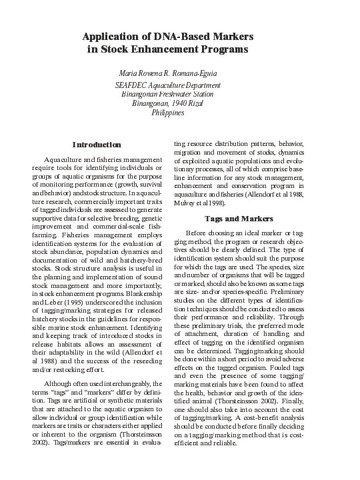
Application of DNA-based markers in stock enhancement programs
Romana-Eguia, Maria Rowena R. (Aquaculture Department, Southeast Asian Fisheries Development Center, 2006)
Aquaculture and fisheries management require tools for identifying individuals or groups of aquatic organisms for the purpose of monitoring performance (growth, survival and behavior) and stock structure. In aquaculture ...
(Aquaculture Department, Southeast Asian Fisheries Development Center, 2006)
Aquaculture and fisheries management require tools for identifying individuals or groups of aquatic organisms for the purpose of monitoring performance (growth, survival and behavior) and stock structure. In aquaculture ... -
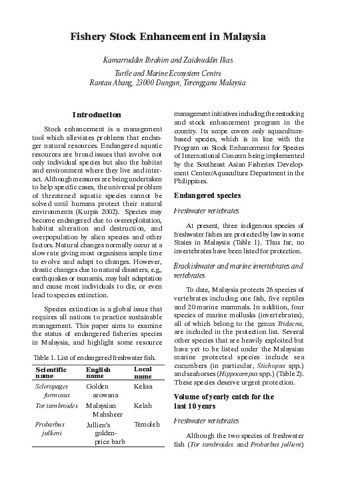
Fishery stock enhancement in Malaysia
(Aquaculture Department, Southeast Asian Fisheries Development Center, 2006)Species extinction is a global issue that requires all nations to practice sustainable management. This paper aims to examine the status of endangered fisheries species in Malaysia, and highlight some resource management ... -
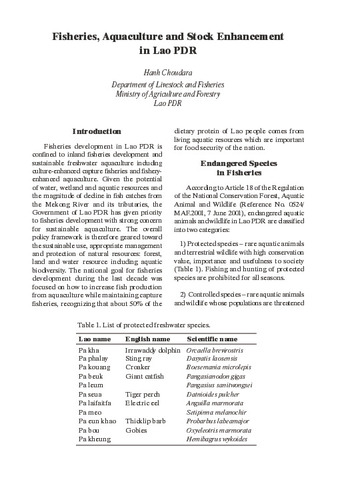
Fisheries, aquaculture and stock enhancement in Lao PDR
(Aquaculture Department, Southeast Asian Fisheries Development Center, 2006)Fisheries development in Lao PDR is confined to inland fisheries development and sustainable freshwater aquaculture including culture-enhanced capture fisheries and fishery-enhanced aquaculture. Given the potential of ...