
Search
Now showing items 1-10 of 23
Preliminary trials in Artemia rearing and salt production in earthen salt ponds
(Aquaculture Department, Southeast Asian Fisheries Development Center, 1979)
The authors report on the production of Artemia obtained on a 0.5 ha pilot project with combined trials in Artemia rearing with solar salt production during the dry seasons and with production of milkfish (Chanos chanos) ...

Notes on ovarian rematuration of ablated sugpo (prawn) Penaeus monodon Fabricius
Primavera, Jurgenne  ; (Aquaculture Department, Southeast Asian Fisheries Development Center, 1977)
; (Aquaculture Department, Southeast Asian Fisheries Development Center, 1977)
To what extent spent P. monodon females can remature and spawn successive broods is an important question in terms of recycling spawners in a commercially viable operation. Corollary to this is the quantity and quality of ...
Preliminary study on the internal genital organ of the giant tiger prawn, Penaeus monodon
(Aquaculture Department, Southeast Asian Fisheries Development Center, 1979)
This report gives information on the anatomy of the internal genital organs of male and female Penaeus monodon.
Growth and survival of Penaeus monodon postlarvae fed shrimp head meal and fish meal as primary animal source of protein
(Aquaculture Department, Southeast Asian Fisheries Development Center, 1978)
Although shrimp head meal alone does not provide for good growth and survival, fish meal can provide high survival rate. The addition of shrimp head improves this diet. It is suggested that cholesterol present in shrimp ...

The effect of different binders on the water stability of feeds for prawn
(Aquaculture Department, Southeast Asian Fisheries Development Center, 1978)
Corn starch, gelatin, sago palm starch, agar, and bread flour were tested for their binding capacity in pelleted diets for Penaeus monodon . Agar was found to be good binder, but it costs too much, while bread flour was ...
Laboratory breeding of the mud crab Scylla serrata (Forskal) through the zoea and megalopa stages to the crab stage
(Aquaculture Department, Southeast Asian Fisheries Development Center, 1977)
A series of experiments is being conducted to establish breeding techniques to mass-produce seedlings of S. serrata for pond cultivation to meet the commercial demand for the crab. The objective is to culture the crab ...

Courtship and mating behavior in Penaeus monodon Fabricius
Primavera, Jurgenne (Aquaculture Department, Southeast Asian Fisheries Development Center, 1978)
(Aquaculture Department, Southeast Asian Fisheries Development Center, 1978)
An illustrated description is given of the courtship and mating behaviour of P. monodon. Courtship and mating follow three distinct phases: (1) parallel swimming of male and female from the bottom to a height of 20-40 cm ...
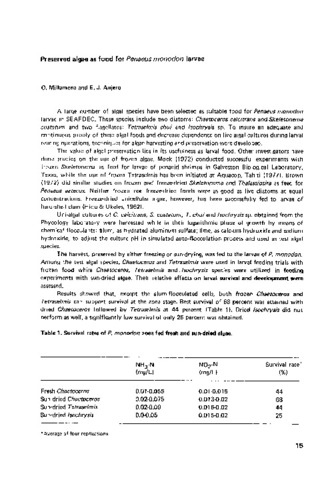
Preserved algae as food for Penaeus monodon larvae
(Aquaculture Department, Southeast Asian Fisheries Development Center, 1978)
Uni-algal cultures of C. calcitrans, S. costatum, T. chui and Isochrysis sp. obtained from the laboratory were harvested. The harvest, preserved by either freezing or sun-drying, was fed to the larvae of P. monodon . Among ...

Isolation and culture in artificial media of Lagenidium from Penaeus monodon larvae
(Aquaculture Department, Southeast Asian Fisheries Development Center, 1977)
Fungal infection of P. monodon larvae is a problem in hatchery operations. The fungus, which attacks the nauplius to postlarval stages and causes up to 100% mortality, has been tentatively identified as belonging to the ...
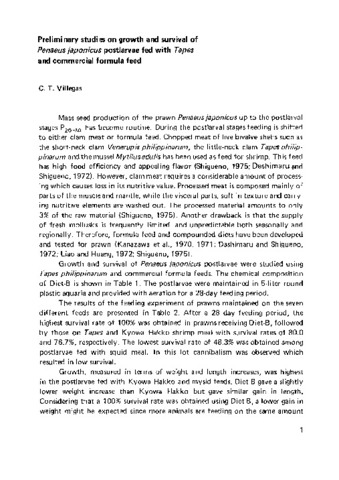
Preliminary studies on growth and survival of Penaeus japonicus postlarvae fed with Tapes and commercial formula feeds
(Aquaculture Department, Southeast Asian Fisheries Development Center, 1978)
Growth and survival of P. japonicus postlarvae was studied using Tapes philippinarum and commercial formula feeds. After a 28-day feeding period, the highest survival rate of 100% was obtained in prawns receiving Diet-B, ...