
Search
Now showing items 1-6 of 6
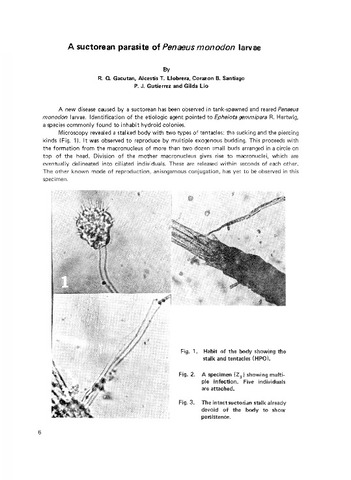
A suctorean parasite of Penaeus monodon larvae
(Aquaculture Department, Southeast Asian Fisheries Development Center, 1977)
A new disease caused by a suctorean has been observed in tank-spawned and reared P. monodon larvae. Identification of the etiologic agent pointed to Ephelota gemmipara R. Hertwig, a species commonly found to inhabit hydroid ...
Effect of furanace on the development of larval stages of Penaeus monodon Fabricius
(Aquaculture Department, Southeast Asian Fisheries Development Center, 1977)
Zoea 2 (Z<sub>2</sub>), Mysis 1 (M<sub>1</sub>) and Postlarva 1 (P<sub>1</sub>) of P. monodon artificially spawned in closed-system concrete hatchery tanks were bioassayed for their tolerance to the antibiotic furanace. ...

Isolation and culture in artificial media of Lagenidium from Penaeus monodon larvae
(Aquaculture Department, Southeast Asian Fisheries Development Center, 1977)
Fungal infection of P. monodon larvae is a problem in hatchery operations. The fungus, which attacks the nauplius to postlarval stages and causes up to 100% mortality, has been tentatively identified as belonging to the ...

Effects of furanace on Brachionus
(Aquaculture Department, Southeast Asian Fisheries Development Center, 1977)
Tiger prawn P.monodon) larvae utilize Brachionus a rotifer, as food in the Zoea 3 and mysis stages when they change from an herbivorous to an omnivorous diet. The present work aims to show the effects of furanace on the ...
Bacteria from seawater used in Penaeus monodon larval cultures
(Aquaculture Department, Southeast Asian Fisheries Development Center, 1977)
Bacteria in the seawater used in P. monodon hatchery operations were isolated on Bachmann's agar. The total plate counts in 25 isolations ranged from 1.0 - 5.0 x 10<sup>2</sup> to 5.1 -10.0 x 10<sup>5</sup> cells per ml. ...

Reduction in Chaetoceros populations by furanace
(Aquaculture Department, Southeast Asian Fisheries Development Center, 1977)
One of the most promising prophylactic agents being tested to control Penaeus monodon larval diseases is furanace (6-hydroxymethyl-2 2(5-nitro-2-furyl) vinyl pyridine). To evaluate further its suitability as a chemotherapeutic ...