Uptake and elimination of iodine-131 by the freshwater clam Corbicula manilensis Philippi from water

View/
Date
1988Page views
3,416ASFA keyword

AGROVOC keyword
Taxonomic term

Metadata
Show full item recordShare
Abstract
Whole body uptake of Iodine-131 by the freshwater clam, Corbicula manilensis, from contaminated water was followed using NaI scintillation counter. The bioaccumulation factor (BF) exclusive of shell was 5.44. The degree of bioaccumulation of I-131 by the different tissues is as follows: visceral remains > gills > gut > gonads > mantle > muscle > foot. The specific activities of the different tissues corresponded with their BF values. The relative distribution of I-131 in the different tissues was generally proportional to the weight ratio of each tissue. Elimination studies gave the effective half-life, \(T^{e}_{0.5}\), of 4.5 days. Estimation of \(T_{0.5}^{e}\) in the different tissues gave the following values: 12 d (mantle), 3.9 d (gonad and muscle), 3.6 d (gut), 3.4 d (gills), 2.4 d (foot) and 1.9 d (visceral remains).
Suggested Citation
Cuvin, M. L. A., & Umaly, R. C. (1988). Uptake and elimination of iodine-131 by the freshwater clam Corbicula manilensis Philippi from water. Natural and Applied Science Bulletin , 40(3), 141-158. http://hdl.handle.net/10862/1246
Type
ArticleISSN
0028-0682Collections
- Journal Articles [1267]
Related items
Showing items related by title, author, creator and subject.
-
Biology and status of aquaculture for giant clams (Tridacnidae) in the Ryukyu Islands, southern Japan
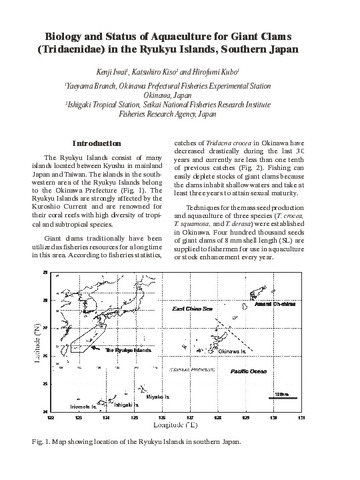
(Aquaculture Department, Southeast Asian Fisheries Development Center, 2006)The Ryukyu Islands consist of many islands located between Kyushu in mainland Japan and Taiwan. The islands in the south-western area of the Ryukyu Islands belong to the Okinawa Prefecture. The Ryukyu Islands are strongly affected by the Kuroshio Current and are renowned for their coral reefs with high diversity of tropical and subtropical species. Giant clams traditionally have been utilized as fisheries resources for a long time in this area. According to fisheries statistics, catches of Tridacna crocea in Okinawa have decreased drastically during the last 30 years and currently are less than one tenth of previous catches. Fishing can easily deplete stocks of giant clams because the clams inhabit shallow waters and take at least three years to attain sexual maturity. Techniques for the mass seed production and aquaculture of three species (T. crocea, T. squamosa, and T. derasa) were established in Okinawa. Four hundred thousand seeds of giant clams of 8 mm shell length (SL) are supplied to fishermen for use in aquaculture or stock enhancement every year. This paper will review the (1) biology of giant clams, (2) present status of aquaculture of giant clams in Okinawa, and (3) other studies on giant clams in southern Japan. -
Iodine disinfection of grouper Epinephelus coioides eggs
Tendencia, Eleonor (European Association of Fish Pathologists, 2003)
In this study, the developmental stage, iodine concentration and exposure time that will reduce the bacterial load without decreasing the hatching rate for the disinfection of grouper (Epinephelus coioides) egg were established. Results of the study showed that the best stage to disinfect grouper egg is at late neurula stage where the embryo shows twitching movement. The effective and safe concentration that will reduce bacterial load but will not decrease hatching rate for the disinfection of grouper egg is 7.5 ppm free iodine for 10 min. Total bacterial count of eggs disinfected with 7.5 ppm free iodine for 10 min (8.99 x 10² cfu/20 eggs) is significantly lower than the unrinsed/undisinfected eggs (1.99 x 10⁷ cfu/20 eggs).
(European Association of Fish Pathologists, 2003)
In this study, the developmental stage, iodine concentration and exposure time that will reduce the bacterial load without decreasing the hatching rate for the disinfection of grouper (Epinephelus coioides) egg were established. Results of the study showed that the best stage to disinfect grouper egg is at late neurula stage where the embryo shows twitching movement. The effective and safe concentration that will reduce bacterial load but will not decrease hatching rate for the disinfection of grouper egg is 7.5 ppm free iodine for 10 min. Total bacterial count of eggs disinfected with 7.5 ppm free iodine for 10 min (8.99 x 10² cfu/20 eggs) is significantly lower than the unrinsed/undisinfected eggs (1.99 x 10⁷ cfu/20 eggs). -
The use of chemicals in aquaculture in Thailand
(Aquaculture Department, Southeast Asian Fisheries Development Center, 2000)In Thailand, many chemicals are used to treat diseases of cultured aquatic animals and to improve water quality in culture facilities. Along with the intensification of aquaculture practices that has occurred in recent years in Thailand, chemical use has also increased, particularly in marine shrimp culture. This paper summarizes information on the types of chemotherapeutants commonly used in Thailand, their sources and costs, the treatment regimes used, the adverse impacts that have resulted and the hazards posed. Also included is information on national regulations, a summary of on-going research, and recommendations to aquaculturists, producers and suppliers of chemicals, government agencies and scientists. It is concluded that although chemicals and drugs will continue to play an important role in the development of Thai aquaculture, they must be used with caution to avoid adverse effects such as environmental damage and the development of resistant strains of pathogens. To minimize chemical usage, additional emphasis needs to be placed on developing good management practices for aquaculture systems.