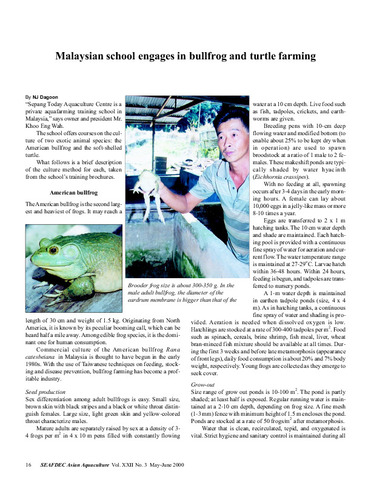
Malaysian school engages in bullfrog and turtle farming
View/

Downloads: 2,360
Date
2000Page views
2,427ASFA keyword

AGROVOC keyword
Taxonomic term

Metadata
Show full item recordShare
Abstract
A brief description is given of the culture methods used in the Sepang Today Aquaculture Centre, a private aquafarming training school in Malaysia, regarding American bullfrog (Rana catesbeiana) and the soft-shelled turtle (Trionyx sinensis). Seed production, grow-out, marketing and future potential are discussed, referring to the school s training brochures for both culture methods.
Suggested Citation
Dagoon, N. J. (2000). Malaysian school engages in bullfrog and turtle farming. SEAFDEC Asian Aquaculture , 22(3), 16-19, 29. http://hdl.handle.net/10862/1632
Type
magazineArticleISSN
0115-4974Collections
Related items
Showing items related by title, author, creator and subject.
-
Aquaculture in Malaysia
(Aquaculture Department, Southeast Asian Fisheries Development Center, 1995)Aquaculture in Malaysia is experiencing rapid growth. Total production in 1992 amounted to 79,699 tons valued at RM 207.4 million. These figures are 23% and 25% higher than the previous year's. Semi-culture of the cockle Anadara granosa was still predominant, contributing about 70% of the total output. Culture and production of the oyster Crassostrea iredalei is still insignificant. Sea bass Lates calcarifer constituted over 80% of the production from marine cages. Cage culture of grouper Epinephelus sp., snapper Lutjanus sp. and pompano Trachinotus blochii were also done in much smaller scale. The mangrove snapper Lutjanus argentimaculatus was recently spawned in captivity and larvae and juveniles were produced. In 1992, the tiger shrimp Penaeus monodon constituted about 87% of brackishwater pond production. Pond culture of the white shrimp P. merguiensis and the mudcrab Scylla sp. is at the experimental stage. Red tilapia hybrid was the major freshwater species cultured in cages, with 1,486 tons harvested in 1992. Freshwater pond production was valued at RM 100.85 million, 22% of which was due to the eel Anguilla japonica. Production of freshwater ornamental fishes is also becoming significant. Other exotic species recently bred and cultured are the African catfish Clarias gariepinus and the pacu Piaractus brachypomus. The indigenous freshwater catfish Mystus nemurus and carp Probarbus julleini have recently been bred in captivity and cultured experimentally. Lately, there have been attempts to culture non-conventional species such as the bullfrog Rana catesbeiana, the soft-shell turtle Trionyx sinensis, and aquatic ornamental plants. -
Aquaculture in Vietnam
(Aquaculture Department, Southeast Asian Fisheries Development Center, 1995)Aquaculture in Vietnam has gained momentum and now produces 370,000 tons of various aquatic commodities. Aquaculture includes shrimp culture in the Mekong Delta; fish culture in cages in rivers, reservoirs, and coastal waters; fish culture in ponds and lakes; mollusk culture in the northern provinces, culture of soft-shell turtle in some provinces, culture of the seaweed Gracilaria. In north and central Vietnam, aquaculture has increased the protein supply, the foreign exchange earnings, employment opportunities, and the living conditions of the people. Vietnam aims to develop aquaculture to produce more than 600,000 tons of aquatic products by the year 2000. -
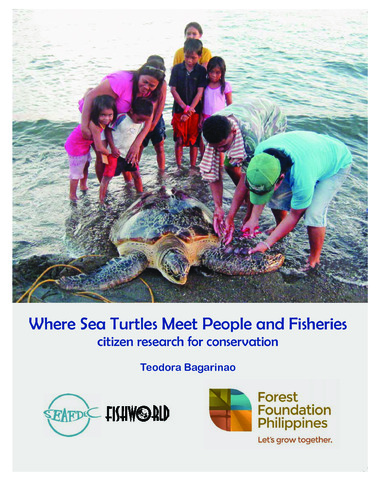
Where sea turtles meet people and fisheries: Citizen research for conservation
Bagarinao, Teodora (Aquaculture Department, Southeast Asian Fisheries Development Center; Forest Foundation Philippines, 2025)
Since 2000, SEAFDEC FishWorld has served as a focal point for community engagement in marine biodiversity conservation, with a particular emphasis on sea turtle protection in the waters surrounding Panay and Guimaras Islands. This book presents the outcomes of a long-term initiative involving the documentation, tagging, release, and care of sea turtles incidentally captured in local fisheries. It provides a permanent record of 335 sea turtles, including documentary photographs of 214 individuals, and offers extensive data and new insights into the status and ecology of these endangered species in Philippine waters. The volume details the interactions between sea turtles, fishing gear, and coastal communities, highlighting collaborative efforts among FishWorld, fishers, and government agencies to promote conservation and reduce turtle capture. Written for fishers, conservation practitioners, government officers, educators, and the general public, the book combines scientific information with accessible, pictorial presentation. It contributes significantly to national efforts to raise awareness, foster community participation, and strengthen the protection of sea turtles and the marine ecosystems that sustain them.
(Aquaculture Department, Southeast Asian Fisheries Development Center; Forest Foundation Philippines, 2025)
Since 2000, SEAFDEC FishWorld has served as a focal point for community engagement in marine biodiversity conservation, with a particular emphasis on sea turtle protection in the waters surrounding Panay and Guimaras Islands. This book presents the outcomes of a long-term initiative involving the documentation, tagging, release, and care of sea turtles incidentally captured in local fisheries. It provides a permanent record of 335 sea turtles, including documentary photographs of 214 individuals, and offers extensive data and new insights into the status and ecology of these endangered species in Philippine waters. The volume details the interactions between sea turtles, fishing gear, and coastal communities, highlighting collaborative efforts among FishWorld, fishers, and government agencies to promote conservation and reduce turtle capture. Written for fishers, conservation practitioners, government officers, educators, and the general public, the book combines scientific information with accessible, pictorial presentation. It contributes significantly to national efforts to raise awareness, foster community participation, and strengthen the protection of sea turtles and the marine ecosystems that sustain them.