Evaluation of leguminous seed meals and leaf meals as plant protein sources in diets for juvenile Penaeus indicus

View/
Date
1998Page views
8,407ASFA keyword

AGROVOC keyword
Taxonomic term

Metadata
Show full item recordShare
Abstract
The potential of locally available legumes (white cowpea, Vigna unguiculata, and green mung-bean, Vigna radiata) and leaf meals (papaya, Carica papaya, and cassava, Manihut esculenta) in combination with defatted soybean meal as protein sources was evaluated in juvenile Penaeus indicus. The feedstuffs were included in practical diets for P. indicus, replacing 9% of the protein in the basal diet. Juvenile P. indicus (mean initial weight 0.08±0.01 g) were fed the practical diets for 61 days. Shrimp fed the control diet had the highest weight gain and specific growth rate, which did not significantly differ (p>0.05) from those of shrimp fed white cowpea meal, papaya leaf meal and cassava leaf meal. Survival of the control shrimp was significantly higher (p<0,05) than that of shrimp fed cassava and papaya leaf meals but comparable to that of shrimp fed white cowpea meal. The growth of shrimp given green mungbean meal was comparable to that of shrimp fed papaya leaf meal, however the shrimp fed mungbean meal had the lowest survival.
The apparent protein digestibility (APD) of white cowpea meal (87%) was significantly higher (p<0.05) than that of the control (82%) and cassava leaf meal (77%) based diets . However, the APD of the white cowpea meal based diet was comparable to those of the papaya leaf meal and green mungbean meal based diets. Results suggest that, besides digestibility, other factors such as the amino acid balance of the diet and the amount of anti-nutritional factors may influence the growth and survival of P. indicus.
Suggested Citation
Eusebio, P. S., & Coloso, R. M. (1998). Evaluation of leguminous seed meals and leaf meals as plant protein sources in diets for juvenile Penaeus indicus. The Israeli Journal of Aquaculture-Bamidgeh , 50(2), 47-54. http://hdl.handle.net/10862/1741
Type
ArticleISSN
0792-156XCollections
- Journal Articles [1267]
Related items
Showing items related by title, author, creator and subject.
-
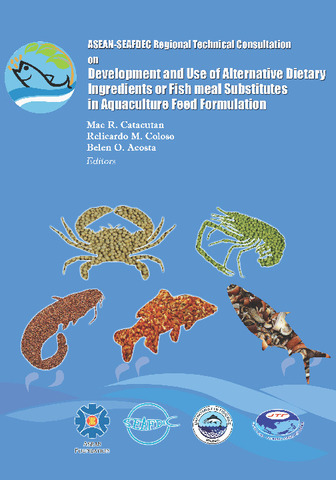
Development and use of alternative ingredients or fish meal substitutes in aquaculture feed formulation: Proceedings of the ASEAN Regional Technical Consultation on Development and Use of Alternative Dietary Ingredients or Fish Meal Substitutes in Aquaculture Feed Formulation
(Aquaculture Department, Southeast Asian Fisheries Development Center, 2015)Recognizing the need for a concerted effort to follow-up on this priority issue of the ASEAN on aquaculture feed development and utilization. SEAFDEC (Aquaculture Department and Secretariat) and the Government of Myanmar organized the 'Regional Technical Consultation (RTC) on development and Use of Alternative Dietary Ingredients or Fish Meal Substitutes in Aquaculture Feed Formulation'. The meeting was convened with the main purpose of providing a forum for charting the regional priorities and future directions on feed development, particularly on the use of alternative feed ingredients or protein substitutes. The specific objectives were to: (i) review the ASEAN-SEAFDEC member country status, constraints associated with developing alternative dietary ingredients for aquaculture feed; (ii) identify specific advances being made in the region with respect to the development of alternative aquaculture feed ingredients; and (iii) define approaches or initiatives supporting catch reduction of low-value/trash fish; (iv) formulate relevant policy recommendations (regional and country-specific) for effective development and utilization of aquaculture feeds; and (v) enhance cooperation among member countries and relevant stakeholders on initiatives that support sustainable aquaculture practices, particularly on feeds. This publication presents the outputs of the RTC. The country reports and review papers presented during the conference which are contained in this volume are cited individually. -
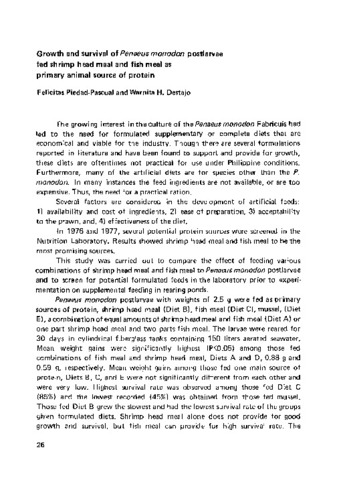
Growth and survival of Penaeus monodon postlarvae fed shrimp head meal and fish meal as primary animal source of protein
(Aquaculture Department, Southeast Asian Fisheries Development Center, 1978)Although shrimp head meal alone does not provide for good growth and survival, fish meal can provide high survival rate. The addition of shrimp head improves this diet. It is suggested that cholesterol present in shrimp could have caused this difference. Composition of the test diets is tabulated, as are proximate chemical analysis of the diets, and the mean initial weights, final weights, weight gains, survival rate, feed consumed, protein consumed, of Penaeus monodon postlarvae, feed conversion and protein efficiency ratio. -
Series: ACIAR Monograph 110
Replacement of fish meal by animal by-product meals in a practical diet for growout culture of grouper (Epinephelus coioides)
(Australian Centre for International Agricultural Research, 2004)This study was conducted to develop compounded feeds having a low content of fish meal for juvenile grouper and as an alternative to trash fish feeding. Epinephelus coioides juveniles were stocked in 36 units of 250-litre tanks at 25 fish/tank. Eight dietary treatments representing increasing (0, 10, 20, 30, 40, 60, 80 and 100%) percentage replacements of fish meal protein with 4:1 combination of meat meal and blood meal were tested in quadruplicate groups of fish arranged in a completely randomized design. Weight gain and specific growth rate (SGR), survival, food conversion rate (FCR) and body composition of fish were determined. Up to 80% of fish meal protein could be replaced by processed meat meal and blood meal, with no adverse effects on growth, survival and feed conversion efficiency of E. coioides juveniles. Use of animal byproduct meals as protein source substantially lowered the level of fish meal required in the juvenile grouper diet. The diet could be effectively used as a substitute for trash fish feeding, thereby reducing the requirements for fishery resource. From an economic standpoint, replacement of fish meal with cheaper animal byproduct meals in a practical diet for grouper could alleviate the problem of low fish meal availability and high cost.