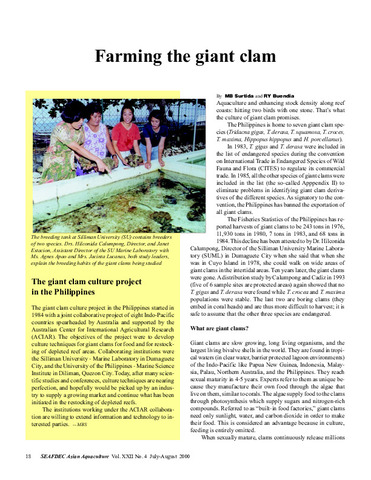
Farming the giant clam


Share
Suggested Citation
Surtida, M. B., & Buendia, R. Y. (2000). Farming the giant clam. SEAFDEC Asian Aquaculture , 22(4), 18-19, 30. http://hdl.handle.net/10862/2736
Type
magazineArticleISSN
0115-4974Collections
Related items
Showing items related by title, author, creator and subject.
-
Series: Aquaculture extension manual; No. 37
Giant clam hatchery, ocean nursery and stock enhancement
(Aquaculture Department, Southeast Asian Fisheries Development Center, 2007)This manual is meant to serve as a guide to the culture of giant clams (Bivalvia, Subfamily Tridacninae). The first part focuses on hatchery methods. The second part is about the ocean nursery. The first two sections refer to selection and setting the ocean nursery site. Clam transport is introduced next although this is further tackled in the last part of this manual. Finally, the third and last part discusses the purposes of stock enhancement, survey methods for stock assessment, transport, monitoring and record keeping. -
Biology and status of aquaculture for giant clams (Tridacnidae) in the Ryukyu Islands, southern Japan
(Aquaculture Department, Southeast Asian Fisheries Development Center, 2006)The Ryukyu Islands consist of many islands located between Kyushu in mainland Japan and Taiwan. The islands in the south-western area of the Ryukyu Islands belong to the Okinawa Prefecture. The Ryukyu Islands are strongly affected by the Kuroshio Current and are renowned for their coral reefs with high diversity of tropical and subtropical species. Giant clams traditionally have been utilized as fisheries resources for a long time in this area. According to fisheries statistics, catches of Tridacna crocea in Okinawa have decreased drastically during the last 30 years and currently are less than one tenth of previous catches. Fishing can easily deplete stocks of giant clams because the clams inhabit shallow waters and take at least three years to attain sexual maturity. Techniques for the mass seed production and aquaculture of three species (T. crocea, T. squamosa, and T. derasa) were established in Okinawa. Four hundred thousand seeds of giant clams of 8 mm shell length (SL) are supplied to fishermen for use in aquaculture or stock enhancement every year. This paper will review the (1) biology of giant clams, (2) present status of aquaculture of giant clams in Okinawa, and (3) other studies on giant clams in southern Japan. -
Mariculture of giant clams
(Aquaculture Department, Southeast Asian Fisheries Development Center, 1992)