Growth and yield of the grouper Epinephelus coioides fed 'trash fish' at different rates and frequencies in floating net cages

Share
Abstract
The effects of various feeding rates and frequencies on the growth and survival of orangespotted grouper Epinephelus coides were determined in floating net cages in Tiniguiban Cove, Puerto Princesa, Palawan. Juveniles (average weight 60 g) were stocked in 2 m x 2 m x 1.5 m cages at a density of 10/m3. The experiment tested six treatments: 10% of body weight (BW) daily; 5% BW daily; ad libitum daily; 10% BW every other day; 5% BW every other day; and ad libitum every other day. After five months, the fish fed at 10% daily had 100% survival and the highest weight gain (520 g), growth rate (3.5 g/d), net production (31.44 kg), and gross income (P5,463). However, returns were negative in all treatments because of either too high feed consumption and poor conversion or low net production.
Suggested Citation
Galzote, G. V., & Abrera, E. C. (2007). Growth and yield of the grouper Epinephelus coioides fed 'trash fish' at different rates and frequencies in floating net cages. In T. U. Bagarinao (Ed.), Research Output of the Fisheries Sector Program (Vol. 2. Reports on Fisheries and Aquaculture, pp. 25-27). Quezon City, Philippines: Bureau of Agricultural Research, Department of Agriculture.
Type
Book chapterISBN
9718511776Related items
Showing items related by title, author, creator and subject.
-
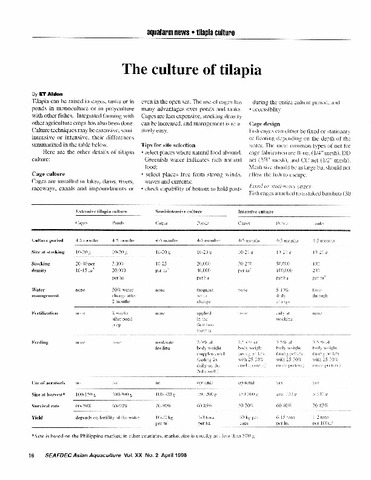
The culture of tilapia
(Aquaculture Department, Southeast Asian Fisheries Development Center, 1998) -
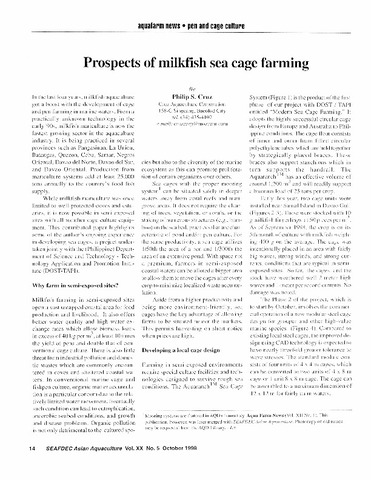
Prospects of milkfish sea cage farming
(Aquaculture Department, Southeast Asian Fisheries Development Center, 1998) -
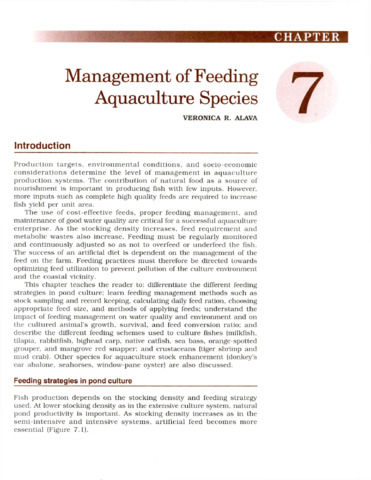
Management of feeding aquaculture species
(Aquaculture Department, Southeast Asian Fisheries Development Center, 2002)This chapter teaches the reader to: differentiate the different feeding strategies in pond culture; learn feeding management methods such as stock sampling and record keeping, calculating daily feed ration, choosing appropriate feed size, and methods of applying feeds; understand the impact of feeding management on water quality and environment and on the cultured animal’s growth, survival, and feed conversion ratio; and describe the different feeding schemes used to culture fishes (milkfish, tilapia, rabbitfish, bighead carp, native catfish, sea bass, orange-spotted grouper, and mangrove red snapper; and crustaceans (tiger shrimp and mud crab). Other species for aquaculture stock enhancement (donkey’s ear abalone, seahorses, window-pane oyster) are also discussed.