On-the-Job Training and Internship


Share
Keywords
On-the-Job Training OJT internshipSubjects
Students
Suggested Citation
SEAFDEC Aquaculture Department. (2024). On-the-Job Training and Internship [Brochure]. Tigbauan, Iloilo, Philippines: Author.
Type
BrochureCollections
- Brochures and flyers [57]
Related items
Showing items related by title, author, creator and subject.
-
SEAFDEC/AQD experience in mangrove-friendly aquaculture training and extension
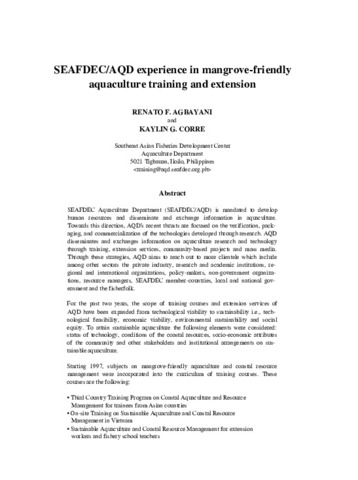
(Aquaculture Department, Southeast Asian Fisheries Development Center, 2000)SEAFDEC Aquaculture Department (SEAFDEC/AQD) is mandated to develop human resources and disseminate and exchange information in aquaculture. Towards this direction, AQD’s recent thrusts are focused on the verification, packaging, and commercialization of the technologies developed through research. AQD disseminates and exchanges information on aquaculture research and technology through training, extension services, community-based projects and mass media. Through these strategies, AQD aims to reach out to more clientele which include among other sectors the private industry, research and academic institutions, regional and international organizations, policy-makers, non-government organizations, resource managers, SEAFDEC member-countries, local and national government and the fisherfolk. For the past two years, the scope of training courses and extension services of AQD have been expanded from technological viability to sustainability i.e., technological feasibility, economic viability, environmental sustainability and social equity. To attain sustainable aquaculture the following elements were considered: status of technology, conditions of the coastal resources, socio-economic attributes of the community and other stakeholders and institutional arrangements on sustainable aquaculture. Starting 1997, subjects on mangrove-friendly aquaculture and coastal resource management were incorporated into the curriculum of training courses. These courses are the following:- Third Country Training Program on Coastal Aquaculture and Resource Management for trainees from Asian countries
- On-site Training on Sustainable Aquaculture and Coastal Resource Management in Vietnam
- Sustainable Aquaculture and Coastal Resource Management for extension workers and fishery school teachers
-
Training updates on marine fish hatchery
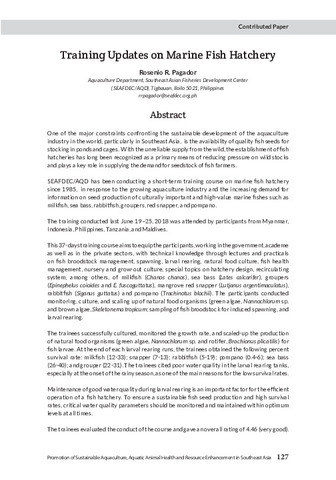
(Aquaculture Department, Southeast Asian Fisheries Development Center, 2021-12)One of the major constraints confronting the sustainable development of the aquaculture industry in the world, particularly in Southeast Asia, is the availability of quality fish seeds for stocking in ponds and cages. With the unreliable supply from the wild, the establishment of fish hatcheries has long been recognized as a primary means of reducing pressure on wild stocks and plays a key role in supplying the demand for seedstock of fish farmers. SEAFDEC/AQD has been conducting a short-term training course on marine fish hatchery since 1985, in response to the growing aquaculture industry and the increasing demand for information on seed production of culturally important and high-value marine fishes such as milkfish, sea bass, rabbitfish, groupers, red snapper, and pompano. The training conducted last June 19–25, 2018 was attended by participants from Myanmar, Indonesia, Philippines, Tanzania, and Maldives. This 37-days training course aims to equip the participants, working in the government, academe as well as in the private sectors, with technical knowledge through lectures and practicals on fish broodstock management, spawning, larval rearing, natural food culture, fish health management, nursery and grow-out culture, special topics on hatchery design, recirculating system, among others, of milkfish (Chanos chanos), sea bass (Lates calcarifer), groupers (Epinephelus coioides and E. fuscoguttatus), mangrove red snapper (Lutjanus argentimaculatus), rabbitfish (Siganus guttatus) and pompano (Trachinotus blochii). The participants conducted monitoring, culture, and scaling up of natural food organisms (green algae, Nannochlorum sp. and brown algae, Skeletonema tropicum; sampling of fish broodstock for induced spawning, and larval rearing. The trainees successfully cultured, monitored the growth rate, and scaled-up the production of natural food organisms (green algae, Nannochlorum sp. and rotifer, Brachionus plicatilis) for fish larvae. At the end of each larval rearing runs, the trainees obtained the following percent survival rate: milkfish (12-33); snapper (7-13); rabbitfish (5-19); pompano (0.4-6); sea bass (26-40); and grouper (22-31). The trainees cited poor water quality in the larval rearing tanks, especially at the onset of the rainy season, as one of the main reasons for the low survival rates. Maintenance of good water quality during larval rearing is an important factor for the efficient operation of a fish hatchery. To ensure a sustainable fish seed production and high survival rates, critical water quality parameters should be monitored and maintained within optimum levels at all times. The trainees evaluated the conduct of the course and gave an overall rating of 4.46 (very good). -
SEAFDEC Regional Fish Disease Program: Safeguarding the quality of aquaculture products and environmental integrity of the southeast Asian region
(Secretariat, Southeast Asian Fisheries Development Center, 2009)