SEAFDEC/AQD Institutional Repository: Recent submissions
Now showing items 201-220 of 4221
-
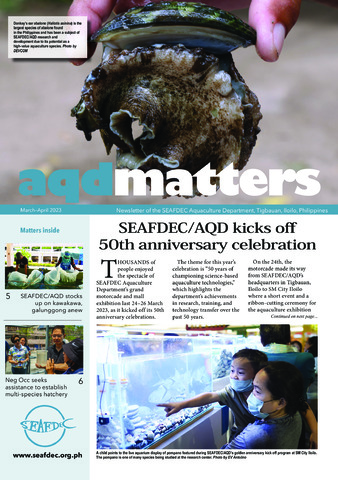
AQD Matters 2023 March - April
(Aquaculture Department, Southeast Asian Fisheries Development Center, 2023-05)In this issue: 1) SEAFDEC/AQD kicks off 50th anniversary celebration; 2) Oil spill-affected fisher folks learn freshwater aquaculture; 3) 4 fisheries grad join SEAFDEC's pool of skilled aquaculturists; 4) SEAFDEC/AQD stocks ... -
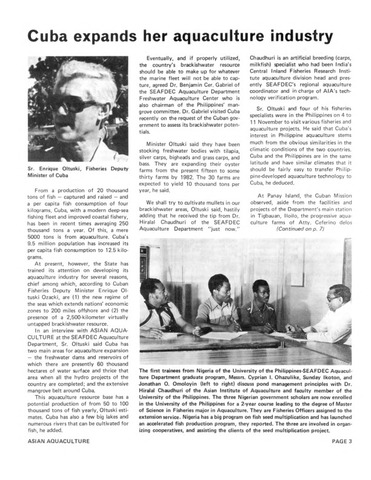
Cuba expands her aquaculture industry
(Aquaculture Department, Southeast Asian Fisheries Development Center, 1978-12)Despite a thriving deep-sea and coastal fishery and high per capita fish consumption in Cuba, aquaculture is relatively undeveloped and will therefore be a target for future expansion following the impact of other nations' new economic zones on the fisheries. Two main areas for expansion exist: the freshwater dams and reservoirs, and the extensive mangrove belt around Cuba, which together have a potential annual production of 50 to 100 thousand tons of fish. At present, stocking programmes are concentrated on tilapia, silver carps, bigheads and grass carps, bass, and oysters; while mullets may be cultivated in brackishwater areas. Cuba has developed a particular interest in the Philippine aquaculture industry owing to the similar climatic conditions of the two countries. -
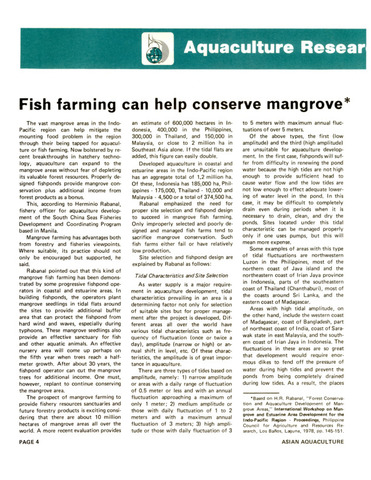
Fish farming can help conserve mangrove
(Aquaculture Department, Southeast Asian Fisheries Development Center, 1978-12)Recent breakthroughs in hatchery technology allow aquaculture developments which are not merely compatible with mangrove areas, but actually improve mangrove conservation and concurrently permit the exploitation of forestry products. This article discusses the important implications of aquaculture development in mangrove areas, and the rationale underlying site selection, project design and technology. -
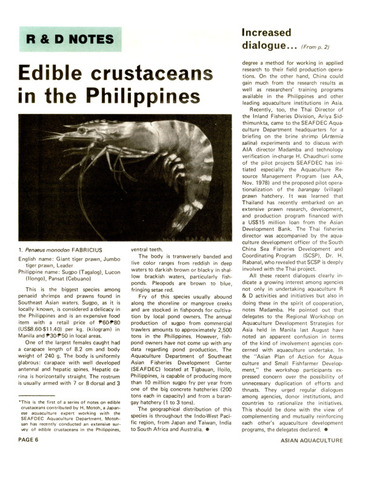
Edible crustaceans in the Philippines
(Aquaculture Department, Southeast Asian Fisheries Development Center, 1978-12)Cursory information on the biology and economic value of sugpo (Penaeus monodon ) relevant to aquaculturists is presented. -
Freshwater fisheries expands program
(Aquaculture Department, Southeast Asian Fisheries Development Center, 1978-12)The SEAFDEC Aquaculture Department Freshwater Fisheries Station, located at Binangonan, on the shores of Laguna Lake, has drafted a programme for expansion. These include the piloting of a fish feed mill and the establishment of a pilot freshwater sugpo (Penaeus monodon) cage culture. Tilapia breeding, which aims to come up with a suitable and fast-growing cross, has also been started. Other freshwater programmes touch on the development of larval rearing techniques for shrimp species, and the setting up of a model eco-community in a fishing village. -
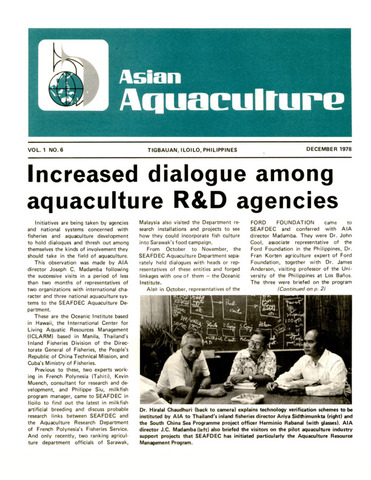
Increased dialogue among aquaculture R&D agencies
(Aquaculture Department, Southeast Asian Fisheries Development Center, 1978-12) -
Molluscan aquaculture in the Philippines: A review
Lebata-Ramos, Ma. Junemie Hazel (Springer, 2023-04-25)
Molluscs are among the most valuable resources of the Philippines, an archipelagic country of 7,107 islands bounded by 36,000 km of coastline and 26.6 million ha of coastal waters. In 2020, production from mussels and oysters alone valued at PhP1.552 billion. As primary sources of food and livelihood for marginalized fisherfolk, they are considered important in food security, nutrition, and poverty alleviation. Nevertheless, for almost a century, mollusc culture remained small-scale, with most fish farmers investing in non-fed species, like mussels and oysters. Moreover, mollusc culture in the country is still dependent on wild sources of seed stocks, making production unsustainable and unreliable. This dependence on the wild seed stocks will continue until the issue of the lack of commercial-scale hatcheries or the limited capacity of existing hatcheries to produce seeds, both for top and emerging mollusc aquaculture species, is resolved. Although technologies from broodstock management to post-harvest are available in some species, the lack of capital and the limited government support limit these artisanal fishers from doing large commercial-scale culture. This paper summarizes what has been done and published on the leading mollusc species cultured in the Philippines. Future research activities may be designed based on the research gaps to refine available technologies and develop new ones to improve culture production. The lack of or limited relevant information on the viable economics of the different culture techniques at different culture phases, the limited availability of post-harvest technologies, and the sparse or lack of genetic information for these leading mollusc species are among the gaps that need to be addressed.
(Springer, 2023-04-25)
Molluscs are among the most valuable resources of the Philippines, an archipelagic country of 7,107 islands bounded by 36,000 km of coastline and 26.6 million ha of coastal waters. In 2020, production from mussels and oysters alone valued at PhP1.552 billion. As primary sources of food and livelihood for marginalized fisherfolk, they are considered important in food security, nutrition, and poverty alleviation. Nevertheless, for almost a century, mollusc culture remained small-scale, with most fish farmers investing in non-fed species, like mussels and oysters. Moreover, mollusc culture in the country is still dependent on wild sources of seed stocks, making production unsustainable and unreliable. This dependence on the wild seed stocks will continue until the issue of the lack of commercial-scale hatcheries or the limited capacity of existing hatcheries to produce seeds, both for top and emerging mollusc aquaculture species, is resolved. Although technologies from broodstock management to post-harvest are available in some species, the lack of capital and the limited government support limit these artisanal fishers from doing large commercial-scale culture. This paper summarizes what has been done and published on the leading mollusc species cultured in the Philippines. Future research activities may be designed based on the research gaps to refine available technologies and develop new ones to improve culture production. The lack of or limited relevant information on the viable economics of the different culture techniques at different culture phases, the limited availability of post-harvest technologies, and the sparse or lack of genetic information for these leading mollusc species are among the gaps that need to be addressed. -
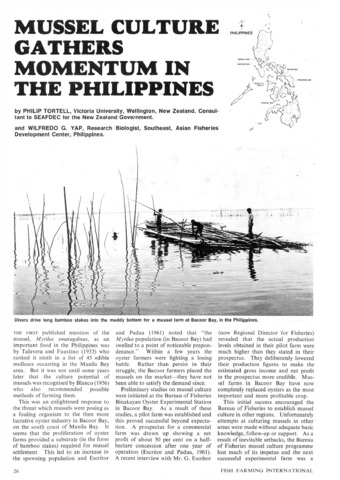
Mussel culture gathers momentum in the Philippines
(Arthur J. Heighway Publications Ltd., 1976-12)Mussels (Mytilus smaragdinus) were posing a threat as fouling organisms in Bacoor Bay, on the south coast of Manila Bay but when attempts were made to market the mussel so much success was achieved that attempts to culture it were begun. A pilot farm was established; mussels now exceed oysters as the most important an profitable crop, 4 mussel projects have now been established, at Bacoor, Tinagong Dagat in northeast Panay, Jiabon in western Samar, and Panguil Bay in northwest Minanao. Projects of the Southeast Asian Fisheries Development Center (SEAFDEC) are also noted. The methods used in mussel culture are described; at Bacoor, Bamboo stakes are used as substrate. Cost and production estimates for a 1 ha farm using the bamboo stake substrate are given. -
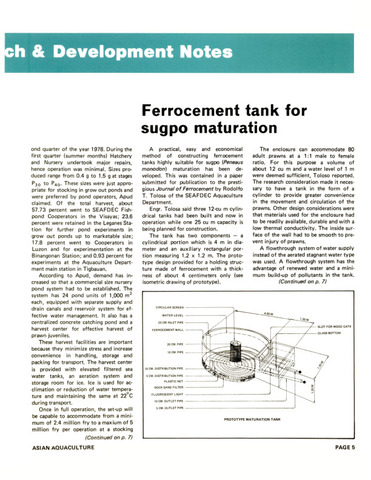
Ferrocement tank for sugpo maturation
(Aquaculture Department, Southeast Asian Fisheries Development Center, 1978-11)A practical, easy, and economical method of constructing ferrocement tanks highly suitable for sugpo (Penaeus monodon) maturation has been developed. The tank incorporates a cylindrical portion and an auxiliary rectangular portion and can accommodate 80 adult prawns at a 1:1 male-to-female ratio. Design considerations are aimed at ease of use and construction. A flowthrough water supply system, plus an oxygenation and filter system, are included. -
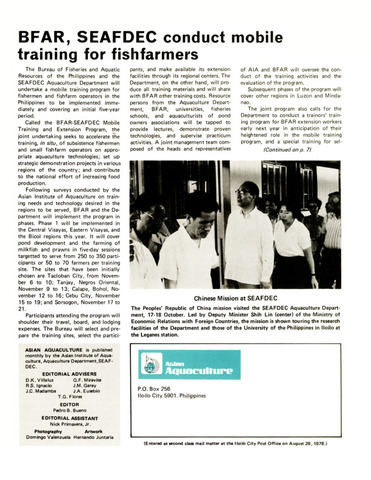
BFAR, SEAFDEC conduct mobile training for fishfarmers
(Aquaculture Department, Southeast Asian Fisheries Development Center, 1978-11)The Bureau of Fisheries and Aquatic Resources of the Philippines and SEAFDEC Aquaculture Department are proposing to undertake a mobile training program for fishermen and fish farm operators in the Philippines to be implemented immediately and covering an initial 5-year period. The program seeks to accelerate the training, in situ, of subsistence fishermen and small fish farm operators on appropriate aquaculture technologies; set up strategic demonstration projects in various regions of the country; and contribute to the national effort of increasing food production. -
Aquaculture development plan in Ivory Coast
(Aquaculture Department, Southeast Asian Fisheries Development Center, 1978-11)An aquaculture development plan has been formulated to eliminate, in the long term, protein deficiency especially in the northern part of the country. It is proposed to establish fish farms, rural fish culture in ponds, and integrated with the rearing in rice valleys, floating cages, racks, and enclosures rearing in lakes, lagoons, rivers, and mangroves. Tilapia nilotica, possibly combined with a predator (Lates niloticus or Clarias lazera), is the most promising species for culture. Brief details of the objectives and organization of the plan are presented in this article. -
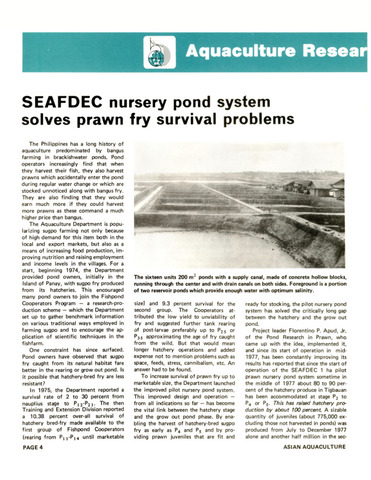
SEAFDEC nursery pond system solves prawn fry survival problems
(Aquaculture Department, Southeast Asian Fisheries Development Center, 1978-11)Prawn culture has been encouraged in the Philippines as an alternative to fish (bangus), since the former provides a higher income, better nutrition, and increased employment. The Aquaculture Department has made sugpo fry (Penaeus monodon ) available to pond owners, but these hatchery-bred fry are found to be much less viable than those from natural habitats. This has prompted the launching of an improved pilot nursery pond system which enables fry to be harvested as early as P4 and P5 stages, using improvements in design and operation to solve the critically long gap between the hatchery and the grow-out pond. By this method, hatchery production has been raised by about 100 percent, and a commercial size nursery has now been established capable of accommodating 2.4 to 5 million fry per operation, or 15 to 40 million per year. -
OI, SEAFDEC in joint R & D venture
(Aquaculture Department, Southeast Asian Fisheries Development Center, 1978-11)The SEAFDEC Aquaculture Department has entered into a collaborative venture with the Oceanic Institute of Hawaii, aimed at research and development, particularly on milkfish (Chanos chanos), transfer of developed technology, and exchange of information. Each institution has a background in aquaculture research activities. -
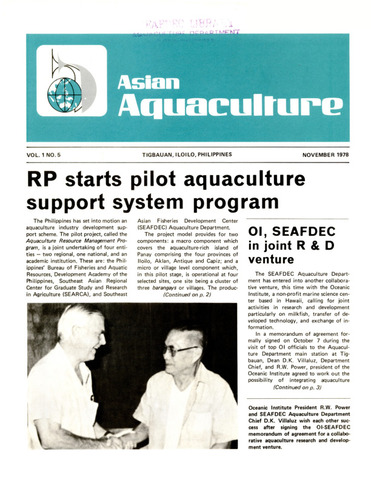
RP starts pilot aquaculture support system program
(Aquaculture Department, Southeast Asian Fisheries Development Center, 1978-11)The Philippines has set into motion an aquaculture industry development support scheme, jointly undertaken by 4 institutions. The project model provides for two components: a macro component which covers the island of Panay, and a micro or village level component concerned with milkfish, crustacean (including sugpo, or tiger prawn), and mollusc production. Details of the proposed infrastructure, technology, field implementation and management are given. -
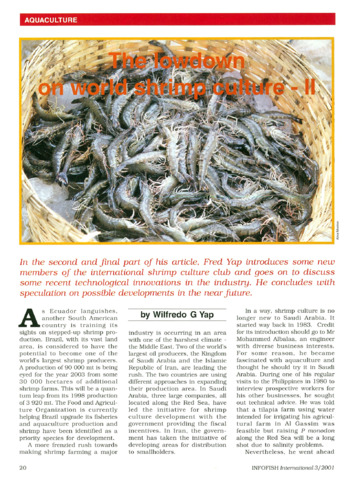
The lowdown on world shrimp culture - II
(INFOFISH, 2001)This paper introduces some new members of the international shrimp culture club and goes on to discuss some recent technological innovations in the industry, particularly the polyculture of tilapia (mainly Oreochromis mossambicus) and shrimp. -
Grow-out culture of oyster Magallana bilineata (Röding, 1798) using pouches: A comparison of growth and survival in the river and earthen pond
Lebata-Ramos, Ma. Junemie Hazel; ; (College of Agriculture and Food Science, University of the Philippines Los Baños, 2023-03)
Oysters are among the most in-demand aquaculture commodities in the Philippines and worldwide. With the decreasing culture area and the deteriorating water quality of oyster beds, there is a need to explore new culture sites and techniques to address the problems of dwindling stocks and the increasing demand for better quality oysters. This study compared the growth and survival of the oysters Magallana bilineata, the new accepted name of Crassostrea iredalei, cultured in an earthen pond and the river using pouches suspended from rafts. Mean growth rates of oysters in length and weight were significantly higher in those reared in the river (0.56 ± 0.02 cm mo-1; 10.27 ± 0.42 g mo-1) than those in the pond (0.41 ± 0.03 cm mo-1; 5.99 ± 0.22 g mo-1), but the meat yield of oysters reared in the river (25.96 ± 0.92%) was almost the same as in the pond (24.05 ± 1.41%). Likewise, the proximate composition was the same for oysters coming from the river and the pond, respectively — 58.04 ± 0.14% and 53.86 ± 0.38% crude protein, 7.00 ± 0.08% and 7.93 ± 0.38% crude fat, 24.68 ± 0.07% and 28.54 ± 0.74% nitrogen-free extract, and 10.27 ± 0.01% and 9.68 ± 0.01% ash. Oyster survival at harvest was significantly higher in the river (70.21 ± 2.84%) than in the pond (13.10 ± 1.57%). However, with some interventions, ponds may still be utilized for oyster culture despite the low survival results in this study. Extending oyster culture in these aquaculture facilities may serve as a basis for interventions to make the pond more habitable for oysters and may help boost production in the country. -
The lowdown on world shrimp culture - I
(INFOFISH, 2001)Based on FAO time series data, in 1984 there were only 33 countries reporting farmed shrimp production. This increased to 51 in 1989 and rose to 60 in 1996. The world total shrimps and prawns production reached 1.114 million mt in 1998. This level represents more than a five-fold increase over the 1985 production of 213 640 mt. The outbreak of disease in shrimp farms has been a serious problem; the example of the white spot virus (WSSV) is given. The situation in two major shrimp producing countries, Thailand and Ecuador, is illustrated. -
Genomic analysis of Vibrio harveyi strain PH1009, a potential multi-drug resistant pathogen due to acquisition of toxin genes
De Mesa, Czarina Anne; Mendoza, Remilyn ; Penir, Sarah Mae ; ; Amar, Edgar ; Saloma, Cynthia (Elsevier, 2023-03-25)
In has increasingly been observed that viral and bacterial coinfection frequently occurs among cultured shrimp and this coinfection could exacerbate the disease phenotype. Here, we describe a newly discovered bacterial strain, Vibrio harveyi PH1009 collected from Masbate Island, Philippines that was found to be co-infecting with the White Spot Syndrome virus a sample of black tiger prawn, Penaeus monodon. The genome of V. harveyi PH1009 was sequenced, assembled, and annotated. Average Nucleotide identity calculation with Vibrio harveyi strains confirmed its taxonomic identity. It is a potential multi-drug and multi-heavy metal resistant strain based on the multiple antibiotic and heavy metal resistance determinants annotated on its genome. Two prophage regions were identified in its genome. One contained genes for Zona occludens toxin (Zot) and Accessory cholera toxin (Ace), essential toxins of toxigenic V. cholerae strains apart from CTX toxins. Pan-genome analysis of V. harveyi strains, including PH1009, revealed an “open” pan-genome for V. harveyi and a core genome mainly composed of genes necessary for growth and metabolism. Phylogenetic tree based on the core genome alignment revealed that PH1009 was closest to strains QT520, CAIM 1754, and 823tez1. Published virulence factors present on the strain QT520 suggest similar pathogenicity with PH1009. However, PH1009 Zot was not found on related strains but was present in strains HENC-01 and CAIM 148. Most unique genes found in the PH1009 strain were identified as hypothetical proteins. Further annotation showed that several of these hypothetical proteins were phage transposases, integrases, and transcription regulators, implying the role of bacteriophages in the distinct genomic features of the PH1009 genome. The PH1009 genome will serve as a valuable genomic resource for comparative genomic studies and in understanding the disease mechanism of the Vibrio harveyi species. -
Effect of size grading on growth of yellow Pacific shortfin eel (Anguilla bicolor pacifica)
Aya, Frolan; ; Garcia, Luis Maria (Wiley, 2023-03-22)
Heterogeneous growth, which is common among farmed fish, can be remedied by size grading. This study focused on whether the size grading process, which is commonly practiced in aquaculture, improves the subsequent growth performance of the Pacific shortfin eel Anguilla bicolor pacifica. Eels [338.70 ± 4.70 mm total length (TL) and 84.93 ± 1.87 g body weight (BW)] were initially reared for 60 days (pre-size grading period) and manually divided into three size groups: small (≤115 g), large (>150 g) and mixed (>115 g but <170 g), all maintained at a density of 5 kg m−3 and reared until day 150 (size grading period). After size grading, mean BW and TL at harvest significantly differed in all eel groups, suggesting growth was size specific. Nonetheless, at day 150, except for biomass, size grading had no significant effect on growth and survival, coefficient of variation of length and weight, and Fulton's condition factor. Large eels had a significantly higher feed intake than mixed or small eels, whereas feed efficiency did not differ among eel groups. Results suggest that size grading promotes size-specific growth but did not improve the overall growth performance of yellow stage of A. bicolor pacifica. -
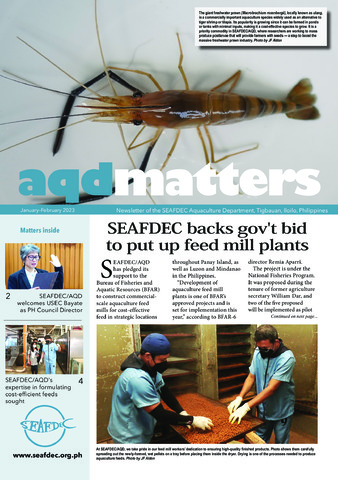
AQD Matters 2023 January - February
(Aquaculture Department, Southeast Asian Fisheries Development Center, 2023-03)In this issue: 1) SEAFDEC backs gov't bid to put up feed mill plants; 2) SEAFDEC/AQD welcomes Usec Bayate as PH Council Director; 3) SEAFDEC/AQD's expertise in formulating cost-efficient feeds sought