SEAFDEC/AQD Institutional Repository: Recent submissions
Now showing items 261-280 of 4221
-
The Department of Trade and Industry supports the seaweed and carrageenan industry
(Seaweed Industry Association of the Philippines, 2003) -
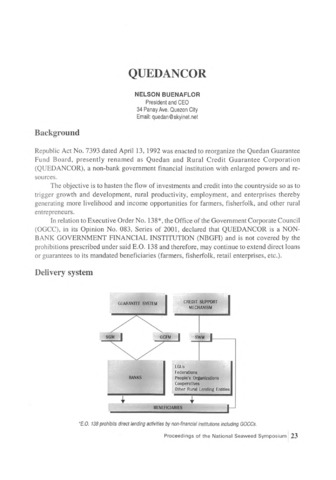
QUEDANCOR
(Seaweed Industry Association of the Philippines, 2003) -
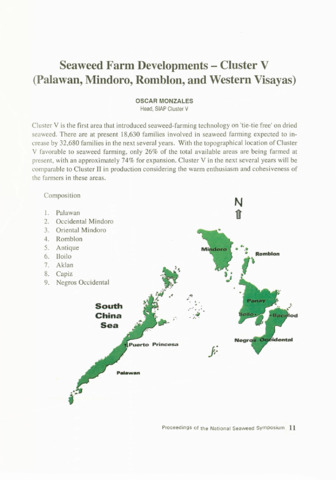
Seaweed farm developments - Cluster V (Palawan, Mindoro, Romblon, and Western Visayas)
(Seaweed Industry Association of the Philippines, 2003) -
Seaweed developments in Western Mindanao - Cluster II
(Seaweed Industry Association of the Philippines, 2003) -
Seaweed industry status in Central and Eastern Visayas - Cluster IV
(Seaweed Industry Association of the Philippines, 2003) -
Department of Agriculture (DA) Program on seaweed
(Seaweed Industry Association of the Philippines, 2003) -
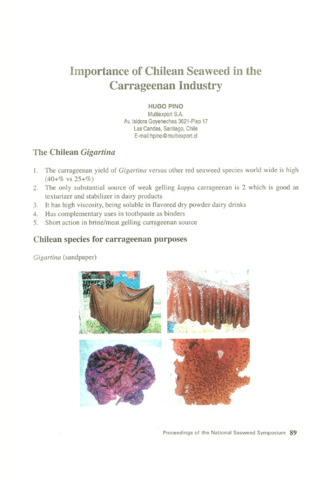
Importance of Chilean seaweed in the carrageenan industry
(Seaweed Industry Association of the Philippines, 2003) -
Marinalg International
(Seaweed Industry Association of the Philippines, 2003) -
The U.P. Marine Science Institute's Programs on carrageenan applications
(Seaweed Industry Association of the Philippines, 2003)The academe's programs on applications of carrageenan originated when the then Ministry of Natural Resources funded a project that aimed to develop the processing technology of Eucheuma and other seaweeds. The research funds allowed then, the Marine Science Center to build the Seaweed Chemistry and Pilot Plant Building in 1976. With the facility and expertise available devoted to seaweed research and development, a number of carrageenan application researches were conducted and developed. In the mid-90's, the carrageenan application programs were given boost by the DOST- PCAMRD Program 'STAND Philippines 2000' that funded a number of researches. The research and development program included applications in food, personal care products, and others. Efforts on structure elucidation and molecular modeling of algal polysaccharides have been initiated. Recently, a program on the physico-chemical properties of oligosaccharides derived from carrageenan is being conceptualized to further investigate the properties of the biomolecules and develop more products. Linkages with other research and academic institutions in the country have produced positive results. New non-traditional carrageenan products have been produced. In conclusion, an awareness program on carrageenan and seaweeds among non-seaweed industries, business sector, government sector, and the public in general should be developed to create interest in carrageenan products. The carrageenan applications research in the country needs right environment, adequate funding, state-of-the-art equipment, technical expertise with brilliant and innovative ideas, and support from the academe, industry, and government. Furthermore, research personnel need continuous exposure to knowledge and ideas, just compensation, and proper recognition. -
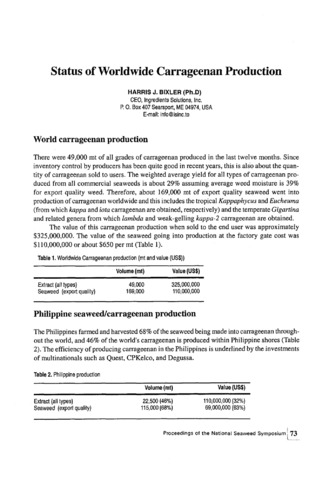
Status of worldwide carrageenan production
(Seaweed Industry Association of the Philippines, 2003) -
Status of the DOST Seaweeds R & D Program
(Seaweed Industry Association of the Philippines, 2003) -
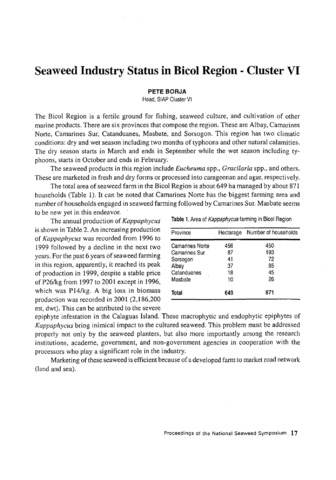
Seaweed industry status in Bicol Region - Cluster VI
(Seaweed Industry Association of the Philippines, 2003) -
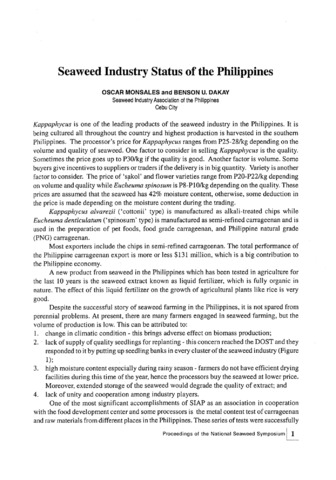
Seaweed industry status of the Philippines
(Seaweed Industry Association of the Philippines, 2003) -
Cage culture of tropical eels, Anguilla bicolor pacifica and A. marmorata juveniles: Comparison of growth, feed utilization, biochemical composition and blood chemistry
Aya, Frolan ; Garcia, Luis Maria (Wiley, 2022-11-02)
This study examined the performance and suitability of two tropical anguillid eels, Anguilla bicolor pacifica and A. marmorata, under cage culture conditions. Juvenile eels (1.73 ± 0.14 g body weight) of each species were stocked in triplicate hapa net cages (1 × 1 × 1.5 m; 30 eels/cage) suspended in outdoor tanks. Growth, feed utilization, biochemical composition and blood chemistry of the two species were compared after 210 days. Except for survival, mean final body weight (FBW), weight gain percentage (WG), specific growth rate (SGR) and yield of A. bicolor pacifica (64.51 ± 13.07 g, 3514 ± 690%, 2.14 ± 0.12%/day, 1534 ± 380 g/m3) were significantly higher than that of A. marmorata (7.77 ± 2.90 g, 356 ± 125%, 0.89 ± 0.16%/day, 178 ± 89 g/m3). In comparison with A. bicolor pacifica, significantly lower feed intake (FI), feed efficiency (FE) and protein efficiency ratio (PER) observed in A. marmorata suggest the need to develop eel diets with feeding stimulants to improve feed acceptance. Biometric indices, body proximate and amino acid composition were not significantly different between the two species. However, serum glutamic oxaloacetic transaminase (GOT), glutamic pyruvic transaminase (GPT) and total protein (TP) in A. bicolor pacifica were significantly higher than that in A. marmorata. These findings suggest that the differences in growth performance and feed utilization between the two anguillid eel species are related to feed palatability, and that A. bicolor pacifica appears to be a suitable species for cage culture because of its faster growth.
; Garcia, Luis Maria (Wiley, 2022-11-02)
This study examined the performance and suitability of two tropical anguillid eels, Anguilla bicolor pacifica and A. marmorata, under cage culture conditions. Juvenile eels (1.73 ± 0.14 g body weight) of each species were stocked in triplicate hapa net cages (1 × 1 × 1.5 m; 30 eels/cage) suspended in outdoor tanks. Growth, feed utilization, biochemical composition and blood chemistry of the two species were compared after 210 days. Except for survival, mean final body weight (FBW), weight gain percentage (WG), specific growth rate (SGR) and yield of A. bicolor pacifica (64.51 ± 13.07 g, 3514 ± 690%, 2.14 ± 0.12%/day, 1534 ± 380 g/m3) were significantly higher than that of A. marmorata (7.77 ± 2.90 g, 356 ± 125%, 0.89 ± 0.16%/day, 178 ± 89 g/m3). In comparison with A. bicolor pacifica, significantly lower feed intake (FI), feed efficiency (FE) and protein efficiency ratio (PER) observed in A. marmorata suggest the need to develop eel diets with feeding stimulants to improve feed acceptance. Biometric indices, body proximate and amino acid composition were not significantly different between the two species. However, serum glutamic oxaloacetic transaminase (GOT), glutamic pyruvic transaminase (GPT) and total protein (TP) in A. bicolor pacifica were significantly higher than that in A. marmorata. These findings suggest that the differences in growth performance and feed utilization between the two anguillid eel species are related to feed palatability, and that A. bicolor pacifica appears to be a suitable species for cage culture because of its faster growth. -
User acceptance of IAMSLIC digital fisheries library
Alayon, Stephen; (International Association of Aquatic and Marine Science Libraries and Information Centers (IAMSLIC), 2018)
The International Association of Aquatic and Marine Science Libraries and Information Centers (IAMSLIC) through the Aquatic Commons Board approved the deployment of IAMSLIC Digital Fisheries Library in the Philippines during the 2015 Conference. The digital library utilized the LibraryBox, a portable, open source distribution tool. This standalone wireless access is ideal for fisheries schools in the area due to limited or no Internet access and intermittent electrical power conditions. With the aim of providing access to SEAFDEC Aquaculture Department (AQD) publications in these schools, more than a thousand publications that were already made available in SEAFDEC/AQD institutional repository were also added in the box. The box contained over 26,000 publications, reports, articles and documents on all aspects of fisheries that are freely available. SEAFDEC/AQD is the first institution in the country to launch t he project in July 2016 using LibraryBox. Five boxes were distributed in Philippine fisheries libraries devastated by Typhoon Yolanda or hazed by fire. This study examined the factors that influence student’s acceptance and attitude towards the IAMSLIC Digital Fisheries Library. A survey was distributed to selected fisheries and marine biology undergraduate students in the Philippines. Relevance, perceived usefulness, perceived ease of use, screen design and behavioral intention to use the digital library were determined. -
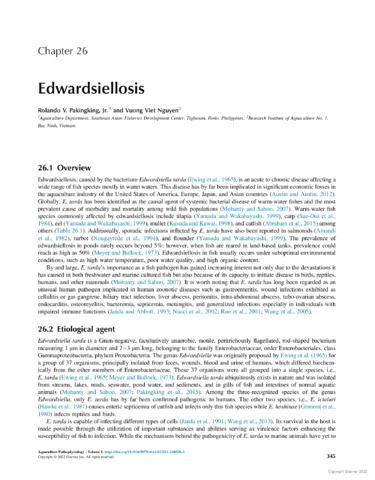
Edwardsiellosis
Pakingking, Rolando V., Jr.; Viet Nguyen, Vuong (Academic Press, 2022)
Edwardsiellosis is an acute to chronic systemic disease in fish characterized by exophthalmia, ascites, hernia, and severe lesions of the internal organs. It is caused by Edwardsiella tarda, a Gram-negative intracellular pathogen implicated in enormous economic losses of cultured seawater and freshwater fish species. E. tarda has a broad host range and geographic distribution, and possesses important virulence factors that enhance its survival and pathogenesis in hosts. This chapter discusses some of the recent research on edwardsiellosis in fish including the etiologic agent's identification, pathology, diagnosis, and virulence factors, and as well as novel strategies aimed at preventing and controlling the disease. -
Viral encephalopathy and retinopathy
; Pakingking, Rolando V., Jr. (Academic Press, 2022)
Viral nervous necrosis (VNN), also referred to as viral encephalopathy and retinopathy (VER), has been reported in at least 120 cultured or wild marine and freshwater fish species and has caused serious economic losses among farmed marine fish species in the past decades. Since the first description of this disease at the end of the 1980s, substantial amounts of researches have been instrumental in understanding the mechanisms involved in fish infection, development of reliable diagnostic methods, and disease prevention and control. This chapter presents some important aspects of the disease with particular emphasis on etiologic agent, clinical signs and gross pathology of the disease, histopathology, disease risk factors, virus propagation and identification, molecular diagnostics, and concomitant prevention and control methods. -
Accumulation and depletion of oxytetracycline (OTC) and oxolinic acid (OXA) in Pompano, Trachinotus blochii
Tendencia, Eleonor (European Association of Fish Pathologists, 2022-09-03)
Accumulation and depletion including withdrawal period for oxytetracycline (OTC) and oxolinic acid (OXA) in pompano (Trachinotus blochii) were determined following oral administration. Pompano were cultured in 250-L fiberglass tanks in a flow-through system provided with aeration. Observed average temperature was 30°C; salinity was 30 ppt. Fish were starved for 2 days then fed with OTC medicated diet (75mg/kg fish/day) or OXA medicated diet (30 mg/kg fish/day) 3 times a day for 10 successive days at 2% body weight and thereafter switched to regular diet for 45 days. Muscle and blood samples were taken at regular intervals during and after cessation of medication. OTC residues in the muscle and blood were analysed using the high performance liquid chromatography (HPLC). Peak OTC accumulation was observed at day 10 of treatment. Higher OTC accumulation was observed in the muscle (0.88+0.27 µg/g) than in the blood (0.3+0.09 µg/ml). OXA accumulation peaked on day 5 of treatment; higher OXA accumulation was observed in the muscle (0.11+0.06 µg/g) compared to blood (0.005+0.0001 ug/ml). Withdrawal period at 30°C for OTC in pompano muscle was 19 days (570 degree-days) and 17 days (510 degree-days) in the blood. For OXA, the withdrawal period in pompano muscle and blood at 30°C temperature was 3 days (90 degree-days). -
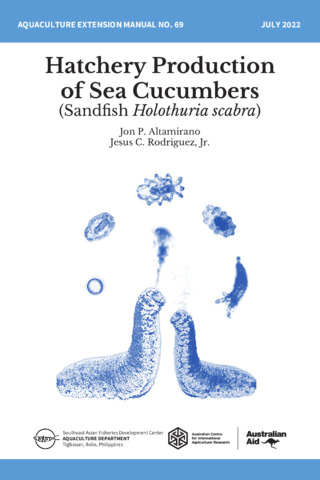
Series: Aquaculture extension manual; No. 69
Hatchery production of sea cucumbers (sandfish Holothuria scabra)
Altamirano, JonThis manual, entitled Hatchery Production of Sea Cucumbers (Sandfish Holothuria scabra) includes the consolidated methods, practical protocols and good practices in sea cucumber breeding that were established within the ...; (Aquaculture Department, Southeast Asian Fisheries Development Center; Australian Centre for International Agricultural Research, 2022-07)
-
Understanding current challenges and future prospects in Integrated Multi-trophic Aquaculture (IMTA) research. Proceedings of the JIRCAS-SEAFDEC/AQD Joint Workshop on IMTA research held at SEAFDEC/AQD, Tigbauan Main Station, Iloilo, Philippines on 6-8 August 2019
(Aquaculture Department, Southeast Asian Fisheries Development Center; Japan International Research Center for Agricultural Sciences, 2022-07)This proceeding is a compilation of the 10-year achievements in IMTA research conducted by JIRCAS and SEAFDEC/AQD researchers and their collaborators, covering topics such as ecological characterization of target species, ...