SEAFDEC/AQD Institutional Repository: Recent submissions
Now showing items 1181-1200 of 4207
-
Effect of tank color on the survival of mud crab Scylla serrata larvae
(Rajiv Gandhi Centre for Aquaculture (MPEDA), 2015)The survival rate of mud crab or mangrove crab Scylla serrata larvae was evaluated using black and yellow-painted tanks. About 400,000 zoea 1 were stocked in 6 tons of treated seawater. The larvae were initially fed with ... -
Mass seed production of mud crab Scylla serrata at Rajiv Gandhi Centre for Aquaculture
(Rajiv Gandhi Centre for Aquaculture (MPEDA), 2015)Mass seed production of mud crab Scylla serrata adopting the best management practices has been done in the hatchery of Rajiv Gandhi Centre for Aquaculture, Thoduvai in Tamil Nadu. Mature female mud crabs from farms and ... -
Reproductive biology of mud crab Scylla tranquebarica found in Ratnagiri coast, Maharashtra, India
(Rajiv Gandhi Centre for Aquaculture (MPEDA), 2015)The study was carried out to determine the reproductive biology of the mud crab Scylla tranquebarica to provide baseline information that are useful in the seed production activities. Size at first maturation was observed ... -
Molecular genetic approaches to resolve taxonomical ambiguity of mud crab species (Genus Scylla) in Indian waters
(Rajiv Gandhi Centre for Aquaculture (MPEDA), 2015)Mud crab or mangrove crab (Genus Scylla de Haan) is one of the most extensively cultured and economically important brachyuran crabs from the family Portunidae in Indo-Pacific countries, including India. Mud crabs exhibit ... -
Scylla species found in Cochin backwaters, Kerala, South India
(Rajiv Gandhi Centre for Aquaculture (MPEDA), 2015)The present study described the Scylla species collected from Cochin backwaters for two years from June 2010 to May 2012. Identification and description of Scylla species were carried out based on the morphological characters ... -
Status of mud crab industry in Thailand
(Rajiv Gandhi Centre for Aquaculture (MPEDA), 2015)Mud crab is an economically important crustacean commodity in Thailand due to its high nutritional and market value. All the four species of mud crab, Scylla paramamosain, S. olivacea, S. serrata and S. tranquebarica are ... -
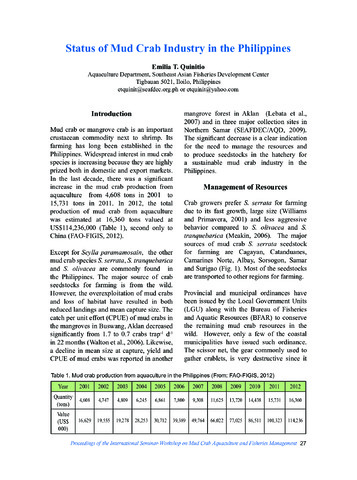
Status of mud crab industry in the Philippines
Quinitio, Emilia T. (Rajiv Gandhi Centre for Aquaculture (MPEDA), 2015)
Mud crab farming has long been established in the Philippines. Scylla serrata, S. tranquebarica and S. olivacea are the common species found in the Philippines. S. serrata is the preferred species for farming by crab ...
(Rajiv Gandhi Centre for Aquaculture (MPEDA), 2015)
Mud crab farming has long been established in the Philippines. Scylla serrata, S. tranquebarica and S. olivacea are the common species found in the Philippines. S. serrata is the preferred species for farming by crab ... -
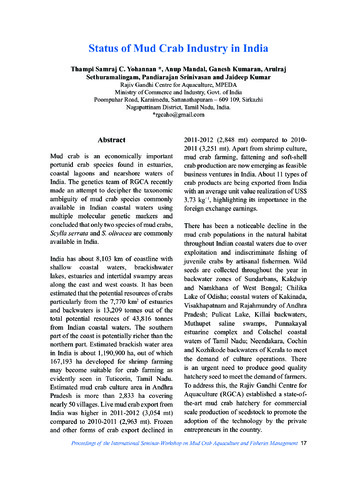
Status of mud crab industry in India
(Rajiv Gandhi Centre for Aquaculture (MPEDA), 2015)Mud crab is an economically important portunid crab species found in estuaries, coastal lagoons and nearshore waters of India. The genetics team of RGCA recently made an attempt to decipher the taxonomic ambiguity of mud ... -
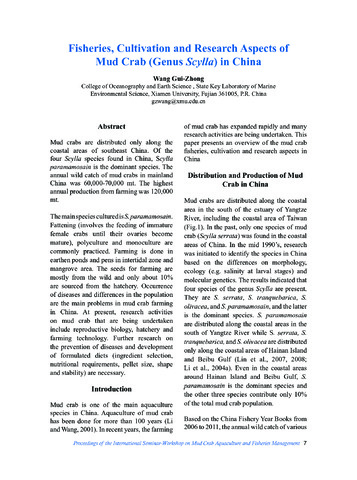
Fisheries, cultivation and research aspects of mud crab (Genus Scylla) in China
(Rajiv Gandhi Centre for Aquaculture (MPEDA), 2015)Mud crabs are distributed only along the coastal areas of southeast China. Of the four Scylla species found in China, Scylla paramamosain is the dominant species. The annual wild catch of mud crabs in mainland China was ... -
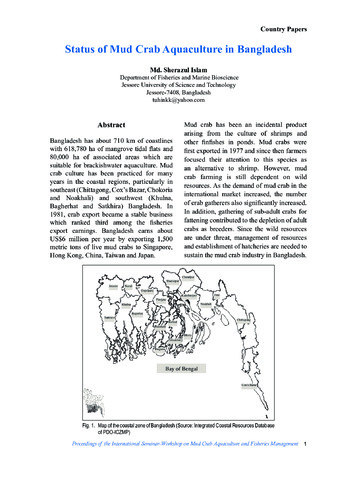
Status of mud crab aquaculture in Bangladesh
(Rajiv Gandhi Centre for Aquaculture (MPEDA), 2015)Bangladesh has about 710 km of coastlines with 618,780 ha of mangrove tidal flats and 80,000 ha of associated areas which are suitable for brackishwater aquaculture. Mud crab culture has been practiced for many years in ... -
Philippines: In the forefront of the mud crab industry: Proceedings of the 1st National Mud Crab Congress
(Aquaculture Department, Southeast Asian Fisheries Development Center, 2017) -
Biological evaluation of existing feed formulations for the grow-out culture of the mud crab, Scylla serrata
(Aquaculture Department, Southeast Asian Fisheries Development Center, 2017)This study was conducted to identify a formulated pelleted feed for the grow-out culture of the mud crab. A commercial crab feed (CCF) was evaluated together with fish by-catch (FBC) and three test diets (formulated and ... -
Effect of feed binder on water stability and digestibility of formulated feed for the mud crab Scylla serrata
(Aquaculture Department, Southeast Asian Fisheries Development Center, 2017)The binding capacity of six natural and eight synthetic feed binders were tested in a basal diet formulated for the mud crab. Incorporation levels of natural binders ranged from 1 to 25% while those of synthetic binders ... -
Nursery culture of mud crab Scylla serrata using different feeding rates
(Aquaculture Department, Southeast Asian Fisheries Development Center, 2017)The effect of different feeding rates on the production and profitability of Phases 1 and 2 (3-week each) nursery culture of hatchery-produced crab Scylla serrata was determined. Minced mussel meat and formulated diet (at ... -
Nursery culture of mud crab, Scylla serrata, using different ratios of natural food to formulated feed
(Aquaculture Department, Southeast Asian Fisheries Development Center, 2017)The effect of feeding different ratios of natural food to formulated feed on the production and profitability of Phases 1 and 2 of nursery culture (3 weeks per phase) of hatchery-produced crab Scylla serrata was investigated. ... -
Breeding and culture of the polychaete, Marphysa mossambica, as feed for the mud crab
; ; Mandario, Mary Anne (Aquaculture Department, Southeast Asian Fisheries Development Center, 2017)
Marine worms (Annelida: Polychaeta) are considered as important food for crustacean broodstock because they contain hormones and correct balance of essential nutrients for reproduction. Marphysa mossambica (Peters, 1854) ... -
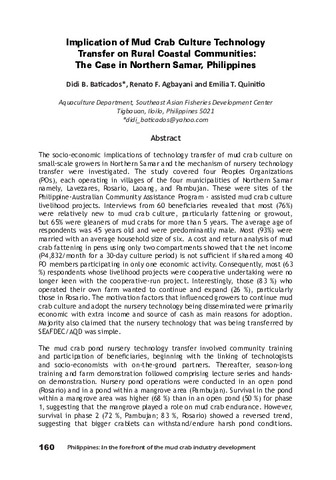
Implication of mud crab culture technology transfer on rural coastal communities: The case in northern Samar, Philippines
; ; Quinitio, Emilia T. (Aquaculture Department, Southeast Asian Fisheries Development Center, 2017)
The socio-economic implications of technology transfer of mud crab culture on small-scale growers in Northern Samar and the mechanism of nursery technology transfer were investigated. The study covered four Peoples ... -
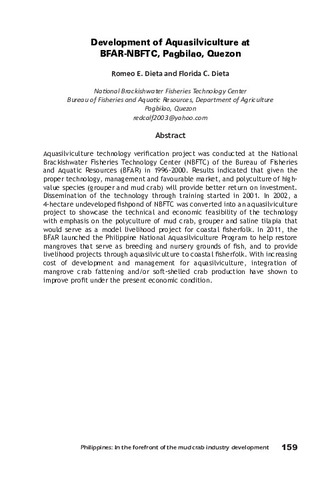
Development of aquasilviculture at BFAR-NBFTC, Pagbilao, Quezon
(Aquaculture Department, Southeast Asian Fisheries Development Center, 2017)Aquasilviculture technology verification project was conducted at the National Brackishwater Fisheries Technology Center (NBFTC) of the Bureau of Fisheries and Aquatic Resources (BFAR) in 1996-2000. Results indicated that ... -
Enhancing mud crab population through mangrove restoration
Lebata-Ramos, Ma. Junemie Hazel; ; Sibonga, Rema ; ; ; (Aquaculture Department, Southeast Asian Fisheries Development Center, 2017)
Mangroves are known as important nurseries for different species of fish and shellfish. In the Philippines, mud crabs Scylla spp. are among the most valuable crustaceans harvested from the mangroves and are considered a ... -
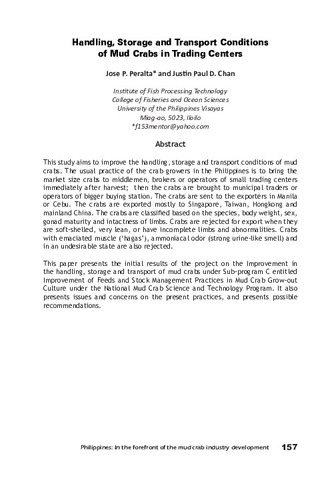
Handling, storage and transport conditions of mud crabs in trading centers
(Aquaculture Department, Southeast Asian Fisheries Development Center, 2017)This study aims to improve the handling, storage and transport conditions of mud crabs. The usual practice of the crab growers in the Philippines is to bring the market size crabs to middlemen, brokers or operators of small ...