SEAFDEC/AQD Institutional Repository: Recent submissions
Now showing items 1281-1300 of 4207
-
Colour discrimination in dim light by the larvae of the African catfish Clarias gariepinus
; Bagarinao, Teodora ; ; ; (Springer, 2017)
Many demersal fish species undergo vertical shifts in habitats during ontogeny especially after larval metamorphosis. The visual spectral sensitivity shifts with the habitat, indicating a change in colour vision. Colour ...
; ; ; (Springer, 2017)
Many demersal fish species undergo vertical shifts in habitats during ontogeny especially after larval metamorphosis. The visual spectral sensitivity shifts with the habitat, indicating a change in colour vision. Colour ... -
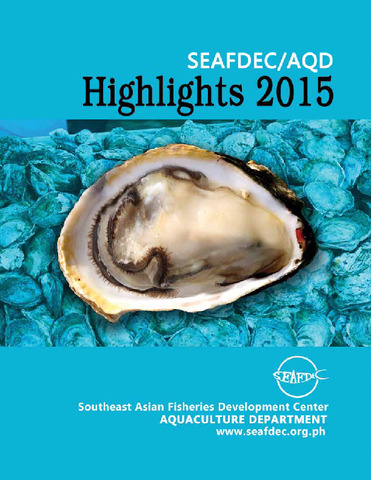
SEAFDEC/AQD highlights 2015
(Aquaculture Department, Southeast Asian Fisheries Development Center, 2016)The SEAFDEC Aquaculture Department is mandated to: 1) conduct scientific research to generate aquaculture technologies appropriate for Southeast Asia; 2) develop managerial, technical and skilled manpower for the aquaculture ... -
Biological evaluation of frozen zooplankton as food for milkfish (Chanos chanos) fry
(Verlag Paul Parey, 1991)Milkfish fry with an average standard length and weight of 13.88 mm and 3.95 mg, respectively, were reared for 30 days using live and frozen Moina macrocopa and Brachionus plicatilis at feeding densities of 10–20 individuals ... -
Series: Aquaculture extension manual; No. 34
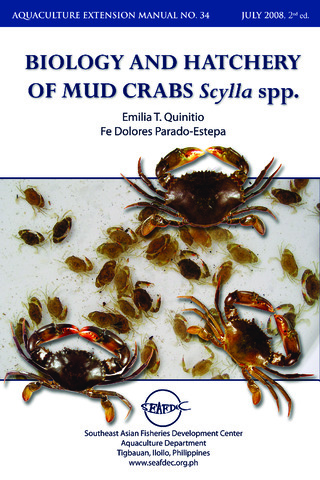
Biology and hatchery of mud crabs Scylla spp.
Quinitio, Emilia T.; (Aquaculture Department, Southeast Asian Fisheries Development Center, 2008)
This manual includes the biology of mud crab, and describes principles and procedures for spawning the mature crabs (Scylla serrata, S. tranquebarica, and S. olivacea) and rearing the zoea to fly size crabs. It focuses on ... -
Arachidonic acid is a major fatty acid in gonads of coral reef fishes and improves larval survival of rabbitfish Sigunus gutattus
(Nova Science Publishers, 2016)The supply of wild fry of coral reef fishes for aquaculture has resulted in the deterioration of their natural stock status, causing public concern. Through a series of studies on the establishment of artificial-fry ... -
Important diseases of Penaeid shrimps
(National Taiwan Ocean University; The Fisheries Society of Taiwan; Asian Fisheries Society; World Aquaculture Society, 2016)In tropical Asia, the two main species of penaeid shrimps that are widely cultured are the black tiger shrimp (Penaeus monodon) and the Pacific white shrimp (Penaeus (Litopenaeus) vannamei). The former species is indigenous ... -
Test of refined formulated feed for the grow-out culture of tropical abalone Haliotis asinina (Linnaeus 1758) in concrete land-based tanks
(National Shellfisheries Association, 2016)A refined formulated feed for the grow-out culture of tropical abalone Haliotis asinina was evaluated to assess its suitability for a shorter culture period (<8 mo). Refinement procedures focused on the application of ... -
Abdominal segment deformity syndrome (asds) and fused body segment deformity (fbsd) in cultured Penaeus indicus
Santander-Avancena, Sheryll; Estepa, Fe Dolores ; ; Faisan, Joseph P., Jr. ; (Elsevier, 2017)
The abdominal segment deformity disease (ASDD) is a new shrimp disease reported only in cultured Penaeus vannamei in Thailand. Shrimp with ASDD have deformed abdominal segment, jagged gut line and bumpy surfaces. Similar ... -
Cloning of mangrove red snapper (Lutjanus argentimaculatus) growth hormone cDNA and mRNA expression during early development
(University of the Philippines Visayas, 2013)Growth hormone regulates growth and development in vertebrates. As a first step to understand the role of growth hormone in the regulation of growth and development of the mangrove red snapper Lutjanus argentimaculatus, ... -
Antimicrobial activity screening of Lyngbya majuscula crude methanolic extract against selected aquaculture pathogens
(University of the Philippines Visayas, 2010)Lyngbya majuscula crude methanolic extract (LMCME) was screened for antimicrobial properties in vitro. The Gram-negative Vibrio harveyi and Aeromonas hydrophila and the Gram-positive Staphylococcus aureus and Micrococcus ... -
Early appearance of the retinal tapetum, cones, and rods in the larvae of the African catfish Clarias gariepinus
; Bagarinao, Teodora; ; (Springer Verlag, 2016)
In the retina of the African catfish Clarias gariepinus, the pigment epithelium and the tapetum were formed in newly hatched larvae, the cones developed within 2 days, and the rods within 3 days after hatching. The retinal ... -
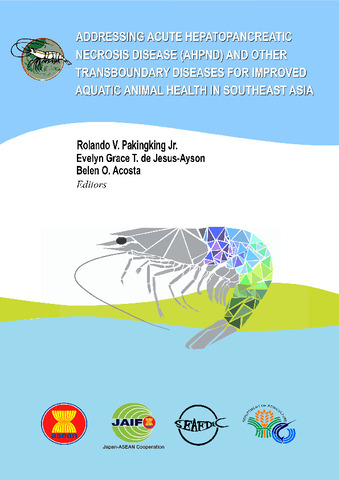
Addressing acute hepatopancreatic necrosis disease (AHPND) and other transboundary diseases for improved aquatic animal health in Southeast Asia: Proceedings of the ASEAN Regional Technical Consultation on EMS/AHPND and Other Transboundary Diseases for Improved Aquatic Animal Health in Southeast Asia, 22-24 February 2016, Makati City, Philippines
(Aquaculture Department, Southeast Asian Fisheries Development Center, 2016) -
Important diseases and practical control measures in shrimp culture in Japan
(Aquaculture Department, Southeast Asian Fisheries Development Center, 2016)The gross product from sea culture in Japan was about USD 3.4 billion in 2013 with kuruma shrimp Marsupenaeus japonicus constituting 2% of the total production. In recent years, annual shrimp production has reached about ... -
Status of acute hepatopancreatic necrosis disease (AHPND) of cultured shrimps in the Philippines
(Aquaculture Department, Southeast Asian Fisheries Development Center, 2016)Shrimp is the fourth most important aquaculture commodity in the Philippines in terms of production quantity and second in terms of export value. The two species of shrimp being cultivated in the Philippines are the black ... -
Regional response on AHPND and other emerging shrimp diseases in the Asia-Pacific
(Aquaculture Department, Southeast Asian Fisheries Development Center, 2016)Transboundary aquatic animal diseases are among the major concerns for establishing biosecurity measures and strengthening of aquatic animal health (AAH) management capacity (including emergency preparedness) in the region. ... -
Status of shrimp health management in Myanmar
(Aquaculture Department, Southeast Asian Fisheries Development Center, 2016)Extensive cultivation of the black tiger shrimp (Penaeus monodon) started in the 1970 s in Myanmar using trap and hold method. P. monodon postlarvae (PL) were trapped into the ponds measuring approximately 50 to 100 hectares ... -
OIE initiatives on acute hepatopancreatic necrosis disease (AHPND) and other aquatic animal diseases in Asia
(Aquaculture Department, Southeast Asian Fisheries Development Center, 2016)The World Organization for Animal Health (OIE) is an intergovernmental organization established in 1924 responsible for improving animal health and welfare worldwide to facilitate safe international trade of animals and ... -
Latest research on acute hepatopancreatic necrosis disease (AHPND) of penaeid shrimps
(Aquaculture Department, Southeast Asian Fisheries Development Center, 2016)Acute hepatopancreatic necrosis disease (AHPND) is caused by unique strains of Vibrio parahaemolyticus (VPAHPND) and V. harveyi that have transferrable plasmid carrying the virulent PirAB-like toxin genes. The ... -
Current status and impact of early mortality syndrome (EMS)/acute hepatopancreatic necrosis disease (AHPND) and hepatopancreatic microsporidiosis (HPM) outbreaks on Thailand s shrimp farming
Songsangjinda, Putth; (Aquaculture Department, Southeast Asian Fisheries Development Center, 2016)
Outbreak of early mortality syndrome (EMS) or acute hepatopancreatic necrosis disease (AHPND) in whiteleg shrimp (Penaeus vannamei) and black tiger shrimp (P. monodon) was first documented in August 2011 in Eastern Thailand. ... -
Status of acute hepatopancreatic necrosis disease (AHPND) and other emerging diseases of penaeid shrimps in Viet Nam
(Aquaculture Department, Southeast Asian Fisheries Development Center, 2016)Acute hepatopancreatic necrosis disease (AHPND), formerly called early mortality syndrome (EMS), was first reported in 2010 among penaeid shrimps cultivated in the Mekong Delta Region of Viet Nam albeit without any laboratory ...