SEAFDEC/AQD Institutional Repository: Recent submissions
Now showing items 321-340 of 4221
-
Series: GL Conference Series; No. 23
Burning grey: The worldwide influence of a locally published grey literature
Palcullo, Vince Ervin ; ; ; Peleña, Ma Cynthia Tolones ; Geromiano, Joy F. ; Superio, Daryl (TextRelease, 2022)
Rice is a major staple crop in the Philippines, which produces a large amount of rice each year. On the other hand, rice production generates biomass waste in the form of rice husks. In consideration of the rice husks’ potential as a biomass energy source and support the development of the rice husk gas stove technology in the Philippines, Engineer Alexis T. Belonio had published a grey literature (GL) entitled “Rice Husk Gas Stove Handbook.” Hence, to fully understand the impact of the technology, a citation analysis was conducted. The works that cited the GL were retrieved from Google Scholar using Harzing’s Publish or Perish software. The complete title of the GL was used as keywords for the search string. Results revealed that the GL was cited by 155 literatures written by 398 authors from 31 countries. Seventy-five (48.4%) of the 155 literatures were cited 797 times. The results showed the wide utilization and the impact of locally-published GL, thereby confirming GL’s value in research and development.
; ; ; Peleña, Ma Cynthia Tolones ; Geromiano, Joy F. ; Superio, Daryl (TextRelease, 2022)
Rice is a major staple crop in the Philippines, which produces a large amount of rice each year. On the other hand, rice production generates biomass waste in the form of rice husks. In consideration of the rice husks’ potential as a biomass energy source and support the development of the rice husk gas stove technology in the Philippines, Engineer Alexis T. Belonio had published a grey literature (GL) entitled “Rice Husk Gas Stove Handbook.” Hence, to fully understand the impact of the technology, a citation analysis was conducted. The works that cited the GL were retrieved from Google Scholar using Harzing’s Publish or Perish software. The complete title of the GL was used as keywords for the search string. Results revealed that the GL was cited by 155 literatures written by 398 authors from 31 countries. Seventy-five (48.4%) of the 155 literatures were cited 797 times. The results showed the wide utilization and the impact of locally-published GL, thereby confirming GL’s value in research and development. -
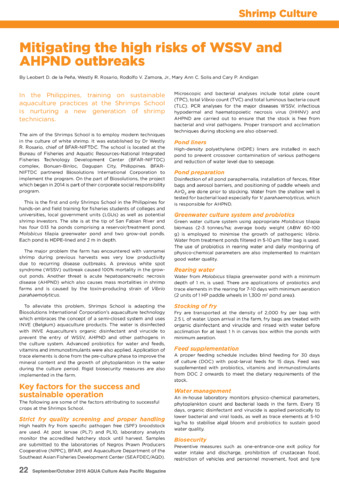
Mitigating the high risks of WSSV and AHPND outbreaks
(Aqua Research Pte Ltd, 2016) -
Efficacy of poultry by-product meal as an effective alternative to fish meal in aquaculture feed for milkfish Chanos chanos
Sugita, Tsuyoshi; ; Sumbing, Joemel (Japan International Research Center for Agricultural Sciences, 2020)
We verified the efficiency of poultry by-product meal (PBM) as a substitute for fish meal (FM) in feed for juvenile milkfish (Chanos chanos). Juveniles (mean 48.0 g) were fed for 12 weeks with two experimental feeds containing different levels of PBM (8.0% and 12%), FM (10% and 5.0%), and cod liver oil (fish oil or FO, 4.0% and 3.8%). A feed without PBM having higher levels of FM and FO (20% and 4.5%, respectively) was used as control. Weight gain, specific growth rate, and feed conversion ratio were not significantly affected by the levels of dietary PBM. In addition, no significant differences were detected among the dietary groups in plasma triglyceride, total cholesterol, phospholipid, glucose, or total protein concentrations. Furthermore, crude protein, crude fat, moisture, and ash contents in the whole body, liver, and dorsal muscle were not significantly influenced by the dietary treatments. The results of organoleptic examinations that included tests of smell, flavor, and texture were almost the same among the dietary groups. These results indicated that PBM is the applicable substitute for FM, with performance of the high PBM feed (PBM-FM-FO = 12%-5.0%-3.8%) being comparable to that of the control feed. -
Intracellular production of recombinant GnRH1 in yeast, Pichia pastoris, and its potential as oral treatment to advance gonadal development in juvenile orange-spotted grouper, Epinephelus coioides
Nocillado, Josephine; Palma, Peter ; Wang, Tianfang ; ; Levavi-Sivan, Berta ; Elizur, Abigail (Elsevier, 2022-05)
Late maturation and large size at maturity are significant challenges when administering hormonal treatments in captive broodstock. Here, we report the potential of yeast, Pichia pastoris, as a vehicle to orally deliver a recombinant gonadotropin-releasing hormone (rGnRH1) aimed at stimulating gonadal development in juvenile orange-spotted grouper, Epinephelus coioides. Two recombinant GnRH1 constructs were designed utilizing pPIC3.5, the yeast expression vector lacking a signal sequence, hence retaining the recombinant within the yeast. The first construct (rGnRH1_1xGAP) comprised of GnRH1 decapeptide and the GnRH-associated peptide (GAP) separated by a cleavage site. The second construct (rGnRH1_10x) consisted of ten GnRH1 decapeptides, each separated by a cleavage site. Expression of the two recombinant peptides was confirmed by mass spectrometry. ELISA for the GnRH analogue (GnRHa) was validated to determine the level of rGnRH1 from the yeast extracts. Parallelism between the serially diluted GnRHa and serially diluted extracts from recombinant yeast confirmed validity of the assay. A luciferase reporter assay showed stimulation of tilapia GnRH type 3 receptor by the yeast extract, suggesting biological activity in vitro. In a short term experiment, lyophilised yeast loaded in gelatine capsules and fed once to juvenile orange-spotted grouper resulted in a significantly higher plasma GnRH compared with the control. In a 4-week experiment, lyophilized yeast containing either rGnRH1_1xGAP or rGnRH1_10x was incorporated in fish pellets and fed daily at a dose of 1 μg rGnRH1/kg fish body weight/day. The mean gonadosomatic index and oocyte diameter did not vary between the treated and control fish. The mean plasma levels of FSH, LH and GnRH in the rGnRH1-fed and control fish did not also vary significantly, however there were individuals in the rGnRH1-fed groups that had increased level of the hormones. Together with histological evidence showing oocyte development in a proportion of fish fed with the recombinant, results of the present study point to a biological activity in vivo of the rGnRH1 in yeast. With further refinement, this technology has the potential to provide a non-invasive method for broodstock management of large, late-maturing species of fish and of small, delicate endangered species that require breeding in captivity. -
A technical and economic evaluation of supplemental feeding strategies for Nile tilapia (Oreochromis niloticus L.) reared in lake-based cages
Romana-Eguia, Maria Rowena R.; ; Aya, Frolan ; ; (AquacultureHub Inc., 2022-03)
Tilapia cage farming in eutrophic lakes uses low stocking densities since tilapias can thrive mainly on natural food or minimal supplementary feeding. For semi-intensive Nile tilapia cage culture, feeding strategies to improve productivity are adopted based on technical viability and cost efficiency, as assessed in the present study. Tilapia fingerlings stocked in triplicate cages per treatment were reared in Laguna de Bay, Philippines for five months, one run each during the dry and wet seasons. The treatments were: I – UNFED or no feeding; II - FED, fish fed for the entire 155 days; III - D45, fish fed from day 45 to harvest; and IV - D75, or fish fed from day 75 to harvest. Average weight gain or AWG (153.18 g and 225.85g, for dry and wet seasons, respectively) were highest in FED. Growth parameters in all fed treatments were significantly higher (p<0.05) than in UNFED for both seasons. Survival rates were higher during the wet season (66-70%) compared to the dry season (35-37%). Moreover, in the wet season, when the lake’s primary productivity is low, full feeding can be done without compromising lake water quality. Results showed that it favored high AWG, survival, reasonable market price, and profit. -
Social and economic aspects of the Agusan marsh key biodiversity area
(2008)Considered a significant wetland ecosystem, the Agusan Marsh has been designated a Key Biodiversity Area (KBA) in the country by the Department of Environment and Natural Resources (CI-Philippines, DENR-PAWB and Haribon, 2006) and a Ramsar site. It is bound on the north by Agusan del Norte, on the east by Surigao Sur, on the south by Davao del Norte, and on the west by Bukidnon and Misamis Oriental. Virgin forests still exist on the western side along the Agusan-Bukidnon boundary. On the eastern part, a portion of the buffer zone is planted to palm oil Elaeis guineensis. The total land size of the Agusan Marsh KBA is 143.73 sq km which is 1.7% of the total land area (8,297.19 sq km) of Agusan del Sur (DENR, 2004). The municipalities which have portions within this KBA are Bunawan (30% of land area within the KBA), La Paz (28.42%), Rosario (21.52%), Loreto, San Francisco, Veruela, and Talacogon. Outside this KBA are three other municipalities of Agusan del Sur - Esperanza, Sta. Josefa and San Luis. Playing a vital role in the socioeconomic development of the provinces of Agusan del Norte and Agusan del Sur, the KBA can be reached through a road running west from the national highway to Talacogon. It is accessed through the interior towns of Talacogon and La Paz, and through the Agusan River and its tributaries, Gibong River and Adgawan River. Bunawan is the usual jump-off area to the Marsh on the southeastern side; it can be reached by bus from Davao City or Butuan City in about three hours. The Marsh can also be reached by pumpboat from Bunawan via Simulao River to the Agusan River which runs from south to north. The biological and ecological features of the Agusan Marsh are discussed elsewhere in this volume. -
Distribution of the avifauna of Agusan marsh, Agusan del Sur, Philippines
(2008)The Agusan Marsh is the 1009th RAMSAR site, a wildlife sanctuary which serves as wintering ground for migratory and wetland birds from Asian and Western countries, and is considered one of the most ecologically significant wetland ecosystems in the Philippines. This study assessed species diversity and distribution of birds in four habitat types of the Agusan Marsh. Sago, Terminalia, Mixed Swamp and Peat Swamp forests in the Marsh were surveyed from August 2005 to January 2006 using a combination of mist netting (3,337 net days) and transect walk methods. One hundred twenty-six species of birds were identified consisting of 26 migrants, 69 non-endemics, and 31 endemics (23.81% endemism) of which seven species are categorized as threatened. The Mixed Swamp Forest had the highest species richness (S=92) while the Peat Swamp Forest had the highest number of migratory birds (S=26). Highest endemicity was recorded in the Terminalia Forest (20.63%) while the Sago Forest had the least number of bird species. Migratory birds were recorded at the start of sampling in August, their numbers considerably increasing thereafter and reaching a peak in November. In contrast, the number of endemic species declined in the same month. Previously recorded only in Luzon, the migratory Siberian Rubythroat (Luscinea calliope) was also found in Agusan Marsh, indicating that this bird may be found in other places in the Philippines. Forty-six species of birds, which include six migratory species, were reported to be of socioeconomic importance. Changes in structural and floristic composition brought about by forest degradation, such as conversion of forest into agriculture, logging and hunting, were seen as threats to the birds in Agusan Marsh. Results indicate that the Marsh supports a considerable number of endemic, threatened, and migratory bird species. Conservation of the different Marsh habitats is necessary for the protection of the broadest avifaunal diversity. -
Species richness, abundance and distribution of aquatic insects of Agusan marsh, Mindanao, Philippines
(2008)A total of 59 species of aquatic insects was recorded from the major habitats in the flood-plain of Agusan Marsh. Species richness was greater in natural habitats than their respective adjoining ricefields, and did not differ among the natural habitats and between seasons. The water beetles had the highest species richness with 28 species, followed by aquatic and semi-aquatic bugs with 17 species, and dragonflies with 11 species, mostly libellulids. While most of the aquatic insects were fairly distributed in many habitats, several species appeared to be unique to one or two natural habitats. Water beetles were the most numerous insects in both wet and dry seasons. Aquatic insects were more abundant in the natural habitats than their adjacent ricefields; they were most abundant in Sedge-dominated Swamps. In ricefields, the site near the Fern-dominated Swamp had the highest abundance, while the site adjacent to the Bangkal Forest had the lowest. -
Hydrology and ecology-related aspects of managing the Agusan marsh
(2008)This paper presents the basin hydrology of Agusan Marsh and the Agusan River Basin. Also presented are basic considerations in the management of the Agusan River Basin environment and discussions on the interaction of hydrology, geomorphology and ecology. In the last few years, there have been interest and plans for water resources developments in the Agusan River Basin. The paper likewise discusses the implications and impacts of these developments on the hydrology, geomorphology and ecology of Agusan Marsh and Agusan River Basin. -
Indicators and possible driving mechanisms of shifts in the position of Agusan river along the Butuan coastal plain
(2008)The Butuan coastal plain is a fan-delta formed by deposition of Agusan River sediments in the past 7,400 radiocarbon years (ky). Traces of paleochannels that scar the coastal plain, seen in satellite images, indicate past river positions. Immediately prior to the present, Masao River was the active distributary as suggested by its well-defined and still continuous paleochannel. Numerous sudden shifts of river position have likely originated in the San Vicente area, the apex region of the fan-delta. These shifts could have been self driven or induced by floods or tectonics. Sediment input from rivers along the eastern flank of the Butuan coastal plain forced a number of downstream shifts. The function of the Agusan Marsh in buffering flashy river discharges in the Butuan coastal plain is threatened by present-day elevated sediment loads of rivers upstream. -
Agusan marsh: A brief history
(2008) -
Residence time models and Pyrodinium blooms in Matarinao and Murcielagos Bays, Philippines
; Benico, Garry; Yñiguez, Aletta ; Alabia, Irene D. ; ; ; Azanza, Rhodora ; Villanoy, Cesar (Department of Science and Technology, 2022-03)
This is the first report on hydrodynamic models to determine current and water residence time patterns for Matarinao and Murcielagos bays in the Philippines, which have a long history of harmful algal blooms (HABs). Field surveys were conducted in Matarinao Bay in April and August 2010 and in Murcielagos Bay in February 2011. Hydrodynamic models of the bays were developed, and spatially explicit water residence times were estimated from the models based on rates of concentration decrease of a tracer within the bay. Both bays exhibited two distinct areas – the mouth with faster current flow and low residence time, and the head area with slower current flow and higher residence time. During the southwest monsoon, the residence time at Matarinao Bay was 5 d longer than that during the northeast monsoon. Phytoplankton sampling in both bays confirmed blooms of Pyrodinium bahamense, but the spatial distribution did not consistently correlate with the simulated residence time patterns. While residence time plays a significant role in algal blooms, extraneous factors may also influence the distribution of phytoplankton within embayments. -
Series: Policy Brief; No. 1
Towards a robust and resilient seaweed aquaculture in the Philippines
; Luhan, Maria RovillaThe aim of this national policy brief is to highlight the current challenges facing the seaweed industry of the Philippines based on robust, scientifically proven results from the UK Research and Innovation funded ...; Ferriols, Victor Marco Emmanuel ; Faisan, Joseph P., Jr. ; Mateo, Jonalyn ; Sibonga, Rema ; Suyo, Jee Grace (GlobalSeaweedSTAR Philippines, 2021)
-
Phytochemical composition antioxidant and antibacterial activity of the Philippine marine green alga (Ulva pertusa)
Pakingking, Rolando V., Jr.; Usero, Roselyn ; ; Logronio, Dan Joseph ; Caipang, Christopher Marlowe (Springer, 2022-03)
The phytochemical constituents, total phenolic and flavonoid contents, antioxidant and antimicrobial activities of the ethanolic extract of the marine green alga Ulva pertusa collected from floating fish net cages off the coast of Guimaras island, Philippines, were investigated. Qualitative phytochemical analysis revealed the presence of bioactive compounds including alkaloids, flavonoids, phenols, saponins, tannins, and terpenoids. Quantitatively, total phenolic and flavonoid contents of the extract were 20.54±2.08 mg gallic acid equivalent (GAE) g-1 and 539.07±6.36 mg rutin equivalent (RE) g-1, respectively. The antioxidant activity of the extract using 1,1-diphenyl-1-picrylhydrazyl (DPPH) assay exhibited a concentration-dependent radical scavenging capacity. Additionally, the ethanolic extract inhibited the growth of Staphylococcus aureus ATCC25923, Escherichia coli ATCC25922, Streptococcus agalactiae, Aeromonas hydrophila, A. sobria, and Vibrio harveyi in a concentration-dependent manner with strong inhibitory activity at 100 mg mL-1 concentration. Taken together, U. pertusa contains bioactive compounds that possess potent antibacterial activity and remarkable antioxidant capacities. These substances are promising candidates that may be utilized in the synthesis of novel drugs. -
The influence of monosex rearing on gonad maturation and reproductive behavior of Indian white prawn, Penaeus indicus broodstock
Santander-Avancena, Sheryll; Monteclaro, Harold ; Estante-Superio, Erish ; ; Traifalgar, Rex Ferdinand (Elsevier, 2022-02)
Monosex culture was proven to be an effective rearing method for grow-out, but in a closed-cycle hatchery, males and females are usually reared communally in tanks until maturation. This study determined the effect of communal rearing (CR) and separate rearing (SR) on male and female Penaeus indicus broodstock gonad maturation. This study also evaluated the influence of the rearing method on reproductive behavior and mating success. The results showed that CR female broodstock had higher maturation rates at 77.78 ± 5.31% (p = 0.061) and a shorter latency period at 6.71 ± 2.54% than SR females (p = 0.211), but the differences were not statistically significant. Similarly, maturation rates for both male groups were 40.62 ± 3.12% and were not significantly different (p = 1.00). The interspermatophore period (p = 0.044), spermatophore weight (p = 0.878), count (p = 0.780), viability (p = 0.257), and percent abnormality (p = 0.257) did not vary between males. In terms of the effect of rearing method on reproductive behavior, males from the SR group initiated more chase (p = 0.018) and fight with other males (p = 0.022) than CR males did, and the differences were significant. SR males also touched the discarded molt (p = 0.167) and advanced to the probe position (p = 0.525) more times than CR males, but the differences were not significant. The sum of all the reproductive behaviors was also significantly higher in the SR (54.00 ± 1.20) than in the CR (24.20 ± 0.86) groups (p = 0.017). Initial results showed that successful mating in the SR (80%) was higher than that recorded in the CR group (20%). These findings suggest that monosex rearing of male and female P. indicus will not negatively affect gonad maturation and will enable sex-specific nutritional manipulations, which can even possibly promote higher mating success. -
AQD Matters 2021 November - December
(Aquaculture Department, Southeast Asian Fisheries Development Center, 2022-02)In this issue: 1) Oplan Balik Sugpo progress reported to PH shrimp industry; 2) SEAFDEC/AQD attends online meeting for information staff; 3) 'Adoptable and sound' community-based freshwater aquaculture course; 4) Fish feed ...