SEAFDEC/AQD Institutional Repository: Recent submissions
221-240 / 4221
-
Inclusion of live mud polychaete (Marphysa iloiloensis) in the feeding regime improved the hatchery performance of domesticated Indian white shrimp (Penaeus indicus)
Estante-Superio, Erish ; Mandario, Mary Anne ; Santander-Avancena, Sheryll ; ; Estepa, Fe Dolores ; Mamauag, Roger Edward (Elsevier, 2023-03-07)
A 60-day feeding trial was conducted to evaluate the effect of inclusion frequency of hatchery-bred mud polychaete, Marphysa iloiloensis, as part of a combination diet on the reproductive performance and larval quality of domesticated P. indicus. The two treatments were fed with a combination of formulated diet, mussel, squid, and mud polychaete with once (T1) and twice (T2) a week inclusion in the feeding regime. In contrast, the control group was fed only a diet combination of mussels, squid, and formulated diet. There was no significant difference in the mean survival of male and female broodstock in all treatments upon termination (\(p\gt0.05)\). Shrimp in T1 and T2 performed significantly better than the control in terms of spawning frequency (\(p=0.037)\) and fertilization rate (\(p=0.001)\), while T1 had significantly high re-maturation (\(p=0.038)\). The survival, spawning, hatching rate, egg, and nauplii production did not differ significantly among treatments (\(p\gt0.05)\). Also, no difference in the gonado-somatic index (GSI), hepato-somatic index (HSI), spermatophore weight, and sperm count was found among diet treatments (\(p\gt0.05)\). Post larvae from T1 and T2 performed significantly better than the control after 25 (\(p=0.008)\) and 30 (\(p=0.009)\) minutes of abrupt exposure to freshwater, respectively. Therefore, even once weekly, mud polychaete inclusion is sufficient to improve the reproductive performance of P. indicus broodstock and produce offspring with boosted resistance in the hatchery.
; Mandario, Mary Anne ; Santander-Avancena, Sheryll ; ; Estepa, Fe Dolores ; Mamauag, Roger Edward (Elsevier, 2023-03-07)
A 60-day feeding trial was conducted to evaluate the effect of inclusion frequency of hatchery-bred mud polychaete, Marphysa iloiloensis, as part of a combination diet on the reproductive performance and larval quality of domesticated P. indicus. The two treatments were fed with a combination of formulated diet, mussel, squid, and mud polychaete with once (T1) and twice (T2) a week inclusion in the feeding regime. In contrast, the control group was fed only a diet combination of mussels, squid, and formulated diet. There was no significant difference in the mean survival of male and female broodstock in all treatments upon termination (\(p\gt0.05)\). Shrimp in T1 and T2 performed significantly better than the control in terms of spawning frequency (\(p=0.037)\) and fertilization rate (\(p=0.001)\), while T1 had significantly high re-maturation (\(p=0.038)\). The survival, spawning, hatching rate, egg, and nauplii production did not differ significantly among treatments (\(p\gt0.05)\). Also, no difference in the gonado-somatic index (GSI), hepato-somatic index (HSI), spermatophore weight, and sperm count was found among diet treatments (\(p\gt0.05)\). Post larvae from T1 and T2 performed significantly better than the control after 25 (\(p=0.008)\) and 30 (\(p=0.009)\) minutes of abrupt exposure to freshwater, respectively. Therefore, even once weekly, mud polychaete inclusion is sufficient to improve the reproductive performance of P. indicus broodstock and produce offspring with boosted resistance in the hatchery. -
Evaluation of community-based livelihood development initiatives: The sustainable livelihood approach
(University of the Philippines Visayas, 2022)The sustainable livelihood approach (SLA) is a tool for evaluating livelihood strategies that utilize assets categorized as environmental, human, physical, financial and social assets. In this study, the SLA was applied to determine the main factors that influence the adoption of integrated multi-trophic aquaculture (IMTA) in milkfish (Chanos chanos Forsskål) farming among fisherfolks. The community-based field trials conducted in Nueva Valencia in Guimaras province for 4 years since 2015 revealed that stakeholders were receptive to IMTA and were able to situate its effects on livelihood assets. The assessment of 52 stakeholders showed small but significant improvements in most livelihood assets during the 3-phased evaluation period. Using the 5-scale Likert rating, the environmental livelihood assets were rated highest but showed slight significant decline due to perceived weather and water level changes that may have negatively affected fish production and income. Financial livelihood assets were initially rated low but significantly improved due to supplemental income derived from wages and harvest. The human livelihood assets significantly improved due to sustained hands-on aquaculture experience. Social livelihood assets also improved due to cohesive interaction during projects implementation. In contrast, the acquisition of physical livelihood assets did not significantly improve because these assets were not commensurate with the many stakeholders who would like to have access to these shared assets. Overall, stakeholders expect IMTA’s potential environmental and economic benefits to overcome additional adoption costs. These include the cost of physical and financial investments in seeds of co-culture species and modified enclosures. Stakeholders expect institutional and government support on further studies on the technical details of IMTA. Fisheries and aquaculture regulations should embed the necessary support systems for the adoption of IMTA and ensure a positive public perception of aquaculture. -
Innofloc: Innovative biofloc technology for the nursery production of shrimp, Litopenaeus vannamei in tanks
Caipang, Christopher Marlowe; ; ; ; Pakingking, Rolando V., Jr. ; ; (University of the Philippines Visayas, 2022)
Nursery systems are valuable production tools in shrimp aquaculture and are effective biosecurity facilities for the high-density culture of shrimp postlarvae (PL), resulting in healthy and uniform-sized juveniles. The nursery production of shrimp is usually carried out in small ponds; however, the use of small and circular tanks with plastic liners is gaining popularity. From an industry standpoint, there is a need to assess how nursery systems can improve the productivity of the shrimp production cycle. Hence, the use of small circular tanks coupled with the incorporation of biofloc technology was assessed in terms of its viability during the nursery production of the Pacific whiteleg shrimp, Litopenaeus vannamei. A 450m2 plastic-lined circular tank was installed and prepared for the stocking of L. vannamei postlarvae (PLs) at a density of 500 PLs per m2. Biofloc was produced and maintained throughout the nursery phase by adding brown sugar as a carbon source at carbon to nitrogen (C:N) ratio of 10. Daily monitoring of the various water quality parameters was carried out, while presumptive Vibrios were enumerated weekly. The shrimp juveniles were sampled for their body weight on the 14th day post-stocking and weekly until harvest on the 30th day of culture. The different water quality parameters were within optimum levels required for shrimp growth. Presumptive Vibrios were dominated by the yellow colonies. The shrimp attained 100% survival with an average body weight of 1.26 g and a feed conversion ratio (FCR) of 0.43 at the end of the nursery production phase. Our results indicate that the use of small circular tanks with biofloc during the nursery production phase of whiteleg shrimp is feasible and can be incorporated during the grow-out culture for improved and continuous production of this shrimp species. -
Bacterial microbiota of hatchery-reared freshwater prawn Macrobrachium rosenbergii (De Man, 1879) and their pathogenicity
Monghit-Camarin, Ma-ann; ; Pakingking, Rolando V., Jr. ; Cuvin-Aralar, Maria Lourdes ; Traifalgar, Rex Ferdinand ; ; ; (University of the Philippines Visayas, 2022)
Quantitative and qualitative analyses of bacterial microbiota associated with hatchery of Macrobrachium rosenbergii (de Man, 1879) were conducted over three larval cycles, along with important water quality parameters. Physicochemical parameters (temperature, DO, salinity, pH, and total ammonia) of culture water were within the optimum level required for the hatchery phase of M. rosenbergii. Significant differences in aerobic plate count (APC) among larval stages were observed. Ten genera and 17 species were identified with the predominance of Gram-negative bacteria constituting 63 % of all isolates (n = 706). A total of 17 dominant bacterial isolates randomly selected from freshwater prawn larvae were screened for in vitro hemolysin activity using blood agar plate (BAP) medium with 5% sheep blood. Pathogenicity of the isolated bacterial strains was assessed through in vivo infection bioassay. Out of the 17 isolates tested, six isolates showed α – β zone of hemolysis on the BAP, i.e., Aeromonas caviae, Bacillus cereus, Plesiomonas shigelloides, Staphylococcus warneri, Vibrio cholerae non-01, and Vibrio furnissii, were used in the infection bioassay. The current data indicate that the six bacterial isolates tested, particularly B. cereus and V. cholerae non-01, are opportunistic pathogens capable of inducing disease epizootics, particularly in freshwater prawn hatcheries with suboptimal rearing water conditions. Thus, control measures to reduce the influx of pathogenic microbes in the system by maintaining good water quality and good farm management practices through disinfection of culture facilities, rearing water, and Artemia cysts, the practice of good hygiene of personnel, regular water exchange, and feed regulation, among others, and cautionary use of antibiotics, can be adopted. -
Characterization of wild eucheumatoids from Visayas, Philippines as inferred from the mitochondrial cox2-3 spacer sequence
Sibonga, Rema; Brakel, Janina ; Gachon, Claire ; Faisan, Joseph P., Jr. ; Brodie, Juliet ; Ward, Georgia ; Ferriols, Victor Marco Emmanuel ; Luhan, Maria Rovilla ; (University of the Philippines Visayas, 2022)
Eucheumatoids are the major seaweed species cultivated in most coastal areas in the Philippines, being a major source of income for many families. Seaweed farmers face issues such as lack of good quality cultivars and the presence of diseases and epiphytes in the cultivated stocks. This study characterizes the wild eucheumatoids, which are potential sources of cultivars that might be resistant to diseases and epiphytes. Wild eucheumatoids were collected from Iloilo (N=18), Guimaras (N=10), and Bohol (N=20), Philippines. Gross morphology was described, and a 10-mm apical tip was excised for DNA extraction. PCR amplification and sequencing using cox2-3 spacer genetic markers were done. Based on sequence data, 5 species can be identified from the Visayas region: the commercially cultivated Kappaphycus alvarezii (Iloilo, Bohol), K. striatus (Iloilo, Guimaras), and Eucheuma denticulatum (Iloilo, Bohol) and the currently uncultivated K. cottonii (Iloilo) and Kappaphycus sp. (Iloilo, Bohol). Haplotype network analysis identifies individuals of K alvarezii and E. denticulatum as haplotype E3 and E13, respectively, which are haplotypes previously reported from seaweed farms and globally distributed for cultivation purposes. The K. striatus from Iloilo and Guimaras are identified as haplotype E89, and the K. cottonii from Iloilo is haplotype E108 which has been described previously from seaweed farms and wild populations, respectively. Interestingly, Kappaphycus sp. from Iloilo and Bohol are identified as haplotype GUI1 initially described in 2014 and yet to be identified up to the species level. Our study shows that purely morphological identification is not sufficient to reliably identify species, thus highlighting the need to employ molecular techniques supporting strain selection. In summary, it reveals a rich diversity of wild eucheumatoids in the Visayas region of the Philippines. In-vitro studies need to reveal the performance of individuals from these wild populations but highlight a great potential for the development of new cultivars. -
Bacterial diseases of tilapia, their zoonotic potential and risk of antimicrobial resistance
Haenen, Olga; Thanh Dong, Ha ; Hoai, Truong Dinh ; Crumlish, Mags ; Karunasagar, Iddya ; Barkham, Timothy ; Chen, Swaine ; Zadoks, Ruth ; Kiermeier, Andreas ; Wang, Bing ; Garrido Gamarro, Esther ; Takeuchi, Masami ; ; Fouz, Belén ; Pakingking, Rolando V., Jr. ; Zeng, Weiwei ; Bondad-Reantaso, Melba (Wiley, 2023-03-05)
Tilapia culture is an important source of income and nutrition to many rural families. Since 2000, the production of tilapia increased and reached domestic and global markets. Major farmed species is Nile tilapia (Oreochromis niloticus), in earthen ponds and cage cultures. Intensification contributed to global tilapia disease outbreaks, with bacterial infections causing mortalities and morbidities, threatening sustainable production. At tilapia farms, high nutrient concentrations, water temperature and fish densities enhance bacterial growth including virulent bacterial clones and potential zoonotic bacteria. Global warming favours this. This review respectively provides a comprehensive overview of the most common and emerging bacterial pathogens, diseases, clinical presentations and diagnostics of tilapia, including bacteria and diseases with zoonotic potential. First, common bacterial disease outbreaks, including streptococcosis, motile Aeromonas septicaemia, francisellosis, columnaris disease and vibriosis are described. Then, information on emerging bacterial infections of concern for tilapia, like edwardsiellosis through Edwardsiella ictaluri and E. tarda, as well as Aeromonas schubertii is provided. Reports of infectious bacterial tilapia disease outbreaks from other bacteria, including Lactococcus garvieae, Aerococcus viridans, Pseudomonas spp., Mycobacterium marinum and Chlamydia spp., and others are reviewed. Furthermore, bacteria with zoonotic potential, like Streptococcus agalactiae ST283, S. iniae, Aeromonas sp., E. tarda, Vibrio vulnificus pathovar (pv) piscis and M. marinum are included in the review, to provide the most current overview of the disease risks affecting production and post-harvest stages. Additionally, the status and risks of antimicrobial resistance in bacteria from tilapia and other cultured fish through imprudent use of antibiotics, and its future at a global level are provided. -
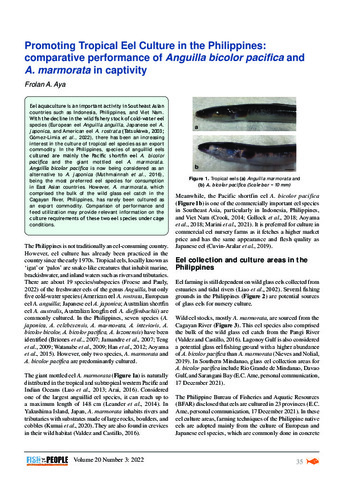
Promoting tropical eel culture in the Philippines: Comparative performance of Anguilla bicolor pacifica and A. marmorata in captivity
Aya, Frolan (Secretariat, Southeast Asian Fisheries Development Center, 2023-02)
Eel aquaculture is an important activity in Southeast Asian countries such as Indonesia, Philippines, and Viet Nam. With the decline in the wild fishery stock of cold-water eel species (European eel Anguilla anguilla, Japanese eel A. japonica, and American eel A. rostrata (Tatsukawa, 2003; Gómez-Limia et al., 2022), there has been an increasing interest in the culture of tropical eel species as an export commodity. In the Philippines, species of anguillid eels cultured are mainly the Pacific shortfin eel A. bicolor pacifica and the giant mottled eel A. marmorata. Anguilla bicolor pacifica is now being considered as an alternative to A. japonica (Muthmainnah et al., 2016), being the most preferred eel species for consumption in East Asian countries. However, A. marmorata, which comprised the bulk of the wild glass eel catch in the Cagayan River, Philippines, has rarely been cultured as an export commodity. Comparison of performance and feed utilization may provide relevant information on the culture requirements of these two eel species under cage conditions. -
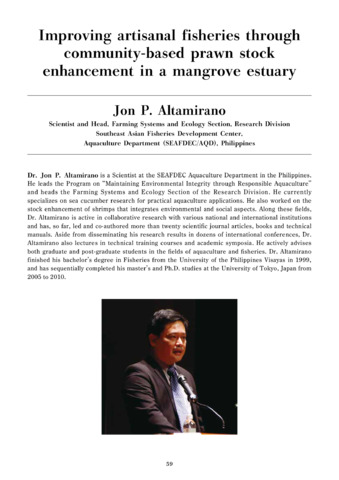
Improving artisanal fisheries through community-based prawn stock enhancement in a mangrove estuary
Altamirano, Jon (Japan International Research Center for Agricultural Sciences, 2022)
Tropical seafood, especially prawns, have always been in high demand with high market prices. Because of this, wild prawn resources are often overfished as indicated by the increasing number of fishers, but with overall declining catch volume and sizes through the years. Prawn aquaculture has, as of course, significantly contributed to the total yield in the past decades. However, the expansion of farms and ponds has often negatively affected the natural nursery grounds in the estuaries and mangroves. The economic gains from aquaculture are limited only to those who invested. However, local communities and artisanal fishers are often deprived of such gains. They are still reliant upon the dwindling natural stocks of fisheries resources. This is where the concept of stock enhancement comes in, wherein hatchery-produced juveniles are released into the water body in order to increase capture fisheries yield for local fishers. In this talk, I will present the case of the tiger prawn Penaeus monodon stock enhancement in the New Washington Estuary (NWE), in Aklan, central Philippines. The NWE was a productive fishing ground providing >24 kg/gear/day of catch in the 1970s but steadily declined to <0.7 kg/gear/day in 2010s. Prawn catches declined both in quality and quantity. Meanwhile, mangrove cover was reduced from 4800 ha in 1950s to only <800 ha in 2010s. Site-specific studies were conducted in NWE on prawn nursery rearing, small-scale release and monitoring experiments, as well as social assessments. Our studies produced essential scientific data to guide future stock enhancement activities in NWE. Even at an experimental scale, our releases showed significant increases in catch by at least 8% but can potentially increase daily income by >400%. However, in order to sustain the prawn fisheries and optimize the benefits, long-term management plans by all stakeholders are needed, especially between the communities and the local government. -
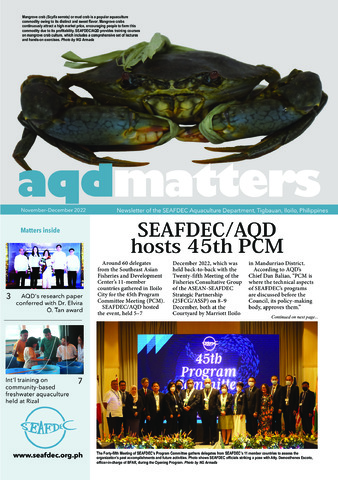
AQD Matters 2022 November - December
(Aquaculture Department, Southeast Asian Fisheries Development Center, 2023-02)In this issue: 1) SEAFDEC/AQD hosts 45th PCM; 2) AQD's research paper conferred with Dr. Elvira Q. Tan award; 3) Scientist emerita elected TWAS Fellow; 4) Malaysian university eyes collab with AQD; 5) Japanese ... -
Seaweed Gracilariopsis heteroclada, formulated flaked diet, and a combination of both as feed for the abalone Haliotis asinina: Effect on growth and survival
Lebata-Ramos, Ma. Junemie Hazel; Solis, Ellen Flor ; (Springer, 2023-01-27)
This paper compares the effect of feeding the abalone Haliotis asinina with seaweed (SW), formulated (FD), and mixed (SW+FD) diets. The feeding experiment, in six replicates, was conducted in a tank facility and lasted for 10 months. At the end of the experiment, abalone fed mixed diets had significantly the highest mean shell length and body weight (45.90±0.19 mm, 22.82±0.31 g), followed by those fed seaweeds (43.47±0.17 mm, 18.25±0.26 g), and lastly, by those fed formulated diets (41.78±0.18 mm, 15.76±0.22 g). Mean growth rates were significantly higher in abalone fed mixed diets at 1.48±0.03 mm and 1.69±0.04 g mo−1 than those fed seaweeds (1.26±0.03 mm, 1.27±0.06 g mo−1) or formulated diet (1.06±0.09 mm, 1.00±0.11 g mo−1). Survival was consistent 1 month from the start of culture until harvest—highest in abalone fed mixed diets (78.81±2.48%), followed by those fed seaweeds (70.12±4.07%), and lastly formulated diet (64.53±4.61%). Moreover, feed conversion ratios (FCR) were significantly lower in abalone fed mixed diets (15.48±0.69) and formulated diet (18.07±3.50) compared with those fed seaweeds (41.31±2.36). The body weight to shell length ratios (BW:SL), which were the same in all treatments at the start of the experiment (0.19 g mm−1), increased to 0.51, 0.44, and 0.38 in abalone fed mixed diets, seaweeds, and formulated diet, respectively. Based on the results of this experiment, giving abalone a mix of formulated and natural diets is the best feeding regime. The importance of a balanced and more nutritional diet on the well-being of the abalone was observed in this study. -
SEAFDEC/AQD highlights 2021
(Aquaculture Department, Southeast Asian Fisheries Development Center, 2023-01)SEAFDEC/AQD highlights 2021 is SEAFDEC/AQD's annual report updating on its accomplishments and progress for the year 2021. -
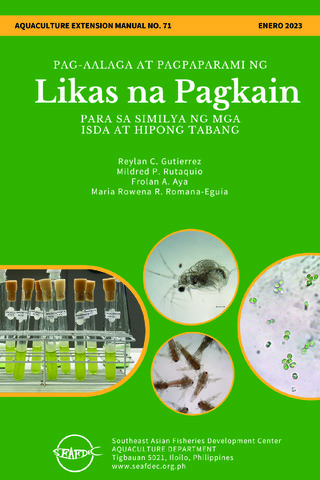
Series: Aquaculture extension manual; No. 71
Pag-aalaga at pagpaparami ng likas na pagkain para sa similya ng mga isda at hipong tabang
; ; Aya, Frolan; Romana-Eguia, Maria Rowena R. (Aquaculture Department, Southeast Asian Fisheries Development Center, 2023-01)
Inilalarawan sa manwal na ito ang iba’t-ibang paraan ng pag-aalaga at pagpaparami ng microalgae at iba pang natural na organismong pagkain para sa mga similya ng isda at hipong tabang na inaalagaan at pinaparami sa mga hatcheries. Sa pamamagitan ng manwal na ito, maisusulong ang paggamit ng mga natural at naproseso na mga nasabing organismo bilang isang paraan para mapabuti ang produksyon ng mga isda at hipong tabang. Ang manwal na ito ay sadyang isinulat para makatulong sa mga lokal na may-ari ng mga hatcheries ng ulang at isdang tabang kabilang na ang kanilang mga technicians. Ito ay naglalayong magkaroon sila ng mas mahusay na pag-unawa sa kahalagahan ng pagpaparami at pag-aalaga ng ng mga likas na pagkain bilang isang kritikal na aspeto sa pag-aalaga at masaganang produksyon ng mga similya sa hatchery. -
Series: Aquaculture extension manual; No. 71
Culture of natural food for farmed freshwater fish and prawn larvae
; ; Aya, Frolan; Romana-Eguia, Maria Rowena R. (Aquaculture Department, Southeast Asian Fisheries Development Center, 2023-01)
This manual describes the various methods for culturing microalgae and other natural food organisms fed to freshwater fish/prawn larvae that are produced and reared in hatcheries. Hence, it will encourage/ promote the use of natural food organisms be these live and/or processed (concentrated algal pastes), as a means of optimizing larval fish/prawn production. The manual was written purposely for local freshwater fish/prawn hatchery owners/operators and their technicians. The authors prepared the manual for hatchery operators to have a better understanding of how and why there is a need to culture natural food organisms as part of the standard larval rearing protocol and to increase/boost fish and/or prawn seedstock production. -
Rapid screening of potential probionts from the gut microbiota of climbing perch, Anabas testudineus
Caipang, Christopher Marlowe; ; Pakingking, Rolando V., Jr. ; ; (International Network for Natural Sciences, 2022-09-25)
The intestinal microbial community has crucial functions for their vertebrate host. Several studies in fish showed that their gastro-intestinal tract harbors a diverse population of bacteria that supplies exogenous nutrients, enzymes, fatty acids and vitamins to their host. Most studies on probiotics involved their practical use for aquaculture, but are limited for the ornamental fish industry. Hence, this study aimed to screen the gut microbiota of a freshwater fish, Anabas testudineus, for potential probiotic candidates for the ornamental fish industry. Gut bacteria were obtained from the gut of climbing perch by plating of serially-diluted samples of the gut contents onto Nutrient Agar (NA). In vitro antagonistic activities of these gut bacteria against a fish bacterial pathogen, Aeromonas hydrophila, were determined by spot-on-lawn method. Isolates that had strong antagonistic activities against A. hydrophila were further characterized using standard staining and biochemical techniques. Rapid screening of the gut microbiota of climbing perch resulted in the identification of a promising probiont, Kurthia gibsonii through sequencing of its 16S rRNA gene. This bacterium is a member of the Planococcaceae family and is a Gram-positive, non-spore forming and rod-like bacterium. The isolate is yellowish in appearance and has a filamentous colony on nutrient agar. It exhibited catalase and amylase activities. Immersion challenge of freshwater ornamental fish with the bacterial isolate showed no mortality at 15 days after exposure. Taken together, the present study demonstrated that the gut microbiota of fish is a rich source of probiotic candidates that can be utilized during the culture of freshwater ornamental fish. -
Evaluation of dietary fermented tuna by-product meal as partial replacement for unprocessed tuna by-product meal in fishmeal-based diets for juvenile olive flounder Paralichthys olivaceus
Aya, Frolan; Moniruzzaman, Mohammad ; ; Won, Seonghun ; Hamidoghli, Ali ; ; (Springer, 2022-12-06)
This study examined the effects of feeding fermented tuna by-product (FTBP) on the growth, non-specific immune response, liver and intestinal morphology, and disease resistance of olive flounder Paralichthys olivaceus. Olive flounders (n = 20; 2 g) were randomly assigned into four dietary groups in triplicates. Fish were fed four test diets (50% crude protein; 10% crude lipid) for 10 weeks in which unprocessed tuna by-product (TBP) meal was replaced (on a protein basis) with 0% (FTBP0 as the control diet), 15% (FTBP15), 30% (FTBP30), and 60% (FTBP60) of FTBP protein. Results showed that growth performance, blood parameters, and proximate composition were not influenced by FTBP inclusion. Non-specific immune parameters such as superoxide dismutase activity in the FTBP30 and FTBP60 groups were significantly higher than in the FTBP15 and the control groups, whereas lysozyme and myeloperoxidase activities were not different. Liver histopathology revealed normal architecture in groups fed FTBP0 and FTBP15 diets although mild alterations were noted in the FTBP30- and FTBP60-fed groups. Intestinal villi height and muscular thickness were not significantly altered with FTBP inclusion. Moreover, higher cumulative survival rate was observed in the FTBP60-fed group than fish fed with the other diets following the 13-day challenge with E. tarda. Together, these results demonstrate that fermented tuna by-product meal could be included at 60% in olive flounder diets. -
Communicating science information to the fishing community in the Philippines
; ; Superio, Daryl (Taylor and Francis, 2022-11-10)
The world is currently experiencing an age of information overload, as information about anything and almost everything is easily obtainable. However, essential information that could help a community strive and survive is often left unread in scientific papers and grey literature, thus unable to reach its intended audience. Fishers, specifically in developing countries such as the Philippines, are still known to be information-poor despite the rich scientific knowledge produced by concerned agencies. This chapter describes and analyses the information needs and seeking behaviour among fishers in the coastal communities in Iloilo, Philippines. Taking the initiative and time to profile how specific groups consume information can help narrow the information gap and aid concerned agencies to create and conceptualise successful, sustainable, and effective information, education, and communication campaigns. -
Production, feeding and storage of Tetraselmis tetrathele paste by electrolytic flocculation
Villa-Franco, Annie; ; ; ; Usero, Roselyn ; de la Peña, Milagros R. (Springer, 2023-02)
An innovative microalgae harvesting technique using electroflocculation was carried out at different voltage treatments (4, 7, and 9 V) using a fabricated voltage regulator and compared with harvesting by electroflocculation at 12 V using a car battery to efficiently electroflocculate Tetraselmis tetrathele. This study was conducted to determine the ideal voltage settings that could improve the quality of harvested paste in terms of nutritional value and metal contamination for its later use in aquaculture. The use of 7 V achieved low Pb content producing the best harvest biomass (1.4 kg, 87 min) which is comparable to the harvest biomass (1.7 kg, 68 min) using a 12 V car battery. Storage of T. tetrathele paste is best done in a chiller (2 ± 1 °C) rather than a freezer (-20 ± -4 °C) for ease in reactivation and maintaining higher cell viability for later use as a starter in aquaculture. Storage in a chiller allows T. tetrathele paste to be resuspended after six months and used as a starter culture. -
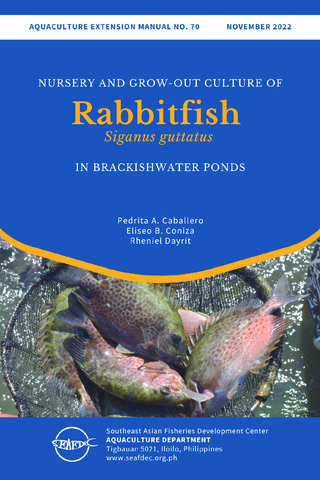
Series: Aquaculture extension manual; No. 70
Nursery and grow-out culture of rabbitfish Siganus guttatus in brackishwater ponds
(Aquaculture Department, Southeast Asian Fisheries Development Center, 2022-11)Rabbitfish Siganus guttatus is a promising aquaculture species due to its tasty meat and commands a higher price than some aquaculture species. Moreover, it has a low protein requirement, resulting in a low-cost feed input. ... -
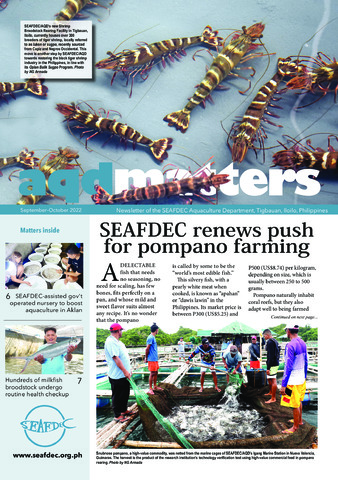
AQD Matters 2022 September - October
(Aquaculture Department, Southeast Asian Fisheries Development Center, 2022-11)In this issue: 1) SEAFDEC renews push for pompano farming; 2) Scientist presents study in international conference; 3) AQD researcher joins RECAB activity on Gender; 4) Meeting convened to review, enhance SEAFDEC's information ... -
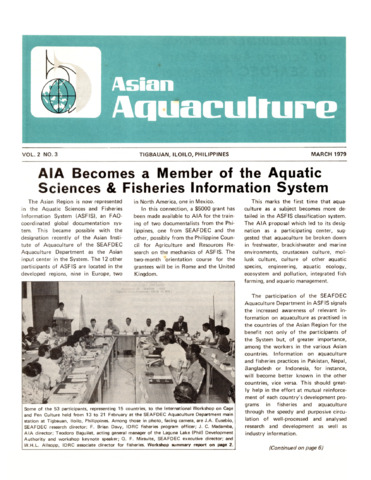
Asian Aquaculture Volume 2(3) March 1979
(Aquaculture Department, Southeast Asian Fisheries Development Center, 1979-03)In this issue: 1) AIA becomes a member of Aquatic Sciences & Fisheries Information System; 2) Cage and pen culture workshop; 3) Technology now available in RP on the culture of milkfish, prawns, molluscs, tilapia; 4) ...