SEAFDEC/AQD Institutional Repository: Recent submissions
241-260 / 4221
-
Some laboratory indications for crab fattening
(Aquaculture Department, Southeast Asian Fisheries Development Center, 1979)Contributed by Alice Fe Laviña of the SEAFDEC Aquaculture Department crab research project. -
Asian Aquaculture Volume 2(2) February 1979
(Aquaculture Department, Southeast Asian Fisheries Development Center, 1979-02)In this issue: 1) Aquaculture scientist is one of RP's outstanding young men in '78; 2) International cage and pen culture and national aquaculture technology consultation held; 3) Advances in prawn research and development ... -
Asian Aquaculture Volume 2(1) January 1979
(Aquaculture Department, Southeast Asian Fisheries Development Center, 1979-01)In this issue: 1) Aquaculture development projects in Asia underway; 2) Four Indian scientists undergo training at SEAFDEC; 3) The milkfish research development program of SEAFDEC; 4) Status of aquaculture in some Latin ... -
Asian Aquaculture Volume 1(6) December 1978
(Aquaculture Department, Southeast Asian Fisheries Development Center, 1978-12)In this issue: 1) Increased dialogue among aquaculture R&D agencies; 2) Freshwater fisheries expands program; 3) Cuba expands her aquaculture industry; 4) Fish farming can help conserve mangrove; 5) Edible crustaceans in ... -
Asian Aquaculture Volume 1(5) November 1978
(Aquaculture Department, Southeast Asian Fisheries Development Center, 1978-11)In this issue: 1) RP starts pilot aquaculture support system program; 2) OI, SEAFDEC in joint R & D venture; 3) SEAFDEC nursery pond system solves prawn fry survival problems; 4) Ferrocement tank for sugpo maturation; 5) ... -
Asian Aquaculture Volume 1(4) October 1978
(Aquaculture Department, Southeast Asian Fisheries Development Center, 1978-10)In this issue: 1) Developing the aquaculture industry of Asia; 2) Training of sugpo hatchery management organized; 3) Status and prospects of and development strategies for aquaculture in Indonesia, Philippines, Singapore ... -
An innovative biofloc technology for the nursery production of Pacific whiteleg shrimp, Penaeus vannamei in tanks
Caipang, Christopher Marlowe ; ; ; ; Pakingking, Rolando V., Jr. ; ; (International Network for Natural Sciences, 2022-10-09)
Nursery production of shrimp is usually done in small ponds; however, the use of small and circular tanks with plastic liners is gaining popularity. From an industry standpoint, there is still a need to assess how nursery systems can be of benefit to the shrimp production cycle. Hence, the use of small circular tanks coupled with the incorporation of biofloc technology was assessed in terms of its viability during the nursery production of the Pacific whiteleg shrimp, Penaeus vannamei. A 450m2 plastic lined circular tank was installed and prepared for the stocking of P. vannamei postlarvae (PLs) at a density of 500 PLs per m2. Biofloc was produced and maintained throughout the nursery phase using brown sugar as carbon source at a carbon to nitrogen (C:N) ratio of 10. Water quality was monitored daily, while presumptive Vibrios were enumerated weekly. Sampling for growth was done at the 14th day post-stocking and weekly until harvest on the 30th day. The different water quality parameters were within optimum levels required for shrimp growth. Presumptive Vibrios were dominated by the yellow colonies. At the end of the nursery phase, there was 100% survival and the shrimp attained an average body weight of 1.26 g and a feed conversion ratio (FCR) of 0.43. Our results indicate that the use of small circular tanks with biofloc during the nursery production phase of whiteleg shrimp is feasible and can be incorporated in the grow-out culture of this shrimp species.
; ; ; ; Pakingking, Rolando V., Jr. ; ; (International Network for Natural Sciences, 2022-10-09)
Nursery production of shrimp is usually done in small ponds; however, the use of small and circular tanks with plastic liners is gaining popularity. From an industry standpoint, there is still a need to assess how nursery systems can be of benefit to the shrimp production cycle. Hence, the use of small circular tanks coupled with the incorporation of biofloc technology was assessed in terms of its viability during the nursery production of the Pacific whiteleg shrimp, Penaeus vannamei. A 450m2 plastic lined circular tank was installed and prepared for the stocking of P. vannamei postlarvae (PLs) at a density of 500 PLs per m2. Biofloc was produced and maintained throughout the nursery phase using brown sugar as carbon source at a carbon to nitrogen (C:N) ratio of 10. Water quality was monitored daily, while presumptive Vibrios were enumerated weekly. Sampling for growth was done at the 14th day post-stocking and weekly until harvest on the 30th day. The different water quality parameters were within optimum levels required for shrimp growth. Presumptive Vibrios were dominated by the yellow colonies. At the end of the nursery phase, there was 100% survival and the shrimp attained an average body weight of 1.26 g and a feed conversion ratio (FCR) of 0.43. Our results indicate that the use of small circular tanks with biofloc during the nursery production phase of whiteleg shrimp is feasible and can be incorporated in the grow-out culture of this shrimp species. -
Vibrio load and percentage composition of sucrose‐fermenting vibrios in Nile tilapia (Oreochromis niloticus) cultured in brackish water earthen ponds and biocontrol potential of recycled tilapia‐conditioned greenwater against population growth of V. parahaemolyticus and non‐sucrose‐fermenting vibrios in the grow‐out culture of white leg shrimp (Litopenaeus vannamei)
Pakingking, Rolando V., Jr.; Palma, Peter ; ; Usero, Roselyn (Wiley, 2022-10-20)
Vibrio are known opportunistic pathogens of pond-cultured fish and shrimp. This study determined the presumptive Vibrio count (PVC) and percentage composition of “beneficial” sucrose-fermenting vibrios (SFVs) and “pathogenic” non-SFVs in the water, sediment, gills and intestines of healthy tilapia Oreochromis niloticus collected every 2 weeks from Days 30 to 120 post-stocking in brackish water earthen ponds. PVCs in water and sediment ranged from 102–104 CFU/ml/CFU/g while in tilapias' gills and intestines, PVCs ranged from 103–106 CFU/g and 102–106 CFU/g, respectively, with SFVs dominating in water, sediment, gills (≥50%), and intestines (≥80%) of tilapia. Because use of tilapia-conditioned green water (TCGW) for shrimp's grow-out culture has been reported effective against acute hepatopancreatic necrosis disease outbreaks caused by V. parahaemolyticus, PVC, SFVs/non-SFVs (%), and V. parahaemolyticus count (VPC) in the recycled TCGW and Litopenaeus vannamei's hepatopancreas were also examined from stocking until 105 days of culture (DOC) in earthen ponds. PVCs ranging from 102–103 CFU/ml and 103–104 CFU/g were noted in water and shrimp's hepatopancreas, respectively. While non-SFVs population in water varied, a downward trend typified by an abrupt 50% reduction was noted in hepatopancreas at DOC 42, and remained or further dropped until DOC 105. VPCs in water likewise varied (undetectable–102 CFU/ml) while in hepatopancreas, counts dropped to undetectable level from DOC 70 onwards. Current data illustrate that remarkable shift of SFVs' dominance in the water and concomitantly in shrimp's hepatopancreas, plays a pivotal role in regulating non-SFVs proliferation in shrimp's hepatopancreas via competitive exclusion. -
Acute lethal toxicity of dried garlic (Allium sativum) powder on orange-spotted grouper (Epinephelus coioides) juveniles under static exposure
(European Association of Fish Pathologists, 2022-10-05)The present study was carried out to assess the toxic effect and determine the lethal concentration of dried garlic (Allium sativum) powder on the orange-spotted grouper (Epinephelus coioides) juveniles. Laboratory static bioassays were conducted to determine the 96-h LC50 of different concentrations of garlic (0, 30, 60, 90, 120, 150 and 180 mg L-1) on grouper juveniles (mean weight, 35.4±6.18 g and mean length, 13.2±0.51 cm). The 96-h LC50 was 74.78 mg L-1 with lower and upper confidence limits of 62.8 and 89.06 mg L-1, respectively. All fish exposed to 30 to 180 mg L-1 exhibited rapid movement, faster opercular activity and erratic swimming whereas at higher concentrations (90 mg L-1 to 180 mg L-1) fish showed additional behavioral changes such as loss of balance, lethargy, gulping for air and respiratory distress. Water quality parameters were within the recommended acceptable limits. This LC50 value can be used as a baseline reference to generate an effective concentration of garlic for future prophylaxis and treatment for parasitic, viral and bacterial infection in grouper. -
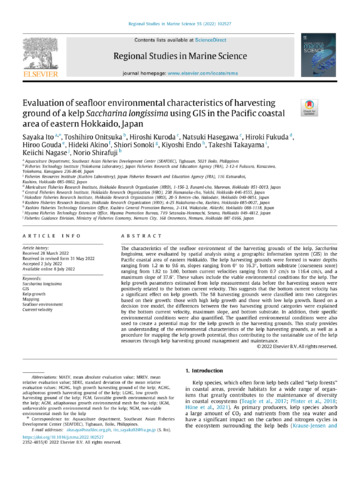
Evaluation of seafloor environmental characteristics of harvesting ground of a kelp Saccharina longissima using GIS in the Pacific coastal area of eastern Hokkaido, Japan
Ito, Sayaka; ; ; Hasegawa, Natsuki ; ; ; ; ; ; ; ; (Elsevier, 2022-09)
The characteristics of the seafloor environment of the harvesting grounds of the kelp, Saccharina longissima, were evaluated by spatial analysis using a geographic information system (GIS) in the Pacific coastal area of eastern Hokkaido. The kelp harvesting grounds were formed in water depths ranging from 1.2 m to 9.6 m, slopes ranging from 0° to 16.3°, bottom substrate (coarseness score) ranging from 1.82 to 3.00, bottom current velocities ranging from 0.7 cm/s to 116.4 cm/s, and a maximum slope of 37.6°. These values include the viable environmental conditions for the kelp. The kelp growth parameters estimated from kelp measurement data before the harvesting season were positively related to the bottom current velocity. This suggests that the bottom current velocity has a significant effect on kelp growth. The 58 harvesting grounds were classified into two categories based on their growth: those with high kelp growth and those with low kelp growth. Based on a decision tree model, the differences between the two harvesting ground categories were explained by the bottom current velocity, maximum slope, and bottom substrate. In addition, their specific environmental conditions were also quantified. The quantified environmental conditions were also used to create a potential map for the kelp growth in the harvesting grounds. This study provides an understanding of the environmental characteristics of the kelp harvesting grounds, as well as a procedure for mapping the kelp growth potential, thus contributing to the sustainable use of the kelp resources through kelp harvesting ground management and maintenance. -
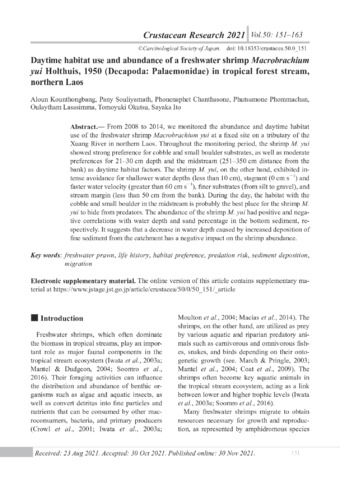
Daytime habitat use and abundance of a freshwater shrimp Macrobrachium yui Holthuis, 1950 (Decapoda: Palaemonidae) in tropical forest stream, northern Laos
; ; ; ; ; ; Ito, Sayaka (Carcinological Society of Japan, 2021-11-30)
From 2008 to 2014, we monitored the abundance and daytime habitat use of the freshwater shrimp Macrobrachium yui at a fixed site on a tributary of the Xuang River in northern Laos. Throughout the monitoring period, the shrimp M. yui showed strong preference for cobble and small boulder substrates, as well as moderate preferences for 21–30 cm depth and the midstream (251–350 cm distance from the bank) as daytime habitat factors. The shrimp M. yui, on the other hand, exhibited intense avoidance for shallower water depths (less than 10 cm), stagnant (0 cm s−1) and faster water velocity (greater than 60 cm s−1), finer substrates (from silt to gravel), and stream margin (less than 50 cm from the bank). During the day, the habitat with the cobble and small boulder in the midstream is probably the best place for the shrimp M. yui to hide from predators. The abundance of the shrimp M. yui had positive and negative correlations with water depth and sand percentage in the bottom sediment, respectively. It suggests that a decrease in water depth caused by increased deposition of fine sediment from the catchment has a negative impact on the shrimp abundance. -
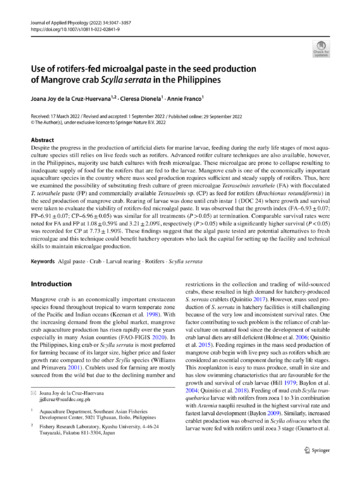
Use of rotifers-fed microalgal paste in the seed production of mangrove crab Scylla serrata in the Philippines
Huervana, Joana Joy; ; Villa-Franco, Annie (Springer, 2022-09-09)
Despite the progress in the production of artificial diets for marine larvae, feeding during the early life stages of most aquaculture species still relies on live feeds such as rotifers. Advanced rotifer culture techniques are also available, however, in the Philippines, majority use batch cultures with fresh microalgae. These microalgae are prone to collapse resulting to inadequate supply of food for the rotifers that are fed to the larvae. Mangrove crab is one of the economically important aquaculture species in the country where mass seed production requires sufficient and steady supply of rotifers. Thus, here we examined the possibility of substituting fresh culture of green microalgae Tetraselmis tetrathele (FA) with flocculated T. tetrathele paste (FP) and commercially available Tetraselmis sp. (CP) as feed for rotifers (Brachionus rotundiformis) in the seed production of mangrove crab. Rearing of larvae was done until crab instar 1 (DOC 24) where growth and survival were taken to evaluate the viability of rotifers-fed microalgal paste. It was observed that the growth index (FA–6.93 ± 0.07; FP–6.91 ± 0.07; CP–6.96 ± 0.05) was similar for all treatments (P > 0.05) at termination. Comparable survival rates were noted for FA and FP at 1.08 ± 0.59% and 3.21 ± 2.09%, respectively (P > 0.05) while a significantly higher survival (P < 0.05) was recorded for CP at 7.73 ± 1.90%. These findings suggest that the algal paste tested are potential alternatives to fresh microalgae and this technique could benefit hatchery operators who lack the capital for setting up the facility and technical skills to maintain microalgae production. -
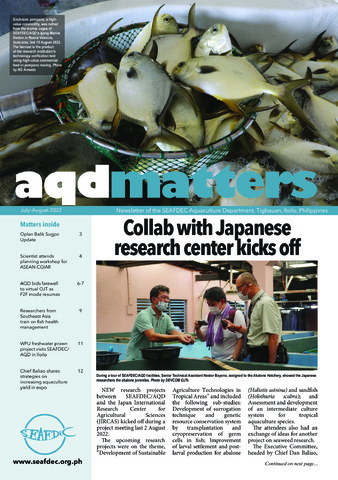
AQD Matters 2022 July - August
(Aquaculture Department, Southeast Asian Fisheries Development Center, 2022-09)In this issue: 1) Oplan Balik Sugpo Update; 2) Scientists attends planning workshop for ASEAN-CGIAR; 3) AQD bids farewell to virtual OJTs as F2F mode resumes; 4) Researchers from Southeast Asia train on fish health management; ... -
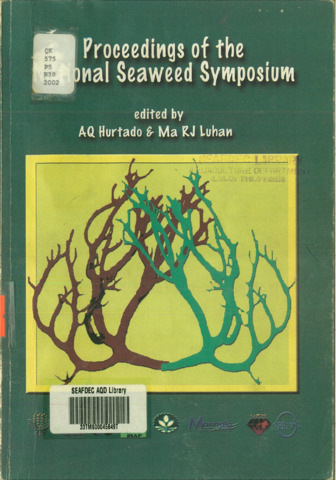
Proceedings of the National Seaweed Symposium, September 3-4, 2002, Cebu City
(Seaweed Industry Association of the Philippines, 2003)The Proceedings of the National Seaweed Symposium is published by the Seaweed industry association of the Philippines (SIAP). The 109-page book is edited by SEAFDEC/AQD researchers Dr. AQ Hurtado and Ms. Ma. RJ Luhan. It ... -
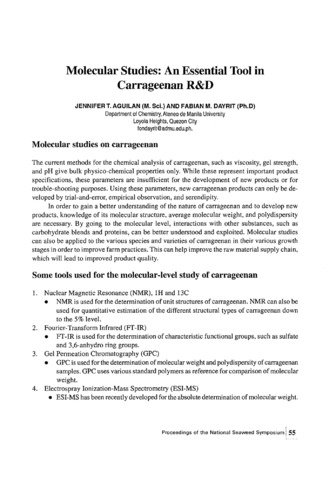
Molecular studies: An essential tool in carrageenan R&D
(Seaweed Industry Association of the Philippines, 2003) -
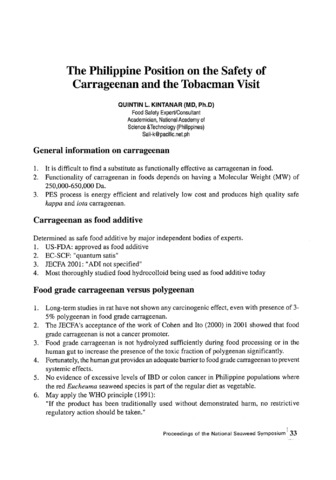
The Philippine position on the safety of carrageenan and the tobacman visit
(Seaweed Industry Association of the Philippines, 2003) -
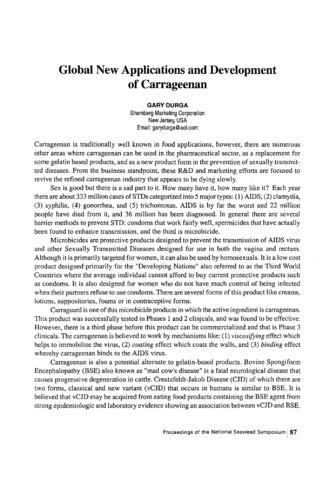
Global new applications and development of carrageenan
(Seaweed Industry Association of the Philippines, 2003) -
Carrageenan market: A global overview
(Seaweed Industry Association of the Philippines, 2003) -
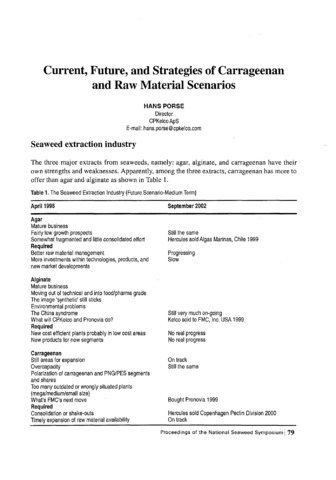
Current, future, and strategies of carrageenan and raw material scenarios
(Seaweed Industry Association of the Philippines, 2003) -
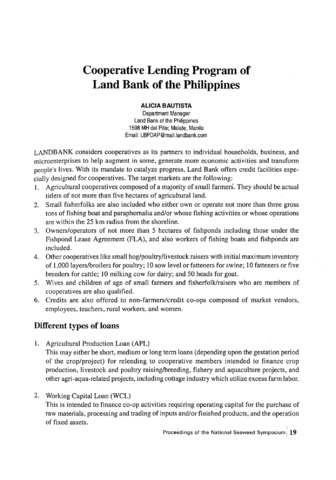
Cooperative Lending Program of Land Bank of the Philippines
(Seaweed Industry Association of the Philippines, 2003)