SEAFDEC/AQD Institutional Repository: Recent submissions
281-300 / 4221
-
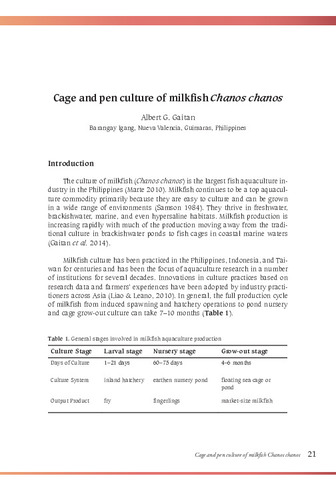
Cage and pen culture of milkfish Chanos chanos
(Aquaculture Department, Southeast Asian Fisheries Development Center; Japan International Research Center for Agricultural Sciences, 2022-07) -
IMTA as a possible countermeasure for reduced aquaculture productivity in Japan
Watanabe, Satoshi ; ; ; Hasegawa, Natsuki ; (Aquaculture Department, Southeast Asian Fisheries Development Center; Japan International Research Center for Agricultural Sciences, 2022-07)
-
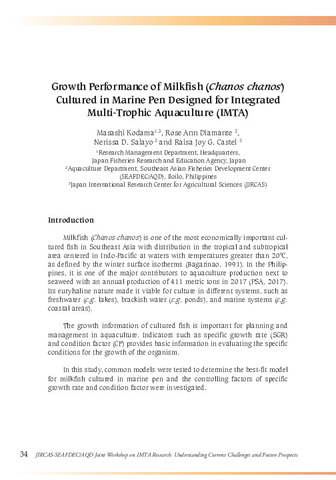
Growth performance of milkfish (Chanos chanos) cultured in marine pen designed for integrated multi-trophic aquaculture (IMTA)
(Aquaculture Department, Southeast Asian Fisheries Development Center; Japan International Research Center for Agricultural Sciences, 2022-07)In this study, common models were tested to determine the best-fit model for milkfish cultured in marine pen and the controlling factors of specific growth rate and condition factor were investigated. -
Environmental impact and growth performance of IMTA species in marine pen culture system
(Aquaculture Department, Southeast Asian Fisheries Development Center; Japan International Research Center for Agricultural Sciences, 2022-07)In this study, locally available marine species were tested, milkfish (Chanos chanos) as the fed species, seaweed (Kappaphycus alvarezii) as inorganic-extractive species for the water column, and sandfish (Holothuria scabra) as organic-extractive species on the sediments. This study aims to verify and improve IMTA systems suitable for farm conditions in coastal areas in the Philippines, with emphasis on mitigating the environmental impacts of mariculture of milkfish. -
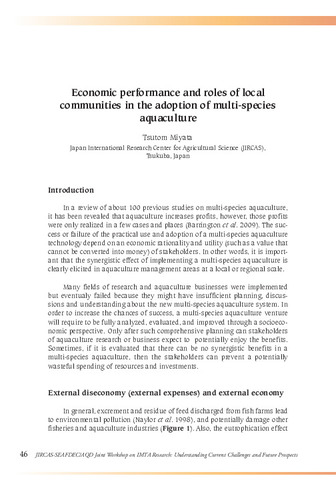
Economic performance and roles of local communities in the adoption of multi-species aquaculture
Miyata, Tsutom (Aquaculture Department, Southeast Asian Fisheries Development Center; Japan International Research Center for Agricultural Sciences, 2022-07)
-
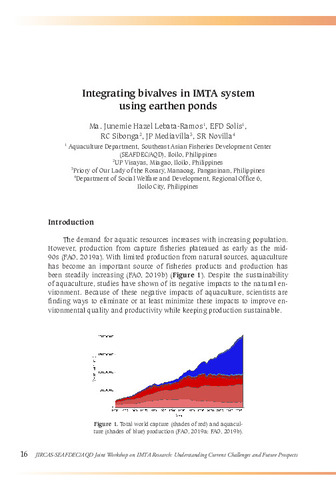
Integrating bivalves in IMTA system using earthen ponds
Lebata-Ramos, Ma. Junemie Hazel; Solis, Ellen Flor ; Sibonga, Rema ; ; (Aquaculture Department, Southeast Asian Fisheries Development Center; Japan International Research Center for Agricultural Sciences, 2022-07)
This study aimed to integrate the mangrove clam Anodontia philippiana, which has the capacity to assimilate sulfide in a pond culture system with milkfish Chanos chanos and seaweeds Gracilariopsis heteroclada. Specifically, it aimed to know the effects of integrating other commodities on the growth and survival of milkfish, the primary culture species in IMTA in ponds. -
Small-scale IMTA of milkfish in pens: The Pandaraonan, Guimaras, Philippines experience
(Aquaculture Department, Southeast Asian Fisheries Development Center; Japan International Research Center for Agricultural Sciences, 2022-07)This study examines IMTA as an option for small-scale fish farmers to grow multiple species in the same area in the coastal waters of Barangay Pandaraonan in Nueva Valencia, Guimaras, Philippines. The study aimed to explore the feasibility of an economically profitable IMTA system where milkfish are grown with sandfish and seaweeds. -
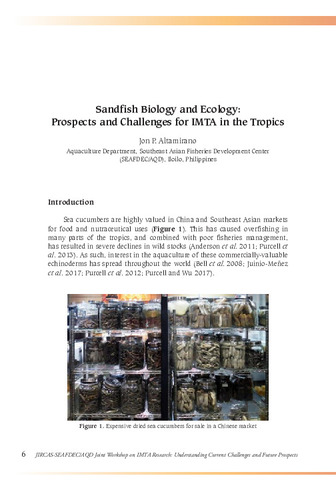
Sandfish biology and ecology: Prospects and challenges for IMTA in the tropics
Altamirano, Jon (Aquaculture Department, Southeast Asian Fisheries Development Center; Japan International Research Center for Agricultural Sciences, 2022-07)
-
Evaluation of livelihood assets in community-based on-farm demonstration of IMTA in milkfish mariculture in Guimaras, Philippines
(Aquaculture Department, Southeast Asian Fisheries Development Center; Japan International Research Center for Agricultural Sciences, 2022-07)This study showed the need to develop the livelihood assets of rural communities to enable them to engage in aquaculture-based income generating activities. The SLA evaluation showed that the benefits in terms of its contribution to livelihood asset build-up is generally positive. While human, social and environmental capacities were improved, the financial and physical assets were dissipated and insufficient for many stakeholders with keen interest to participate in the communal project. Therefore, the recommendation is to organize more and bigger collaborative projects, such as this IMTA of milkfish, with emphasis on sustainable livelihood asset development to create significant economic impact to target beneficiaries. -
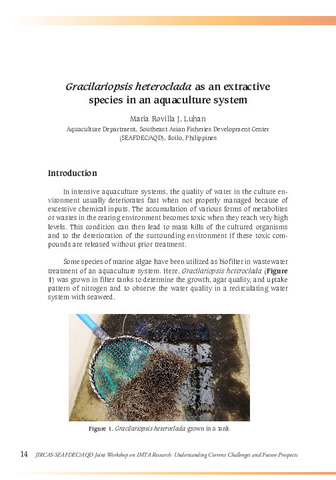
Gracilariopsis heteroclada as an extractive species in an aquaculture system
Luhan, Maria Rovilla (Aquaculture Department, Southeast Asian Fisheries Development Center; Japan International Research Center for Agricultural Sciences, 2022-07)
The study was conducted within the integrated finfish broodstock facility complex of SEAFDEC/AQD at Tigbauan, Iloilo, Philippines. The broodstock facility has a water recirculating system. The 500-ton capacity broodstock/spawning tanks were stocked with 25 grouper (Epinephelus coioides) and 90 milkfish (Chanos chanos) breeders. Water from the broodstock tanks passes through the sedimentation tank, then through the filter tank before it goes back to the broodstock tanks. The filter tank has an area of 20 m2, a water depth of 25 cm, and a water flow rate of 43 L sec-1 (≈3720 m3 day-1). -
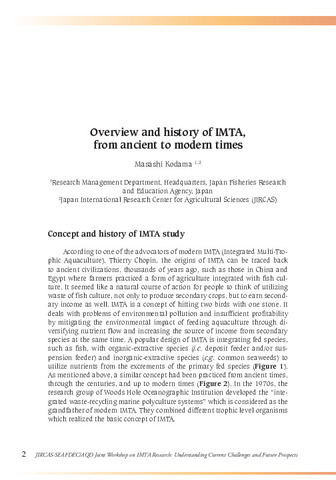
Overview and history of IMTA, from ancient to modern times
(Aquaculture Department, Southeast Asian Fisheries Development Center; Japan International Research Center for Agricultural Sciences, 2022-07) -
Effect of water mass mixing on phytoplankton dynamics in the scallop culture areas off Okhotsk Sea: A microcosm experiment
Aya, Frolan; Kudo, Isao (Elsevier, 2022-09)
The nearshore (Soya Warm Water (SWW)) and offshore (Intermediate Cold Water (ICW) and Okhostk Sea Low Salinity Water (OSLSW)) waters in the Okhotsk Sea differ substantially in their physico-chemical characteristics. Thus, the extent to which water mass mixing impacts phytoplankton dynamics in the Japanese scallop Patinopecten yessoensis culture areas needs to be assessed to properly manage scallop stocks. This study examined the phytoplankton dynamics in nearshore (SWW) and offshore (ICW and OSLSW) waters and phytoplankton response to water mass mixing (SWW + ICW, OSLSW + ICW) for 5 days in spring (2007) and summer (2007–2009) microcosm experiments. Increased chlorophyll a concentration in ICW was observed due to higher nutrients available for phytoplankton uptake than in OSLSW and SWW at the start of each microcosm experiment. In comparison to spring microcosm, mixing of SWW + ICW promoted higher chlorophyll a concentration and faster Si(OH)4 utilization than in OSLSW + ICW in summer. In addition, the size structure of chlorophyll a differed from micro-size (>) in SWW + ICW to nano-size (<) chlorophyll a in OSLSW + ICW. Suspended particulate organic matter (SPOM) \(\mathsf{\delta^{13}C}\) ratios were positively correlated with chlorophyll a in both mixed microcosms whereas SPOM \(\mathsf{\delta^{15}N}\) isotopic ratios were inversely related to nitrate concentration in SWW + ICW, except in spring. This suggests that stable isotopes can be used in predicting phytoplankton biomass and nutrient utilization. In comparison to microcosm experiments, nearshore water column structure suggests vertical water mixing in summer to autumn when phytoplankton biomass and micro-size fraction were at maximum. Taken together, the advance of nutrient-rich ICW to nutrient-poor nearshore areas in the Okhotsk Sea resulted in increased chlorophyll a biomass and dominance of micro-size phytoplankton in summer, potentially enhancing nutrient and food supply to bottom-cultured scallops as suggested by both microcosm experiments and field observations. -
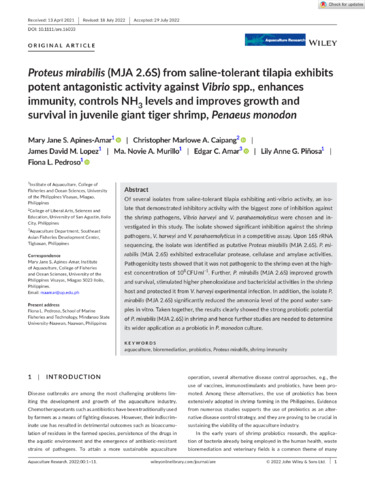
Proteus mirabilis (MJA 2.6S) from saline-tolerant tilapia exhibits potent antagonistic activity against Vibrio spp., enhances immunity, controls \(\mathsf{NH_3}\) levels and improves growth and survival in juvenile giant tiger shrimp, Penaeus monodon
Apines-Amar, Mary Jane; Caipang, Christopher Marlowe ; ; ; Amar, Edgar ; ; Pedroso, Fiona (Wiley, 2022-08-10)
Of several isolates from saline-tolerant tilapia exhibiting anti-vibrio activity, an isolate that demonstrated inhibitory activity with the biggest zone of inhibition against the shrimp pathogens, Vibrio harveyi and V. parahaemolyticus were chosen and investigated in this study. The isolate showed significant inhibition against the shrimp pathogens, V. harveyi and V. parahaemolyticus in a competitive assay. Upon 16S rRNA sequencing, the isolate was identified as putative Proteus mirabilis (MJA 2.6S). P. mirabilis (MJA 2.6S) exhibited extracellular protease, cellulase and amylase activities. Pathogenicity tests showed that it was not pathogenic to the shrimp even at the highest concentration of 108 CFU ml−1. Further, P. mirabilis (MJA 2.6S) improved growth and survival, stimulated higher phenoloxidase and bactericidal activities in the shrimp host and protected it from V. harveyi experimental infection. In addition, the isolate P. mirabilis (MJA 2.6S) significantly reduced the ammonia level of the pond water samples in vitro. Taken together, the results clearly showed the strong probiotic potential of P. mirabilis (MJA 2.6S) in shrimp and hence further studies are needed to determine its wider application as a probiotic in P. monodon culture. -
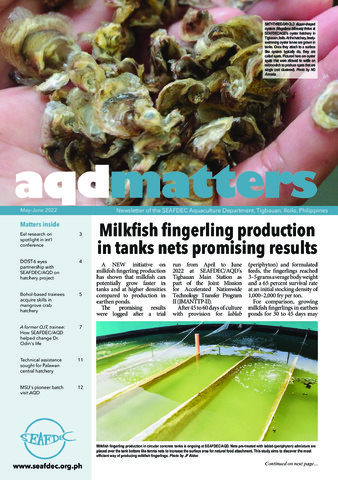
AQD Matters 2022 May - June
(Aquaculture Department, Southeast Asian Fisheries Development Center, 2022-07)In this issue: 1) Eel research on spotlight in int'l conference; 2) DOST-6 eyes partnership with SEAFDEC/AQD on hatchery project; 3) Bohol-based trainees acquire skills in mangrove crab hatchery; 4) A former OJT, trainee: ... -
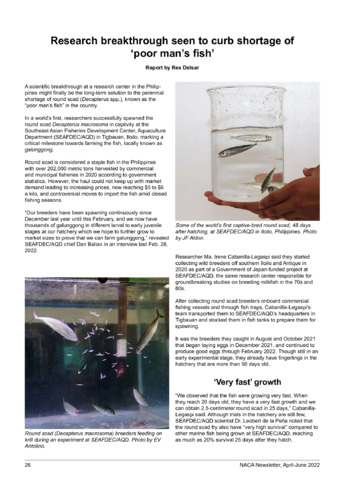
Research breakthrough seen to curb shortage of 'poor man's fish'
(Network of Aquaculture Centres in Asia-Pacific (NACA), 2022)A scientific breakthrough at a research center in the Philippines might finally be the long-term solution to the perennial shortage of round scad (Decapterus spp.), known as the “poor man’s fish” in the country. In a world’s first, researchers successfully spawned the round scad Decapterus macrosoma in captivity at the Southeast Asian Fisheries Development Center, Aquaculture Department (SEAFDEC/AQD) in Tigbauan, Iloilo, marking a critical milestone towards farming the fish, locally known as galunggong. -
Enhancing the reproductive performance of cultured shrimp: novel information on scent, maturation, and mating
Santander-Avancena, Sheryll (Secretariat, Southeast Asian Fisheries Development Center, 2022-07)
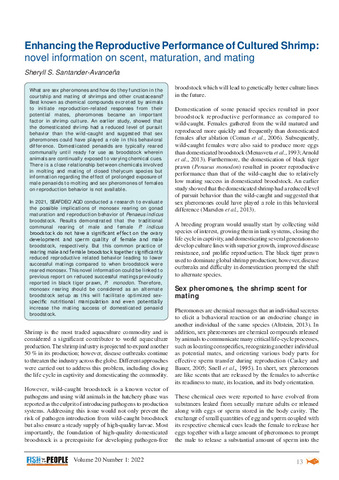
What are sex pheromones and how do they function in the courtship and mating of shrimps and other crustaceans? Best known as chemical compounds excreted by animals to initiate reproduction-related responses from their potential mates, pheromones became an important factor in shrimp culture. An earlier study, showed that the domesticated shrimp had a reduced level of pursuit behavior than the wild-caught and suggested that sex pheromones could have played a role in this behavioral difference. Domesticated penaeids are typically reared communally until ready for use as broodstock wherein animals are continually exposed to varying chemical cues. There is a close relationship between chemicals involved in molting and mating of closed thelycum species but information regarding the effect of prolonged exposure of male penaeids to molting and sex pheromones of females on reproduction behavior is not available. In 2021, SEAFDEC/AQD conducted a research to evaluate the possible implications of monosex rearing on gonad maturation and reproduction behavior of Penaeus indicus broodstock. Results demonstrated that the traditional communal rearing of male and female P. indicus broodstock do not have a significant effect on the ovary development and sperm quality of female and male broodstock, respectively. But this common practice of rearing male and female broodstock together significantly reduced reproductive related behavior leading to lower successful matings compared to when broodstock were reared monosex. This novel information could be linked to previous report on reduced successful matings previously reported in black tiger prawn, P. monodon. Therefore, monosex rearing should be considered as an alternate broodstock setup as this will facilitate optimized sexspecific nutritional manipulation and even potentially increase the mating success of domesticated penaeid broodstock. -
Evaluation of maturation promoting factor in polychaete (Marphysa sp.) on Indian white prawn, Penaeus indicus female broodstock
Santander-Avancena, Sheryll; Traifalgar, Rex Ferdinand ; Monteclaro, Harold ; ; ; ; Quinitio, Gerald (Wiley, 2022-07-15)
Polychaete is considered the best maturation diet for penaeids; however, fluctuating supply and quality warrant detailed studies to understand the specific maturation-promoting factors present in polychaete. Indian white prawn, Penaeus indicus, was fed diets supplemented with different fractions of Marphysa sp. extracts. Fractions, such as the total soluble fraction (TSF), neutral lipid fraction (NLF), and polar lipid fraction (PLF), were incorporated in the maturation diet at 0.25, 0.50, and 1.00% following a 3 × 3 factorial design. One group was fed with basal diet (BD), and another was fed with fresh squid, mussel, and polychaete, serving as the control. After a 30-day feeding trial, results showed that the inclusion of polychaete extracts in the diet significantly improved P. indicus maturation compared to groups fed BD and control with 40% maturation rates (MR) (p = 3.4 × 10⁻⁴). MR was optimum in groups receiving diets supplemented with ≥0.5% TSF (70.00% ± 0.00) and NLF (60.00% ± 5.77). Similar improved MR was achieved in treatments receiving ≥0.25% PLF supplementation (60% ± 0.00). Accordingly, relative expression of ovarian vitellogenin mRNA of broodstock fed under 0.25 and 0.50% PLF group was 4.44 and 3.96 folds higher than BD, respectively (p = 0.003). No significant differences were detected in the broodstock survival, latency period, hepatosomatic, and gonadosomatic indices. Biochemical content analyses showed no significant differences among the nine treatments except for broodstock's higher ovary protein content in the TSF group (p = 0.037). This study highlights PLF as the most potent component of the polychaete extract in promoting gonad maturation in P. indicus maturation supplemented at a 0.25% optimum inclusion level. -
Efficacy of tilapia oral vaccine coupled with a nanocomposite biomaterial as carrier for vaccine delivery
; ; Pakingking, Rolando V., Jr.; Argayosa, Anacleto (Food and Agriculture Organization of the United Nations, 2021-12)
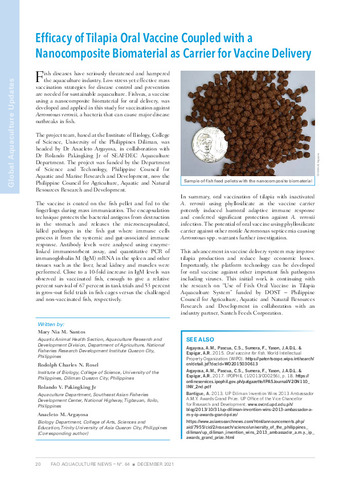
Fish diseases have seriously threatened and hampered the aquaculture industry. Low stress yet effective mass vaccination strategies for disease control and prevention are needed for sustainable aquaculture. Fishvax, a vaccine using a nanocomposite biomaterial for oral delivery, was developed and applied in this study for vaccination against Aeromonas veronii, a bacteria that can cause major disease outbreaks in fish. The project team, based at the Institute of Biology, College of Science, University of the Philippines Diliman, was headed by Dr. Anacleto Argayosa, in collaboration with Dr. Rolando Pakingking Jr. of SEAFDEC Aquaculture Department. The project was funded by the Department of Science and Technology, Philippine Council for Aquatic and Marine Research and Development, now the Philippine Council for Agriculture, Aquatic and Natural Resources Research and Development. -
Motile aeromonads recovered from tilapia (Oreochromis niloticus) cultured in earthen ponds in the Philippines: Assessment of antibiotic susceptibility and multidrug resistance to selected antibiotics
Pakingking, Rolando V., Jr.; Espanola, Jasca Gayle ; Palma, Peter ; Usero, Roselyn (AquacultureHub Inc., 2022-07)
A total of 177 motile Aeromonas spp., comprised of A. hydrophila (n=162) and A. sobria (n=15), isolated from the water, sediment, gills and intestines of tilapia collected from the grow-out culture earthen ponds in the Philippines were investigated for their antimicrobial susceptibility to 10 antibiotics commonly used in fish aquaculture. All motile Aeromonas spp. tested generally exhibited a very high percentage of resistance to amoxicillin (A. hydrophila: 95%; A. sobria: 100%), erythromycin (99%;100%), neomycin (83%;100%), and oxytetracycline (92%;100%), respectively. On the contrary, they showed substantial susceptibility to chloramphenicol, nitrofurantoin, doxycycline, enrofloxacin and norfloxacin. Results of the antimicrobial susceptibility testing demonstrated that 94.4% and 100% of A. hydrophila and A. sobria isolates tested were resistant to antibiotics belonging to at least 3 or more categories and therefore considered as multiple drug resistant strains. The multiple antibiotic resistance (MAR) indexing of A. hydrophila and A. sobria strains showed that they originated from high-risk sources. -
Growth and carrageenan quality of sporophyte and gametophyte of the commercially important red seaweed Kappaphycus alvarezii
Luhan, Maria Rovilla; Mateo, Jonalyn ; (Science and Technology Information Institute, Department of Science and Technology, 2022)
One dilemma facing the farming of the carrageenophyte Kappaphycus is the deteriorating quality of seedstock. Rejuvenating the commercial stocks using spores from reproductive wild parents that are sexually and asexually produced could perhaps restore the traits that are useful for culture. The use of gametophyte and sporophyte (=tetrasporophyte) phases of Kappaphycus alvarezii from spores is explored as a source of seedstock. The growth and physical properties of semi-refined carrageenan extracted from the resulting sporophyte and gametophyte thalli of the same ages were determined. The growth rate of the diploid tetrasporophyte thalli was significantly higher than that of the haploid gametophyte. Gel strength and yield of semi-refined carrageenan from the two life cycle phases were not significantly different, whereas the viscosity was significantly higher in the diploid tissues. Kappaphycus sporophytes were potentially superior to gametophytes as a source of seedstock for mariculture, but problems need to be addressed – including improving the growth rate and reducing the cost of production – before its application could be realized.