SEAFDEC/AQD Institutional Repository: Recent submissions
801-820 / 4207
-
Aqua Dep't News Vol. XVIII No. 8
(Aquaculture Department, Southeast Asian Fisheries Development Center, 2003-03-10) -
Aqua Dep't News Vol. XVIII No. 6
(Aquaculture Department, Southeast Asian Fisheries Development Center, 2003-02-24) -
Aqua Dep't News Vol. XVIII No. 5
(Aquaculture Department, Southeast Asian Fisheries Development Center, 2003-02-17) -
Aqua Dep't News Vol. XVIII No. 3
(Aquaculture Department, Southeast Asian Fisheries Development Center, 2003-02-03) -
Aqua Dep't News Vol. XVIII No. 4
(Aquaculture Department, Southeast Asian Fisheries Development Center, 2003-02-10) -
Aqua Dep't News Vol. XVII No. 38
(Aquaculture Department, Southeast Asian Fisheries Development Center, 2002-09-23) -
Aqua Dep't News Vol. XVII No. 37
(Aquaculture Department, Southeast Asian Fisheries Development Center, 2002-09-12) -
Aqua Dep't News Vol. XVII No. 36
(Aquaculture Department, Southeast Asian Fisheries Development Center, 2002-09-09) -
Aqua Dep't News Vol. XVII No. 35
(Aquaculture Department, Southeast Asian Fisheries Development Center, 2002-09-02) -
Aqua Dep't News Vol. XVII No. 34
(Aquaculture Department, Southeast Asian Fisheries Development Center, 2002-08-26) -
Aqua Dep't News Vol. XVII No. 33
(Aquaculture Department, Southeast Asian Fisheries Development Center, 2002-08-19) -
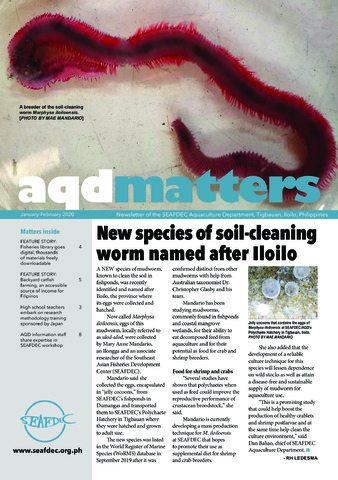
AQD Matters 2020 January - February
(Aquaculture Department, Southeast Asian Fisheries Development Center, 2020-03) -
Digestibility and effective level of meat and bone meal in formulated diet for milkfish, Chanos chanos Forsskal, grown in fresh and seawater
(Masyarakat Akuakultur Indonesia (MAI), 2015)The efficient level of MBM for good growth and survival of milkfish, Chanos chanos Forsskal, without histological changes in tissues (liver, intestine, muscle, kidney and brain) was determined in both freshwater (FW) and ... -
Analysis of biosecurity-related policies governing the seaweed industry of the Philippines
(Springer Verlag, 2020-03-10)The seaweed industry in the Philippines is a significant contributor to aquaculture production, both nationally and internationally. It out-produces the capture fisheries sector and most global producers, with the exception ... -
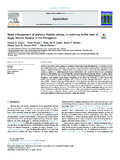
Stock enhancement of abalone, Haliotis asinina, in multi-use buffer zone of Sagay Marine Reserve in the Philippines
(Elsevier, 2020)Donkey's ear abalone (Haliotis asinina) is a gourmet seafood export of the Philippines but its wild stock is at risk due to high fishing pressure. This paper aims to show evidences that abalone seeds produced in hatcheries ... -
Point-of-no-return and delayed feeding mortalities in first-feeding larvae of the silver therapon Leiopotherapon plumbeus (Kner) (Teleostei: Terapontidae)
Garcia, Luis Maria ; ; Aya, Frolan (Elsevier, 2020-02)
This study examined the incidence of mortalities among first-feeding post-yolk sac silver therapon Leiopotherapon plumbeus (Kner) larvae deprived of live food in the hatchery. Starting after their yolk was consumed at 40 ...
; ; Aya, Frolan (Elsevier, 2020-02)
This study examined the incidence of mortalities among first-feeding post-yolk sac silver therapon Leiopotherapon plumbeus (Kner) larvae deprived of live food in the hatchery. Starting after their yolk was consumed at 40 ... -
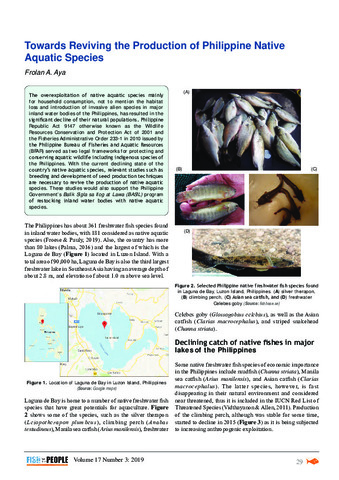
Towards reviving the production of Philippine native aquatic species
Aya, Frolan (Secretariat, Southeast Asian Fisheries Development Center, 2019)
The overexploitation of native aquatic species mainly for household consumption, not to mention the habitat loss and introduction of invasive alien species in major inland water bodies of the Philippines, has resulted in ... -
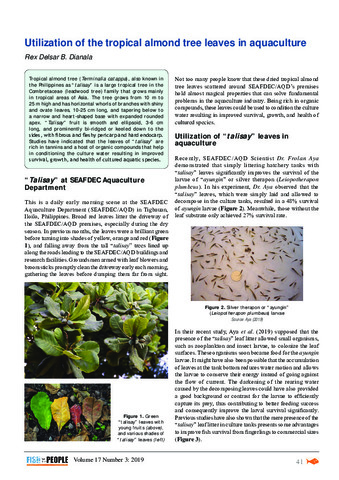
Utilization of the tropical almond tree leaves in aquaculture
(Secretariat, Southeast Asian Fisheries Development Center, 2019)Tropical almond tree (Terminalia catappa), also known in the Philippines as “talisay” is a large tropical tree in the Combretaceae (leadwood tree) family that grows mainly in tropical areas of Asia. The tree grows from 10 ... -
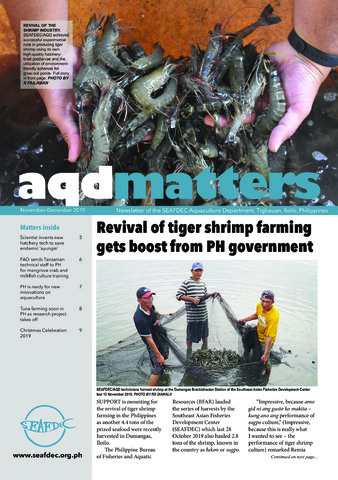
AQD Matters 2019 November - December
(Aquaculture Department, Southeast Asian Fisheries Development Center, 2020-01) -
Behavioural evidence for colour vision determined by conditioning in the purple mud crab Scylla tranquebarica
; Bagarinao, Teodora; ; ; ; (Springer Verlag, 2020-01-04)
Crabs and shrimps (order Decapoda) use colours in various tasks such as foraging and mate choice. Colour vision requires at least two types of photoreceptors with different spectral sensitivities. Previous physiological ...