公開日 のブラウズ: Books and Book Chapters
1-20 / 123
-
Basis for a blue revolution?
(International Development Research Centre, 1979)In 1977, scientists at the Southeast Asian Fisheries Development Centre (SEAFDEC) in the Philippines became the first anywhere to succeed in breeding milkfish (Chanos chanos) in captivity. The advance was made possible by an IDRC grant, approved in 1974, for a three-year project of research in the breeding and rearing of this important source of protein. The initial grant, for $826,000, was renewed for another three years in December 1978 in the amount of $421,100. -
Aeration system at the Tigbauan Research Station of the Southeast Asian Fisheries Development Center, Aquaculture Department (SEAFDEC/AQD)
(ASEAN/UNDP/FAO Regional Small Scale Coastal Fisheries Development Project, 1986)Roots blowers are used to meet aeration requirements at the Tigbauan Research Station (TRS) of the SEAFDEC Aquaculture Department in Iloilo. Air is delivered through a system of PVC pipes and plastic tubing attached to air cocks. Water depth aerated ranges from 0.15 m to 2.1 m. Diffuser aerators and air lift circulators are commonly used. Improvements made since the system was set up in 1974 include burying of PVC lines to prevent rapid deterioration from direct exposure to sunlight and adoption of a closed loop pipe system to achieve even pressure distribution. The aeration system is working well at present, but some improvements and modifications are being worked out. Studies and revisions proposed to further improve the aeration system are: determining rates of oxygen transfer occurring in culture tanks, segregating small tanks from big ones, installation of suitable air filters to eliminate contaminants, and exercise of vigilance in spotting leaks and defective outlets. -
Impact of fishpond management on the mangrove ecosystem in the Philippines
; Bagarinao, Teodora (Natural Resources Management Center and National Mangrove Committee, Ministry of Natural Resources, 1986)
Fishpond development in the Philippines is discussed, examining resulting impacts on the mangrove ecosystems. Socio-economical implications and management measures are also considered.
(Natural Resources Management Center and National Mangrove Committee, Ministry of Natural Resources, 1986)
Fishpond development in the Philippines is discussed, examining resulting impacts on the mangrove ecosystems. Socio-economical implications and management measures are also considered. -
Nutrition and feeds
(Oceanic Institute, 1986)Milkfish culture is gradually shifting from the traditional extensive aquaculture system, where in the fish depends mainly on natural food for growth, to semi=intensive or intensive culture systems in which additional inputs such as formulated diets are used to increase fish production (Chen, 1981). This paper reviews present information on digestive organs and enzymes, food and feeding habits of the age groups, digestibility of feedstuffs, and nutrient requirements for milkfish. -
Fry and fingerling collection and handling
(The Oceanic Institute, 1986)A review is made of methods and practices of collection, storage, transport and acclimation of milkfish (Chanos chanos ) fry and fingerlings in various countries. Factors affecting catch and survival are examined. -
Selection, transport and acclimation of prawn fry
(U.P. Aquaculture Society, 1988)The most important criterion among many used by operators for choosing poostlarvae to stock in ponvds, is the stage of development. THe stages considered suitable for stocking (about PL20) can be identified by examination of anatomical features including the rostal spine number, the length of carapace and sixth abdominal segment. Pigmentation in uropods, size uniformity and activity of post larvae are useful considerations. During Transport,decreasing water temperature to lwer metabolic rate helps ensure the adequacy of oxygen in bags. Upon stocking, acclimation to the temperature and salinity of pond water is very importan. If changes are sudden, regulatory mechanisms may fail, resulting in moralities. -
Prawn grow-out practices in the Philippines
(Aquaculture Department, Southeast Asian Fisheries Development Center, 1988)A review is made of the current situation regarding Penaeus monodon pond culture in the Philippines, examining in particular pond management practices, including site suitability, engineering design, and harvest and post-harvest handling. Problems and prospects in the industry are also discussed, together with some recommendations. -
Maturation, reproduction, and broodstock technology
Primavera, Jurgenne (Aquaculture Department, Southeast Asian Fisheries Development Center, 1988)
Following a review of first maturation in Penaeus monodon , details are given of endocrine, nutritional and environmental methods of induced maturation used in aquaculture. Broodstock constitution and maintenance operations are discussed and a comparison made of maturation tanks, pens and cages. -
Hatchery operations and management
(Aquaculture Department, SEAFDEC, 1988)A review is made of hatchery technology regarding the culture of Penaeus monodon , describing the results of research in the following areas: site selection; hatchery design; larval rearing techniques, particularly in the development of live and artificial feed; water management; and, nursery practices for postlarvae. -
Typical prawn diseases - causes, prevention, and treatment
(U.P. Aquaculture Society, 1988)Diseases of prawn in ponds are caused by microorganisn like viruses, bacteria fungi and protozoans as well as factors such as nutritional deficiency, poor pond conditions and environmental pollutants. Most of these may be controlled by environmental and dietary manipulation. Control of transfers or introduction of new prawn species may also reduce the risk of disease occurrence. Chemotherapy is considered only as alast resort in the control of diseases in prawn ponds. The basic features of prawn diseases with emphasis on causative agents and methods of preventio and treatment are discussed. -
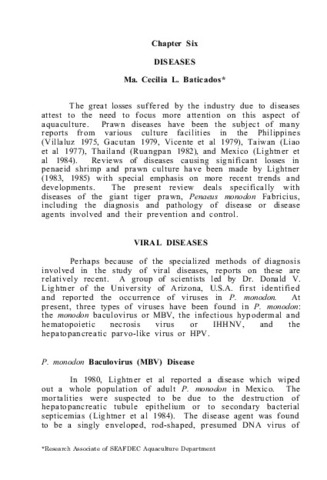
Diseases
(Aquaculture Department, Southeast Asian Fisheries Development Center, 1988)A review is made of diseases of cultured Penaeus monodon , examining the diagnosis and pathology of the disease or disease agents involved and their prevention and control. Both infectious (viral, bacterial, fungal and protozoan) and other (nutritional, toxic and environmental) diseases are considered. -
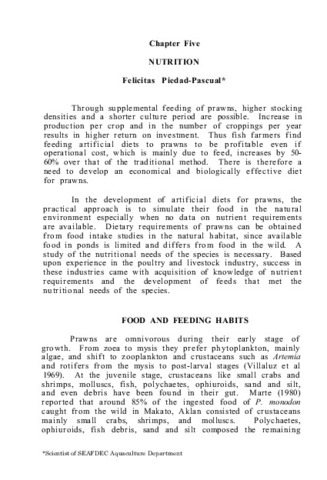
Nutrition
(Aquaculture Department, Southeast Asian Fisheries Development Center, 1988)A discussion is presented on dietary requirements of Penaeus monodon during culture operations. Food and feeding habits are described and nutrient requirements detailed, examining proteins and amino acids, lipids and fatty acids, carbohydrates and vitamins and minerals. The development of diets is discussed briefly and the physical characteristics of pellets outlined. Anti-nutritive factors, feed and feedstuff resources, and feeding practices are also considered. -
Prawn health in aquaculture
(U.P. Aquaculture Society, 1988)Disease management of intensively-cultured prawns requires an understanding of physiology and disease causation. Maladies result from an interaction of the prawn, disease agents and their environment. In intensive culture, the environment becomes increasingly difficult to control. Hence, surveillance for the early signs of disease, potential pathogens and the development of adverse environmental conditions should be integral components of a sound management system. -
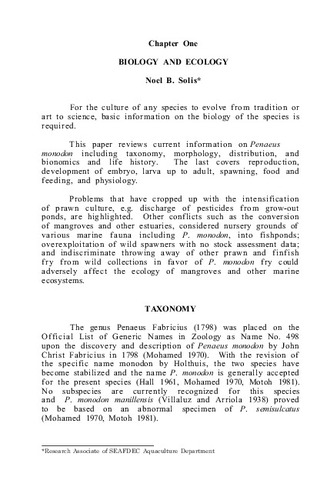
Biology and ecology
(Aquaculture Department, Southeast Asian Fisheries Development Center, 1988)A review is made of current information on Penaeus monodon covering various aspects, including taxonomy, morphology, distribution, bionomics and life history. Reproduction, embryonic development, larval stages, spawning, food and feeding, and physiology are described and applications of such information to culture of the species are considered. -
Fate and effects of water-borne heavy metals in Penaeus monodon
; Quinitio, Emilia T. (European Aquaculture Society, 1991)
Heavy metals impair the aquaculture of shrimps and the quality of shrimp products. Some heavy metals occur in high amounts particularly in the hepatopancreas and the antennal gland (Gibson and Barker, 1979). This study was performed in order to determine whether copper, iron, and lead are accumulated in the hepatopancreas and the antennal gland extensions running along the hepatopancreas. Furthermore, damages of these metals and cadmium to the hepatopancreas cells were investigated. According to its commercial significance the giant tiger prawn, Penaeus monodon, was chosen as test species. -
Series: Developments in Aquaculture and Fisheries Science; 23
Prawn/shrimp culture industry in the Philippines
Primavera, Jurgenne (Elsevier, 1992)
The Philippines is an archipelago of more than 7,100 islands with 17,460 km of coastline, including mangrove forests which covered about 450,000 ha in the 1920s. Coastal aquaculture began a few centuries ago when earthen ponds for the culture of milkfish (Chanos chanos) were first converted from mangrove swamps. For a long time, coastal aquaculture was synonymous with milkfish pond culture; while prawns and shrimps were incidental byproducts resulting from wild fry that entered the ponds during tidal water exchange. In 1943, studies on low density monoculture of the giant tiger prawn (Penaeus monodon) using wild fry were initiated at the Dagat-dagatan Experimental Station of the Bureau of Fisheries in Malabon, Rizal Province. Information on the ecology and early life history of P. monodon generated by the Institute of Fisheries Research Development of the Mindanao State University (MSU-IFRD) in the early 1970s was used in setting up the first experimental prawn hatchery at IFRD. This was followed by the establishment of big-tank and small-tank hatcheries at the Aquaculture Department of the Southeast Asian Fisheries Development Center (SEAFDEC/AQD) in Iloilo Province. An active technology transfer program that included short-term, hands-on training courses on small-scale hatchery starting in 1977, contributed to a dramatic hatchery production of 15 million prawn PL in 1978. Based on the earlier Dagat-dagatan studies, SEAFDEC/AQD started higher-density (semi-intensive) growout pond experiments with P. monodon in the mid-1970's. At that time, farmers started stocking more than 10,000 PL/ha using hatchery fry. Soon after, the first intensive culture trials, using imported Taiwanese technology and feed formulations were undertaken by a Philippine food conglomerate. The availability of both seed and feed, and the attraction of lucrative export market prices contributed to the take-off of the prawn industry. In 1983, when the country's 56 hatcheries produced 85 million PL's, and commercial pellets for intensive culture first appeared in the market, pond production totalled 12,100 MT, a quantum leap from a harvest of only 1,800 MT the previous year. Since then production of PL, adults and exports have steadily increased to a peak of 20,000 MT of exports from 40,000 MT of pond harvests in 1988. The following year the bubble burst. From a high of P200/kg (US$1 =P21) in 1988, farm gate prices plummeted to as low as P70/kg in mid-1989 due to Southeast Asian excess production of black tiger prawn, and to prawn exports from China glutting the Japanese market. This chapter discusses the various components of the Philippine prawn industry with a focus on growout, problems of the farming sector, and problems of the industry as a whole. Lastly, recommendations are offerred for long-term viability. -
Assessment of the seaweeds industry
(Department of Science and Technology and United Nations Development Programme, 1995) -
The rabbitfishes
(Elsevier, 1995) -
Series: Aquaculture economics in developing countries: regional assessments and an annotated bibliography
Aquaculture economics in Asia and the Pacific: A regional assessment
(Rome: FAO, 1997)A broad overview is given of research and information on aquaculture economics in Asia and the Pacific. Following a description of the general state of aquaculture in the region, an examination is made of the available research and information on the various aquaculture systems: inland/freshwater aquaculture; brackishwater /coastal aquaculture; and, marine aquaculture/sea farming. Studies on post-harvest handling, processing, transportation and marketing, and market analysis and development are discussed. Environmental issues and concerns, social equity and women's issues, community-based coastal resources management, technology transfer and macro-economic policies and institutional structures are also analysed. Aquaculture economics research is also assessed, highlighting thrusts, priorities, constraints and needs. -
Tropical shrimp farming and its sustainability
Primavera, Jurgenne (Academic Press, 1998)
In December 1996, the Supreme Court of India ordered the closure of all semi-intensive and intensive shrimp farms within 500 m of the high tide line, banned shrimp farms from all public lands, and required farms that closed down to compensate their workers with 6 years of wages in a move to protect the environment and prevent the dislocation of local people. If the 1988 collapse of farms across Taiwan provided evidence of the environmental unsustainability of modern shrimp aquaculture, the landmark decision of India's highest court focused attention on its socioeconomic costs. This chapter briefly describes shrimp farming, discusses its ecological and socioeconomic impacts and recommends measures to achieve long-term sustainability including improved farm management, integrated coastal zone management, mangrove conservation and rehabiUtation, and regulatory mechanisms and policy instruments.