Mudcrab culture


Date
1999Page views
4,678ASFA keyword

AGROVOC keyword
Taxonomic term

Metadata
Perlihat publikasi penuhShare
Description
Summarizes the available technologies on mudcrab grow-out - monoculture in ponds, polyculture with milkfish in ponds, monoculture in tidal flats with existing mangroves, and mudcrab fattening. Details on stocking density, some management tips and investment costs are given.
Type
BrochureKoleksi
- Brochures and flyers [56]
Related items
Showing items related by title, author, creator and subject.
-
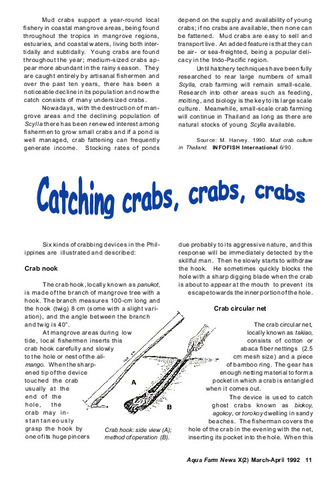
Catching crabs, crabs, crabs
(Aquaculture Department, Southeast Asian Fisheries Development Center, 1992) -
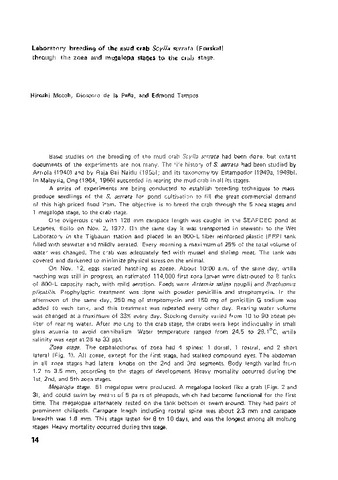
Laboratory breeding of the mud crab Scylla serrata (Forskal) through the zoea and megalopa stages to the crab stage
(Aquaculture Department, Southeast Asian Fisheries Development Center, 1977)A series of experiments is being conducted to establish breeding techniques to mass-produce seedlings of S. serrata for pond cultivation to meet the commercial demand for the crab. The objective is to culture the crab through the 5 zoea stages and 1 megalopa stage to the crab stage. A brief resume of the experiments is presented. Heavy mortality occurred at the 1st, 2nd and 5th zoea stages, and during the megalopa stage. Initial mortality is attributed to unfavourable rearing conditions, and later mortality to cannibalism. -
Monosex culture of the mud crab Scylla serrata at three stocking densities with Gracilaria as crab shelter
(Australian Centre for International Agricultural Research, 1999)The effects of three levels of stocking density (0.5, 1.5 or 3.0/m2) and monosex culture (male or female) on the growth, survival and production of Scylla serrata were investigated. Juvenile crabs were stocked in 150 m2 enclosures in earthen ponds with Gracilaria as shelter and fed a mixed diet of 75% fresh brown mussel flesh and 25% fish bycatch. There was no interaction between stocking density levels and monosex culture (P<0.05) so the data were pooled for each sex or stocking density treatment. Results showed that highest survival was obtained from a stocking density of 0.5/m2 (P<0.05). Crab growth at different stocking densities was not significantly different (P>0.05). Highest return on investment (ROI) and lowest production costs were attained from 0.5/m2. Partial budgeting analysis showed that no net benefit accrued from stocking beyond 1.5/m2. Male crabs attained significantly better (P<0.05) final weight and specific growth rate than female crabs. Length, width, survival and production between male and female crabs were not significantly different (P>0.05). Male and female monoculture gave high net revenue and ROI of more than 100 but male monoculture is more profitable. Overall the results suggest that the culture of male or female mud crabs at 0.5–1.5/m2 with Gracilaria is economically viable.