Communicating the value of international grey literature: The Aquatic Sciences and Fisheries Abstracts experience
View/
Date
2022Author
Page views
812ASFA keyword

AGROVOC keyword
Metadata
Perlihat publikasi penuhShare
Subjects
Information storage and retrieval systems--Grey literature Grey literature--Information services Grey literature Aquatic sciences--Electronic information resources
Description
In collaboration with its partners, ASFA has worked across multiple platforms to raise awareness and understanding of the effective promotion of grey literature to the managers and users of this valuable information source. This chapter presents the outreach activities, promotional materials, and training sessions that have been successfully implemented to achieve this aim, and reflects on both successes and areas where improvements are yet to be made.
Suggested Citation
Vicary, T., Kalentsits, M., Lim, F., & Superio, D. (2022). Communicating the value of international grey literature: The Aquatic Sciences and Fisheries Abstracts experience. In M. Leonard & S. E. Thomas (Eds.), Managing Grey Literature: Technical Services Perspectives (pp. 81–100). Chicago: ALA Editions.
Type
Book chapterISBN
9780838948811Koleksi
- Books and Book Chapters [123]
Related items
Showing items related by title, author, creator and subject.
-
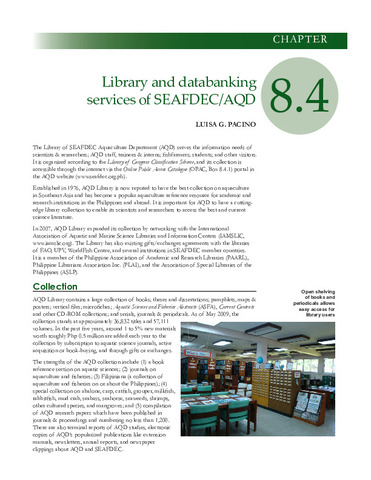
Library and databanking services of SEAFDEC/AQD
(Aquaculture Department, Southeast Asian Fisheries Development Center, 2009)The Library of SEAFDEC Aquaculture Department (AQD) serves the information needs of scientists & researchers; AQD staff, trainees & interns; fish farmers; students; and other visitors. It is organized according to the ... -
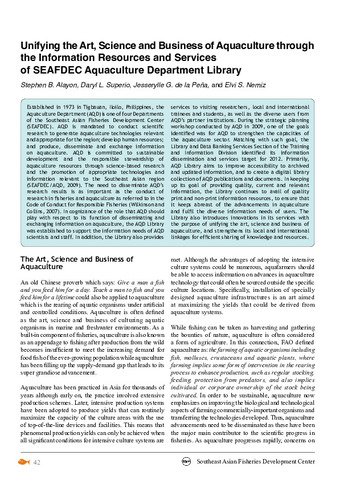
Unifying the art, science and business of aquaculture through the information resources and services of SEAFDEC Aquaculture Department Library
Alayon, Stephen ; Superio, Daryl ; ; Nemiz, Elvi S. (Secretariat, Southeast Asian Fisheries Development Center, 2013)
Established in 1973 in Tigbauan, Iloilo, Philippines, the Aquaculture Department (AQD) is one of four Departments of the Southeast Asian Fisheries Development Center (SEAFDEC). AQD is mandated to conduct scientific research to generate aquaculture technologies relevant and appropriate for the region; develop human resources; and produce, disseminate and exchange information on aquaculture. AQD is committed to sustainable development and the responsible stewardship of aquaculture resources through science-based research and the promotion of appropriate technologies and information relevant to the Southeast Asian region (SEAFDEC/AQD, 2009). The need to disseminate AQD’s research results is as important as the conduct of research in fisheries and aquaculture as referred to in the Code of Conduct for Responsible Fisheries (Wilkinson and Collins, 2007). In cognizance of the role that AQD should play with respect to its function of disseminating and exchanging information on aquaculture, the AQD Library was established to support the information needs of AQD scientists and staff. In addition, the Library also provides services to visiting researchers, local and international trainees and students, as well as the diverse users from AQD’s partner institutions. During the strategic planning workshop conducted by AQD in 2009, one of the goals identified was for AQD to strengthen the capacities of the aquaculture sector. Matching with such goal, the Library and Data Banking Services Section of the Training and Information Division identified its information dissemination and services target for 2012. Primarily, AQD Library aims to improve accessibility to archived and updated information, and to create a digital library collection of AQD publications and documents. In keeping up its goal of providing quality, current and relevant information, the Library continues to avail of quality print and non-print information resources, to ensure that it keeps abreast of the advancements in aquaculture and fulfil the diverse information needs of users. The Library also introduces innovations in its services with the purpose of unifying the art, science and business of aquaculture, and strengthens its local and international linkages for efficient sharing of knowledge and resources.
; Superio, Daryl ; ; Nemiz, Elvi S. (Secretariat, Southeast Asian Fisheries Development Center, 2013)
Established in 1973 in Tigbauan, Iloilo, Philippines, the Aquaculture Department (AQD) is one of four Departments of the Southeast Asian Fisheries Development Center (SEAFDEC). AQD is mandated to conduct scientific research to generate aquaculture technologies relevant and appropriate for the region; develop human resources; and produce, disseminate and exchange information on aquaculture. AQD is committed to sustainable development and the responsible stewardship of aquaculture resources through science-based research and the promotion of appropriate technologies and information relevant to the Southeast Asian region (SEAFDEC/AQD, 2009). The need to disseminate AQD’s research results is as important as the conduct of research in fisheries and aquaculture as referred to in the Code of Conduct for Responsible Fisheries (Wilkinson and Collins, 2007). In cognizance of the role that AQD should play with respect to its function of disseminating and exchanging information on aquaculture, the AQD Library was established to support the information needs of AQD scientists and staff. In addition, the Library also provides services to visiting researchers, local and international trainees and students, as well as the diverse users from AQD’s partner institutions. During the strategic planning workshop conducted by AQD in 2009, one of the goals identified was for AQD to strengthen the capacities of the aquaculture sector. Matching with such goal, the Library and Data Banking Services Section of the Training and Information Division identified its information dissemination and services target for 2012. Primarily, AQD Library aims to improve accessibility to archived and updated information, and to create a digital library collection of AQD publications and documents. In keeping up its goal of providing quality, current and relevant information, the Library continues to avail of quality print and non-print information resources, to ensure that it keeps abreast of the advancements in aquaculture and fulfil the diverse information needs of users. The Library also introduces innovations in its services with the purpose of unifying the art, science and business of aquaculture, and strengthens its local and international linkages for efficient sharing of knowledge and resources. -
Series: GL Conference Series; No. 23
Burning grey: The worldwide influence of a locally published grey literature
Palcullo, Vince Ervin; ; ; Peleña, Ma Cynthia Tolones ; Geromiano, Joy F. ; Superio, Daryl (TextRelease, 2022)
Rice is a major staple crop in the Philippines, which produces a large amount of rice each year. On the other hand, rice production generates biomass waste in the form of rice husks. In consideration of the rice husks’ potential as a biomass energy source and support the development of the rice husk gas stove technology in the Philippines, Engineer Alexis T. Belonio had published a grey literature (GL) entitled “Rice Husk Gas Stove Handbook.” Hence, to fully understand the impact of the technology, a citation analysis was conducted. The works that cited the GL were retrieved from Google Scholar using Harzing’s Publish or Perish software. The complete title of the GL was used as keywords for the search string. Results revealed that the GL was cited by 155 literatures written by 398 authors from 31 countries. Seventy-five (48.4%) of the 155 literatures were cited 797 times. The results showed the wide utilization and the impact of locally-published GL, thereby confirming GL’s value in research and development.