
Grazing periodicity, grazing rate, feeding preference, and gut examination of early juveniles of abalone Haliotis asinina–fed five benthic diatom species
View/
Date
2022-06-03
Page views
648ASFA keyword

AGROVOC keyword
Taxonomic term

Metadata
Perlihat publikasi penuhShare
Abstract
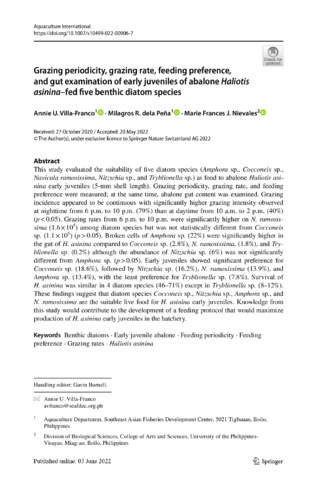
This study evaluated the suitability of five diatom species (Amphora sp., Cocconeis sp., Navicula ramosissima, Nitzschia sp., and Tryblionella sp.) as food to abalone Haliotis asinina early juveniles (5-mm shell length). Grazing periodicity, grazing rate, and feeding preference were measured; at the same time, abalone gut content was examined. Grazing incidence appeared to be continuous with significantly higher grazing intensity observed at nighttime from 6 p.m. to 10 p.m. (79%) than at daytime from 10 a.m. to 2 p.m. (40%) (p < 0.05). Grazing rates from 6 p.m. to 10 p.m. were significantly higher on N. ramosissima (1.6 × 10⁵) among diatom species but was not statistically different from Cocconeis sp. (1.1 × 10⁵) (p > 0.05). Broken cells of Amphora sp. (22%) were significantly higher in the gut of H. asinina compared to Cocconeis sp. (2.8%), N. ramosissima, (1.8%), and Tryblionella sp. (0.2%) although the abundance of Nitzschia sp. (6%) was not significantly different from Amphora sp. (p > 0.05). Early juveniles showed significant preference for Cocconeis sp. (18.6%), followed by Nitzschia sp. (16.2%), N. ramosissima (13.9%), and Amphora sp. (13.4%), with the least preference for Tryblionella sp. (7.8%). Survival of H. asinina was similar in 4 diatom species (46–71%) except in Tryblionella sp. (8–12%). These findings suggest that diatom species Cocconeis sp., Nitzschia sp., Amphora sp., and N. ramosissima are the suitable live food for H. asinina early juveniles. Knowledge from this study would contribute to the development of a feeding protocol that would maximize production of H. asinina early juveniles in the hatchery.
Keywords
Benthic diatoms Early juvenile abalone Feeding periodicity Feeding preference Grazing ratesSuggested Citation
Villa-Franco, A., de la Peña, M. R., & Nievales, M. (2022). Grazing periodicity, grazing rate, feeding preference, and gut examination of early juveniles of abalone Haliotis asinina–fed five benthic diatom species. Aquaculture International , 30(5), 2343-2364. https://doi.org/10.1007/s10499-022-00906-7
Type
ArticleISSN
0967-6120; 1573-143XKoleksi
- Journal Articles [1267]
Related items
Showing items related by title, author, creator and subject.
-
Settlement, growth and survival of donkey's ear abalone Haliotis asinina (Linne) in response to diatom diets and attachment substrate
(Science and Technology Information Institute, 2010)The effect of feeding four diatom diets (Amphora sp., Navicula ramosissima, Amphora sp. + N. ramosissima, and mixed diatoms) and two attachment substrates (PP+CCA: polyvinyl plates with crustose coralline algae; PP-CCA: polyvinyl plates without crustose coralline algae) were determined for seed production of abalone, Haliois asinina. On day 5, significantly higher number of larvae settled on PP+CCA fed with mixed diatoms followed by Amphora sp., N. ramosissima, Amphora sp. + N. ramosissima, and abalone larvae reared on PP-CCA fied with N. ramosissima only. Fewer larvae settled on PP-CCA fed with Amphora + N. ramosissima, Amphora sp. and mixed diatoms. The size of abalone juveniles from PP-CCA was significantly bigger compared with juveniles measured from PP+CCA. However, the number of juveniles harvested from tanks provided with PP+CCA was higher compared with tanks with PP-CCA. This study has shown that crustose coralline algae favored the settlement of H. asinina larvae and inoculation of diatom slurry is necessary to provide sufficient food for the growing larvae. -
Use of thraustochytrid Schizochytrium sp. as source of lipid and fatty acid in a formulated diet for abalone Haliotis asinina (Linnaeus) juveniles
(Springer Verlag, 2016)The effects of using thraustochytrid Schizochytrium sp. as source of lipid and fatty acids in a formulated diet on growth, survival, body composition, and salinity tolerance of juvenile donkey’s ear abalone, Haliotis asinina, were investigated. Treatments consisted of diets either containing a 1:1 ratio of cod liver oil (CLO) and soybean oil (SBO) (Diet 1) or thraustochytrid (Diet 2) as source of lipid and fatty acids at 2 % level. Natural diet Gracilariopsis heteroclada (Diet 3) served as the control. No significant difference in growth was observed in abalone fed Diet 3 (SGR: 5.3 % BW day−1; DISL: 265 μm day−1) and Diet 2 (SGR: 5.2 % BW day−1; DISL: 255 μm day−1). Survival ranged from 78 to 85 % for all treatments and was not significantly different from each other. A 96-h salinity stress test showed highest survival of 84 % in abalone fed Diet 2 compared with those fed diets 1 and 3 (42 %). The high growth rate of abalone fed Diet 2 and high tolerance to low salinity could be attributed to its high DHA content (8.9 %), which resulted to its high DHA/EPA ratio of 10.5 %. These fatty acids play a significant role in abalone nutrition. The fatty acid profile of abalone meat is a reflective of the fatty acid profile of the oil sources in the diet. The present study suggests that the use of Schizochytrium oil in lieu of CLO and SBO can support good growth of abalone which is comparable with abalone fed the natural seaweeds diet. -
Diet development and evaluation for juvenile abalone, Haliotis asinina: animal and plant protein sources
(Elsevier, 2003)Growth studies were conducted to determine the suitability of animal and plant protein sources in the diet of abalone, Haliotis asinina. Juvenile abalone with mean initial weight and shell length of 0.69±0.04 g and 11.4±0.35 mm, respectively, were fed practical diets for 84 days at a temperature range of 28–31 °C. The practical diets contained 27% crude protein from various sources such as fish meal (FM), shrimp meal (SM), defatted soybean meal (DSM), and Spirulina sp. (SP). A formulated diet (diet 1) served as the control. The diets were fed to abalone at 2–5% body weight once daily at 1600 h. Weight gain (WG), increase in shell length (SL), specific growth rate (SGR), protein efficiency ratio (PER) and feed conversion ratio (FCR) were evaluated. Highest weight gain (WG: 454%) was attained with abalone fed diet 2 with protein sources coming from a combination of FM, SM, and DSM. This value was, however, not significantly different (P<0.05) from those fed diets 4 and 1 (Control diet) with protein sources coming from FM, SM, SP and FM, DSM, SM, respectively. Abalone fed diet 3, which used both plant protein sources, DSM and SP, showed significantly lower WG (327%). Survival was generally high ranging from 85% to 100% for all treatments. The SGR showed the same trend as the percent weight gain. The FCR and PER obtained, however, were not significantly different for all treatments. The amino acid profile of diets 1, 2, and 4 simulated that of the abalone protein, which could have been a contributing factor to the higher growth rate of abalone fed these diets. Diet 3, which contained only plant protein sources, showed relatively lower methionine values compared with the abalone muscle tissue. Although abalone are considered herbivorous animals, results of this study indicate that a combination of dietary plant and animal protein sources was necessary to attain the best growth rate.


