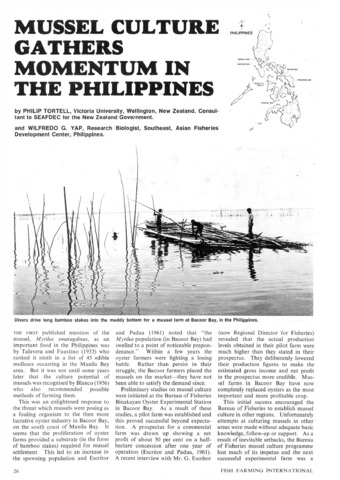
Mussel culture gathers momentum in the Philippines
閲覧/開く
日付
1976-12Page views
1,212ASFA keyword

AGROVOC keyword

Geographic names

Metadata
アイテムの詳細レコードを表示するShare
抄録
Mussels (Mytilus smaragdinus) were posing a threat as fouling organisms in Bacoor Bay, on the south coast of Manila Bay but when attempts were made to market the mussel so much success was achieved that attempts to culture it were begun. A pilot farm was established; mussels now exceed oysters as the most important an profitable crop, 4 mussel projects have now been established, at Bacoor, Tinagong Dagat in northeast Panay, Jiabon in western Samar, and Panguil Bay in northwest Minanao. Projects of the Southeast Asian Fisheries Development Center (SEAFDEC) are also noted. The methods used in mussel culture are described; at Bacoor, Bamboo stakes are used as substrate. Cost and production estimates for a 1 ha farm using the bamboo stake substrate are given.
Keywords
SEAFDEC/AQD BFAR Asian green musselSubjects
Philippines. Bureau of Fisheries and Aquatic Resources Southeast Asian Fisheries Development Center. Aquaculture Department
Suggested Citation
Tortell, P., & Yap, W. G. (1976). Mussel culture gathers momentum in the Philippines. Fish Farming International , 3(4), 26-28. http://hdl.handle.net/10862/6434
Type
magazineArticleISSN
0262-0820Collections
- Magazine Articles [20]
Related items
Showing items related by title, author, creator and subject.
-
Series: Aquaculture extension manual; No. 8
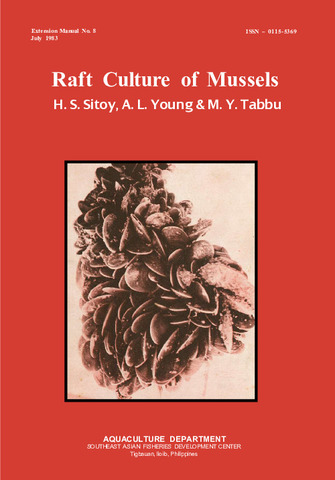
Raft culture of mussels
(Aquaculture Department, Southeast Asian Fisheries Development Center, 1983) -
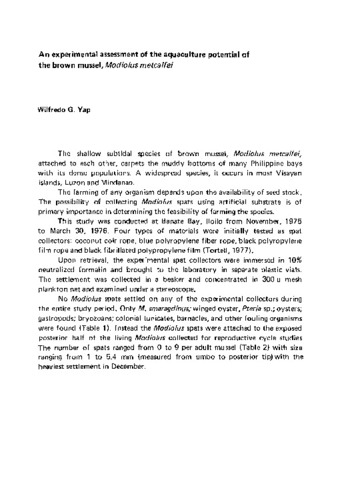
An experimental assessment of the aquaculture potential of the brown mussel, Modiolus metcalfei
(Aquaculture Department, Southeast Asian Fisheries Development Center, 1978)A study was conducted at Banate Bay, Iloilo, from November 1975 to March 1976. Trials were conducted using spat collectors of four types, but no Modiolus metcalfei spat settled on any of the experimental collectors during the entire study period. Instead they attached to the exposed posterior half of the living Modiolus collected for reproductive cycle studies. The aquaculture potential of the brown mussel is considered to be low. Improvement of its production potential should be approached along the line of resource management rather than aquaculture. This management should be aimed at two objectives: (1) maintenance of enough adults on settlement surfaces, and (2) provision of space to allow new recruitments to grow. A possible solution, therefore, is controlled harvesting or thinning after the peak in the settlement season. In this manner, the chances of the mussel bed recovering year after year may be enhanced. -
Settlement preference of the brown mussel, Modiolus metcalfei, Hanley and its implication on the aquaculture potential of the species
(Fisheries Research Society of the Philippines, 1978)A study on the settlement preference of M. metcalfei was made in Banate Bay, Iloilo, using four types of materials as spat collectors. During the six-month study period, not a single Modiolus spat was found in any of the materials tested. Spats were found attached to the posterior half of living adult mussels collected for related studies. Tests with empty Modiolus shells and bamboo fish corrals as spat collectors showed negative results indicating that settlement response in the brown mussel is elicited by the presence of living animals.