Reproduction, early development, and larval rearing of the climbing perch Anabas testudineus (Teleostei: Anabantidae) in captivity

View/
Date
2023-06Page views
1,637ASFA keyword

AGROVOC keyword
Taxonomic term

Metadata
Show full item recordShare
Abstract
Induced spawning, early development, and larval rearing of the climbing perch Anabas testudineus were examined under captive conditions. Five female climbing perch [125.33 ± 3.27 mm standard length (SL); 70.67 ± 5.59 g body weight (BW)] were each paired with apparently mature males (108.50 ± 3.97 mm SL; 39.27 ± 4.70 g BW) and induced to spawn with 5,000 IU human chorionic gonadotropin (hCG) + 0.5 mL Ovaprim/kg BW. All hCG + Ovaprim-injected fish spawned 9 – 11 h after hormone administration but saline-injected fish (control group) failed to spawn. Mean egg production per female, fertilization and hatching rates, and larval production per female were 7,667 ± 1,313, 98.11 ± 1.63%, 61.01 ± 19.92%, and 4,435 ± 1,041, respectively. Fertilized eggs (1.52 – 1.96 mm in diameter) were almost spherical, non-adhesive, transparent, and buoyant due to a large, single oil globule (515 ± 33 µm in diameter). First cleavage appeared 30 min post-fertilization (MPF) and egg development lasted for 20 – 24 h post-fertilization (HPF) (29°C). Newly hatched climbing perch larvae [1.73 ± 0.08 mm in total length (TL)] with yolk volume (YV) and oil globule volume (OGV) of 0.545 ± 0.104 mm3 and 0.072 ± 0.013 mm3, respectively had no pigmented eyes or functional mouth parts and digestive tract, and immobile with the yolk sac pointed upward. Eyes became pigmented and both mouth and anus opened in 1 d old larvae (2.09 ± 0.04 mm TL) in preparation for exogenous feeding. Except for body depth (BD) and pre-anal length (PAL), a general increase in TL (1.73 – 3.72 mm), eye diameter (ED) (0.164 – 0.378 mm), head length (HL) (0.205 – 0.923 mm), and mouth gape (MG) size (0.308 – 0.552 mm) was observed, coinciding with yolk resorption in 7 d post-hatched larvae. Climbing perch larvae were reared at four stocking densities (25, 50, 75, 100 larvae L-1) and fed solely on live food (Brachionus rotundiformis from days 2 to 12 and Artemia nauplii from days 13 to 40) or co-fed live food and microparticulate diet (MPD) (Artemia nauplii from days 2 to 15 and Artemia + MPD from days 16 to 40). Mean survival rates at lower densities (25 – 50 larvae L-1) were significantly higher than those reared at 75 and 100 larvae L-1 (P < 0.05). Furthermore, climbing perch larvae co-fed Artemia nauplii and MPD showed better survival (28.67 – 81.00%) than those fed solely on live food (24.88 – 64.00%). However, at the end of the 40 d trial period, growth parameters did not vary significantly among densities (P > 0.05), except for the condition factor in larvae co-fed Artemia nauplii and MPD. Taken together, results demonstrate the effectiveness of hCG + Ovaprim for captive breeding and observations on the early development of climbing perch, and the feasibility of rearing the larvae at 25 – 50 L-1 on a combination of Artemia nauplii and MPD under laboratory conditions.
Suggested Citation
Aya, F., Gutierrez, R. C., & Garcia, L. M. (2023). Reproduction, early development, and larval rearing of the climbing perch Anabas testudineus (Teleostei: Anabantidae) in captivity. Philippine Agricultural Scientist , 106(2), 197-207. http://hdl.handle.net/10862/6449
Type
ArticleISSN
0031-7454Collections
- Journal Articles [1267]
Related items
Showing items related by title, author, creator and subject.
-
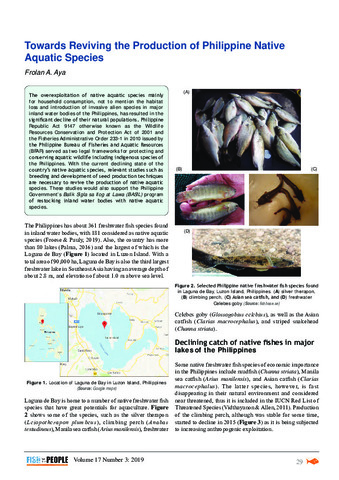
Towards reviving the production of Philippine native aquatic species
Aya, Frolan (Secretariat, Southeast Asian Fisheries Development Center, 2019)
The overexploitation of native aquatic species mainly for household consumption, not to mention the habitat loss and introduction of invasive alien species in major inland water bodies of the Philippines, has resulted in the significant decline of their natural populations. Philippine Republic Act 9147 otherwise known as the Wildlife Resources Conservation and Protection Act of 2001 and the Fisheries Administrative Order 233-1 in 2010 issued by the Philippine Bureau of Fisheries and Aquatic Resources (BFAR) served as two legal frameworks for protecting and conserving aquatic wildlife including indigenous species of the Philippines. With the current declining state of the country’s native aquatic species, relevant studies such as breeding and development of seed production techniques are necessary to revive the production of native aquatic species. These studies would also support the Philippine Government’s Balik Sigla sa Ilog at Lawa (BASIL) program of restocking inland water bodies with native aquatic species.
(Secretariat, Southeast Asian Fisheries Development Center, 2019)
The overexploitation of native aquatic species mainly for household consumption, not to mention the habitat loss and introduction of invasive alien species in major inland water bodies of the Philippines, has resulted in the significant decline of their natural populations. Philippine Republic Act 9147 otherwise known as the Wildlife Resources Conservation and Protection Act of 2001 and the Fisheries Administrative Order 233-1 in 2010 issued by the Philippine Bureau of Fisheries and Aquatic Resources (BFAR) served as two legal frameworks for protecting and conserving aquatic wildlife including indigenous species of the Philippines. With the current declining state of the country’s native aquatic species, relevant studies such as breeding and development of seed production techniques are necessary to revive the production of native aquatic species. These studies would also support the Philippine Government’s Balik Sigla sa Ilog at Lawa (BASIL) program of restocking inland water bodies with native aquatic species. -
Seasonal gonad cycle of the climbing perch Anabas testudineus (Teleostei: Anabantidae) in a tropical wetland
; Aya, Frolan; ; Garcia, Luis Maria (Springer Verlag, 2015)
Seasonal reproduction of the climbing perch Anabas testudineus in the Candaba wetland, Philippines, is described. Monthly specimens were collected, gonads and viscera excised, and the gonads histologically examined. Low mean female gonadosomatic index [GSI (%)] from September to February (0.3–2.1 %) increased in March (8.7 %), peaked in May (10.9 %), and declined in June (3.3 %), but increased again in July and August (8.3–5.5 %). Male GSIs (at least 1 %) were low from September until May, increased in June (2.5 %), and then declined thereafter. All the six oocyte and four spermatogenic cell development stages were observed in the gonads throughout the annual cycle. The ovary was dominated by primary growth oocytes (chromatin nucleolus, perinucleolus) from August to February (77–90 %), but yolky oocytes (previtellogenic, vitellogenic) comprised 15 % to 28 % of the ovary from March to July. Mature oocytes were present for most of the year, comprising 40 % of the total oocytes in March-April, peaking in May (50 %), but declining to 30 % in June–July. Spermatozoa consistently dominated the testis throughout the annual cycle, particularly in November and March (58 %). Food intake in both sexes was generally low during the dry season (December–April) when gonad activity was also low, but started to increase at the onset of the wet season (May–November) when gonad activity began to peak. These results demonstrate that the climbing perch gonads exhibit asynchronous development, allowing a protracted breeding season with intense gonad activity timed at the onset of the wet season, concurrent with increasing food intake through the rest of the season. -
Fatty acid composition of Nile tilapia Orechromis niloticus muscles: A comparative study with commercially important tropical freshwater fish in Philippines
; ; ; ; El-Haroun, Ehab (AquaFish Collaborative Research Support Program, 2008)
Six tropical freshwater species were collected from Philippines in order to study the characteristic of polyunsaturated fatty acids distributions. 16:0 and 18: l n-9 were the predominant saturated fatty acid (SFA) and monounsaturated fatty acid (MUFA) in both neutral lipids (NL) and polar lipids (PL). There was an absence or very low values of n3 highly unsaturated fatty acid (HUFA) in NL of all species. However these fatty acids found in PL of all species studied with higher levels. The high proportions of docosahexaenoic acid (DHA) in PL were found with catfish Arius (20.71%), ayungin (17.64%), and snakehead (17.09%) whereas anabas (4.21%) gave lower DHA content. In PL, arachidonic acids (ARA) was found in high proportions, and also is superior to eicosapentaenoic acid (EPA) (ranged from 3.35 to 10.67% and from 0.42 to 4.74%, respectively). Tilapia lipid appears to be intermediate in nutritional quality between all species studied; the proportions of DHA, EPA and ARA in PL were 16.27%, 4.52% and 9.36%, respectively. According to the n-3/n-6 ratio in both fractions, only ayungin is in the range typical of freshwater fish. Our results indicate that the wild tropical freshwater fish studied here are not good sources of n-3 HUFA fatty acids. Therefore, aquatic nutritionists and farmers should combine their efforts in order to manipulate the nutritional quality of these species to enhance their n-3 HUFAs concentrations especially when these species are reared in captivity system. The wash-out strategy may provide an adequate description of the changes in the fillet lipid fatty acid profiles of fatty fish.