Fresh chilled and fresh frozen shrimps and prawns – Product standard

Download URL
www.bafs.da.gov.phDate
2023Page views
1,669ASFA keyword

AGROVOC keyword
Taxonomic term

Geographic names

Metadata
Perlihat publikasi penuhShare
Description
This Standard applies to fresh chilled and fresh frozen raw shrimps and prawns, which may be whole, deheaded, peeled, and peeled and deveined. This document applies to shrimps and prawns of the Penaeidae, Pandalidae, Crangonidae, Palaemonidae families but not limited to the species listed in Annex A (Commercially available shrimps and prawns species in the Philippines).
Suggested Citation
Bureau of Agriculture and Fisheries Standards. (2023). Fresh chilled and fresh frozen shrimps and prawns – Product standard (PNS/BAFS 70: 2023). https://www.bafs.da.gov.ph
Type
standardISBN
9786214554928Series
PNS/BAFS 70: 2023Koleksi
Related items
Showing items related by title, author, creator and subject.
-
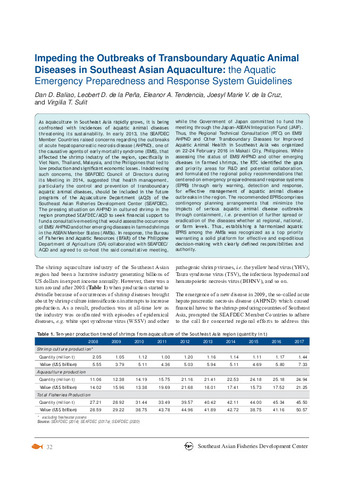
Impeding the outbreaks of transboundary aquatic animal diseases in Southeast Asian aquaculture: The aquatic emergency preparedness and response system guidelines
; ; Tendencia, Eleonor ; ; (Secretariat, Southeast Asian Fisheries Development Center, 2020)
As aquaculture in Southeast Asia rapidly grows, it is being confronted with incidences of aquatic animal diseases threatening its sustainability. In early 2013, the SEAFDEC Member Countries raised concerns regarding the outbreaks of acute hepatopancreatic necrosis disease (AHPND), one of the causative agents of early mortality syndrome (EMS), that affected the shrimp industry of the region, specifically in Viet Nam, Thailand, Malaysia, and the Philippines that led to low production and significant economic losses. In addressing such concerns, the SEAFDEC Council of Directors during its Meeting in 2014, suggested that health management, particularly the control and prevention of transboundary aquatic animal diseases, should be included in the future programs of the Aquaculture Department (AQD) of the Southeast Asian Fisheries Development Center (SEAFDEC). The pressing situation on AHPND in cultured shrimp in the region prompted SEAFDEC/AQD to seek financial support to fund a consultative meeting that would assess the occurrence of EMS/AHPND and other emerging diseases in farmed shrimps in the ASEAN Member States (AMSs). In response, the Bureau of Fisheries and Aquatic Resources (BFAR) of the Philippine Department of Agriculture (DA) collaborated with SEAFDEC/AQD and agreed to co-host the said consultative meeting, while the Government of Japan committed to fund the meeting through the Japan-ASEAN Integration Fund (JAIF). Thus, the Regional Technical Consultation (RTC) on EMS/AHPND and Other Transboundary Diseases for Improved Aquatic Animal Health in Southeast Asia was organized on 22-24 February 2016 in Makati City, Philippines. While assessing the status of EMS/AHPND and other emerging diseases in farmed shrimps, the RTC identified the gaps and priority areas for R&D and potential collaboration, and formulated the regional policy recommendations that centered on emergency preparedness and response systems (EPRS) through early warning, detection and response, for effective management of aquatic animal disease outbreaks in the region. The recommended EPRS comprises contingency planning arrangements that minimize the impacts of serious aquatic animal disease outbreaks through containment, i.e. prevention of further spread or eradication of the diseases whether at regional, national, or farm levels. Thus, establishing a harmonized aquatic EPRS among the AMSs was recognized as a top priority warranting a solid platform for effective and expeditious decision-making with clearly defined responsibilities and authority.
; ; (Secretariat, Southeast Asian Fisheries Development Center, 2020)
As aquaculture in Southeast Asia rapidly grows, it is being confronted with incidences of aquatic animal diseases threatening its sustainability. In early 2013, the SEAFDEC Member Countries raised concerns regarding the outbreaks of acute hepatopancreatic necrosis disease (AHPND), one of the causative agents of early mortality syndrome (EMS), that affected the shrimp industry of the region, specifically in Viet Nam, Thailand, Malaysia, and the Philippines that led to low production and significant economic losses. In addressing such concerns, the SEAFDEC Council of Directors during its Meeting in 2014, suggested that health management, particularly the control and prevention of transboundary aquatic animal diseases, should be included in the future programs of the Aquaculture Department (AQD) of the Southeast Asian Fisheries Development Center (SEAFDEC). The pressing situation on AHPND in cultured shrimp in the region prompted SEAFDEC/AQD to seek financial support to fund a consultative meeting that would assess the occurrence of EMS/AHPND and other emerging diseases in farmed shrimps in the ASEAN Member States (AMSs). In response, the Bureau of Fisheries and Aquatic Resources (BFAR) of the Philippine Department of Agriculture (DA) collaborated with SEAFDEC/AQD and agreed to co-host the said consultative meeting, while the Government of Japan committed to fund the meeting through the Japan-ASEAN Integration Fund (JAIF). Thus, the Regional Technical Consultation (RTC) on EMS/AHPND and Other Transboundary Diseases for Improved Aquatic Animal Health in Southeast Asia was organized on 22-24 February 2016 in Makati City, Philippines. While assessing the status of EMS/AHPND and other emerging diseases in farmed shrimps, the RTC identified the gaps and priority areas for R&D and potential collaboration, and formulated the regional policy recommendations that centered on emergency preparedness and response systems (EPRS) through early warning, detection and response, for effective management of aquatic animal disease outbreaks in the region. The recommended EPRS comprises contingency planning arrangements that minimize the impacts of serious aquatic animal disease outbreaks through containment, i.e. prevention of further spread or eradication of the diseases whether at regional, national, or farm levels. Thus, establishing a harmonized aquatic EPRS among the AMSs was recognized as a top priority warranting a solid platform for effective and expeditious decision-making with clearly defined responsibilities and authority. -
An overview of the nutrition, feed and feeding techniques of prawn penaeid/shrimps
(Philippine Council for Aquatic and Marine Research and Development, 1989)This paper echoes what transpired during the first International Conference of Penaeid Prawns/Shrimps held in Iloilo City in December 4-7, 1984, particularly on the Nutrition nd Feed Development. Around 25 papers were presented during the conference. The nutrient requirements of P. japonicus and to some extent, P. monodon have been studied quite extensively compared to other penaeid species. Requirements for protein, carbohydrates fats, amino acids and essential fatty acids for juveniles and larvae have been defined compared to those of the broodstock. Optimum protein levels for prawn juveniles vary from 28-38% for P. kerathurus, 40-46% for P. monodon, 43% for P. indicus and 50-54% for P. japonicus. Dissacharides like sucrose and trehalose have been found to be good source of carbohydrates at 20-25% in the diet. Crustacean diets require around 0.5% cholesterol. There are few studies on vitamine and mineral requirements. There are artificial diets for juveniles and microencapsulated diets that can completely replace live organisms as larval feed. Microencapsulated diets have been field-tested for P. vannamei, P. stylirostris, P. monodon, P. indicus and P. merguiensis in Ecuador, Taiwan, Malaysia, Thailand and the Philippines. When a commercial diet for the broodstock becomes available ther will be an artificial diet for athe life cycle of tha prawn. -
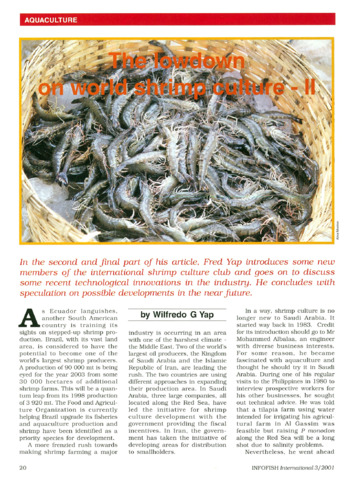
The lowdown on world shrimp culture - II
(INFOFISH, 2001)This paper introduces some new members of the international shrimp culture club and goes on to discuss some recent technological innovations in the industry, particularly the polyculture of tilapia (mainly Oreochromis mossambicus) and shrimp.