SEAFDEC/AQD Institutional Repository: Recent submissions
Now showing items 301-320 of 4221
-
Identification of a chromosomally-encoded sucrose operon-like gene cluster in Vibrio parahaemolyticus strain PH05 isolated from Negros Island, Philippines
De Mesa, Czarina Anne ; Mendoza, Remilyn ; Amar, Edgar ; ; Saloma, Cynthia (Cold Spring Harbor Laboratory, 2021-02-27)
The ability of bacteria to metabolize a wide variety of carbon sources has been known to aid in their ability for efficient colonization. Vibrio parahaemolyticus, a known aquatic pathogen has been reported to have the ability to metabolize a number of carbohydrates including D-glucose, D-galactose, L-arabinose, D-mannose, and D-ribose to name a few. Classical isolation of V. parahaemolyticus from other members of the family Vibrionaceae relies on its carbon utilization pattern. Conventionally, V. parahaemolyticus lacks the ability to utilize sucrose and this has been the basis for its isolation using the Thiosulfate-citrate-bile salts-sucrose (TCBS) agar. Reports of V. parahaemolyticus having the ability to utilize sucrose have been presented yet there is paucity of information and detailed study on this phenotype. In this study, we report the V. parahaemolyticus strain PH05 that has the ability to metabolize sucrose. Phenotypic and genotypic characterization of this V. parahaemolyticus strain isolated from Negros Island, Philippines, revealed that V. parahaemolyticus strain PH05 is atypical appearing yellow on TCBS agar plates. It is capable of utilizing sucrose, unlike the majority of V. parahaemolyticus isolates. Genome analyses of this strain revealed the presence of a chromosomally encoded sucrose operon-like gene cluster encoded in chromosome 2 with the following sucrose-utilization associated genes: scrY, ccpA, treP, scrK, and scrB genes coding for sucrose porin, catabolite control protein A, PTS System sucrose-specific EIIBC component, fructokinase, and sucrose-6-phosphate hydrolase. The mode of transmission of these genes to V. parahaemolyticus strain PH05 is still unknown. However, the presence of insertion sequences (IS) and phage elements in the same chromosome suggests horizontal gene transfer events. Taken together, our results point to the possibility that acquired sucrose utilization genes may contribute to the fitness of V. parahaemolyticus strain PH05 in the environment.
; Mendoza, Remilyn ; Amar, Edgar ; ; Saloma, Cynthia (Cold Spring Harbor Laboratory, 2021-02-27)
The ability of bacteria to metabolize a wide variety of carbon sources has been known to aid in their ability for efficient colonization. Vibrio parahaemolyticus, a known aquatic pathogen has been reported to have the ability to metabolize a number of carbohydrates including D-glucose, D-galactose, L-arabinose, D-mannose, and D-ribose to name a few. Classical isolation of V. parahaemolyticus from other members of the family Vibrionaceae relies on its carbon utilization pattern. Conventionally, V. parahaemolyticus lacks the ability to utilize sucrose and this has been the basis for its isolation using the Thiosulfate-citrate-bile salts-sucrose (TCBS) agar. Reports of V. parahaemolyticus having the ability to utilize sucrose have been presented yet there is paucity of information and detailed study on this phenotype. In this study, we report the V. parahaemolyticus strain PH05 that has the ability to metabolize sucrose. Phenotypic and genotypic characterization of this V. parahaemolyticus strain isolated from Negros Island, Philippines, revealed that V. parahaemolyticus strain PH05 is atypical appearing yellow on TCBS agar plates. It is capable of utilizing sucrose, unlike the majority of V. parahaemolyticus isolates. Genome analyses of this strain revealed the presence of a chromosomally encoded sucrose operon-like gene cluster encoded in chromosome 2 with the following sucrose-utilization associated genes: scrY, ccpA, treP, scrK, and scrB genes coding for sucrose porin, catabolite control protein A, PTS System sucrose-specific EIIBC component, fructokinase, and sucrose-6-phosphate hydrolase. The mode of transmission of these genes to V. parahaemolyticus strain PH05 is still unknown. However, the presence of insertion sequences (IS) and phage elements in the same chromosome suggests horizontal gene transfer events. Taken together, our results point to the possibility that acquired sucrose utilization genes may contribute to the fitness of V. parahaemolyticus strain PH05 in the environment. -
Development of brackish water aquaculture emphasizing sustainability in Western Visayas, central Philippines
(International Institute of Fisheries Economics & Trade, 2004)Western Visayas is located in central Philippines and consists of Guimaras Island, Panay Island and Negros Occidental. This region is advanced in aquaculture. Interviews were conducted at Ivisan and Carles municipalities, located at the northeastern part of Panay Island, in November 2003 to investigate the state of aquaculture start-ups by local people. Many small-scale aquafarmers had started in the business after 1997. Most (93%) respondents currently engaged in aquaculture wanted to continue in their business. In this paper, marine fishcage culture, marine fishpen culture, oyster culture, mussel culture and seaweed culture are collectively termed "small-scale aquaculture". Brackish water aquaculture in Western Visayas originally started by digging ponds in mangrove forests, but the growth in the number of ponds resulted in the degradation of water quality and outbreaks of prawn disease. Today, tiger prawn culture has declined and milkfish culture remains stagnant because of low price induced by a glut of milkfish. Both municipalities, however, are active in planting mangrove trees with the help of the central government, and coastal fishermen aggressively engage in small-scale aquaculture. The investigation revealed that both pond culture and small-scale aquaculture are leading towards practicing sustainable production systems and for some reasons it was noted that their production was lower than before. -
Developing technologies for giant grouper (Epinephelus lanceolatus) aquaculture in Vietnam, the Philippines and Australia
Nocillado, Josephine; Elizur, Abigail ; Palma, Peter ; ; ; ; ; ; Anderson, Kelli ; ; Knibb, Wayne ; ; ; (Australian Centre for International Agricultural Research, 2021-06-29)
This project established a sustainable aquaculture industry for giant grouper in Vietnam and the Philippines through the development of captive breeding and larval-rearing techniques. Captive breeding innovations and larval-rearing techniques, developed through a collaborative Fisheries project, are sustaining the aquaculture industry for giant grouper in Vietnam and the Philippines. Groupers are vital to the live reef food-fish trade in South-East Asia, and the giant grouper is a high-value, fast-growing species with significant aquaculture potential. Establishing a sustainable giant grouper aquaculture industry is a high priority for the region, but research is hampered by the high level of investment required to hold and maintain giant grouper broodstock. Lack of commercial production is also due to limited knowledge about the giant grouper’s maturation and spawning behaviour, and low larval survival. -
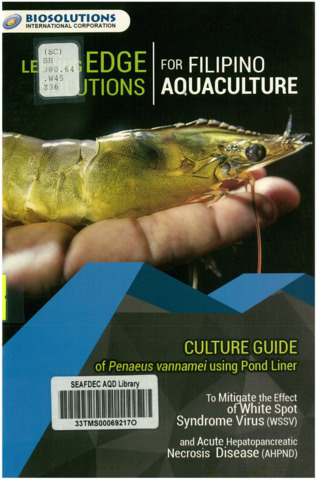
Culture guide of Penaeus vannamei using pond liner to mitigate the effects of white spot syndrome virus (WSSV) and acute hepatopancreatic necrosis disease (AHPND)
(Biosolutions International Corporation, 2016)This manual aims to share the methodologies leading to the success of shrimp farming operations. It is a work in progress to be regularly updated as new techniques are developed to deal with future challenges and diseases that will affect the shrimp industry. -
Grazing periodicity, grazing rate, feeding preference, and gut examination of early juveniles of abalone Haliotis asinina–fed five benthic diatom species
Villa-Franco, Annie; de la Peña, Milagros R. ; Nievales, Marie (Springer, 2022-06-03)
This study evaluated the suitability of five diatom species (Amphora sp., Cocconeis sp., Navicula ramosissima, Nitzschia sp., and Tryblionella sp.) as food to abalone Haliotis asinina early juveniles (5-mm shell length). Grazing periodicity, grazing rate, and feeding preference were measured; at the same time, abalone gut content was examined. Grazing incidence appeared to be continuous with significantly higher grazing intensity observed at nighttime from 6 p.m. to 10 p.m. (79%) than at daytime from 10 a.m. to 2 p.m. (40%) (p < 0.05). Grazing rates from 6 p.m. to 10 p.m. were significantly higher on N. ramosissima (1.6 × 10⁵) among diatom species but was not statistically different from Cocconeis sp. (1.1 × 10⁵) (p > 0.05). Broken cells of Amphora sp. (22%) were significantly higher in the gut of H. asinina compared to Cocconeis sp. (2.8%), N. ramosissima, (1.8%), and Tryblionella sp. (0.2%) although the abundance of Nitzschia sp. (6%) was not significantly different from Amphora sp. (p > 0.05). Early juveniles showed significant preference for Cocconeis sp. (18.6%), followed by Nitzschia sp. (16.2%), N. ramosissima (13.9%), and Amphora sp. (13.4%), with the least preference for Tryblionella sp. (7.8%). Survival of H. asinina was similar in 4 diatom species (46–71%) except in Tryblionella sp. (8–12%). These findings suggest that diatom species Cocconeis sp., Nitzschia sp., Amphora sp., and N. ramosissima are the suitable live food for H. asinina early juveniles. Knowledge from this study would contribute to the development of a feeding protocol that would maximize production of H. asinina early juveniles in the hatchery. -
Common edible molluscs of the Philippines: A field guide
(Aquaculture Department, Southeast Asian Fisheries Development Center, 1981)The Molluscs comprise the largest phylum of marine invertebrates, with over 80,000 species described (Barnes, 1974). They are soft-bodied animals, which, in most cases, secrete a protective outer "shell." Two major classes ... -
Series: ACIAR Technical Report; No. 97
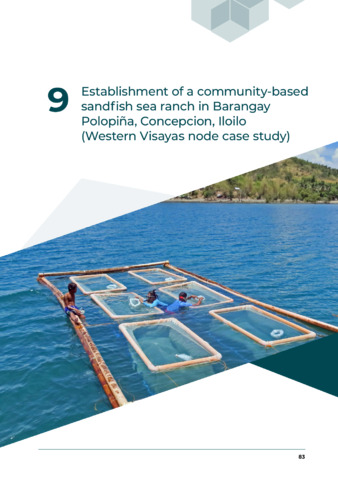
Establishment of a community-based sandfish sea ranch in Barangay Polopiña, Concepcion, Iloilo (Western Visayas node case study)
Altamirano, Jon; Suyo, Jee Grace ; Baylon, Roselyn ; (Australian Centre for International Agricultural Research, 2022)
-
Seasonal growth, organ indices and food consumption of the Japanese scallop Patinopecten yessoensis (Jay, 1857) in relation to food availability in Tokoro seabed, Okhotsk Sea, North Japan
Aya, Frolan; Kudo, Isao (The Plankton Society of Japan (The Japanese Association of Benthology), 2022-05-30)
The coastal waters off Tokoro, Okhotsk Sea have been characterized by a substantial decrease in primary production from spring to summer season which will have repercussions on the maintenance of the Japanese scallop Patinopecten yessoensis (Jay, 1857) culture. This study examined the seasonal changes in scallop growth, condition and organ indices in relation to environmental conditions, and compared the sinking particulate organic carbon (POC) flux as an estimate of food availability to scallop food requirements. Monthly specimens were obtained in July 2005, and from May 2006 to December 2008 off Tokoro, Okhotsk Sea. Growth parameters derived from the modified von Bertalanffy growth function of 885 scallop individuals were the mean asymptotic shell height H∞=126.51 mm, Brody growth coefficient K=0.081 year−1, and t0=6.19 year. Condition (CI) and gonadosomatic indices (GSI) increased in April and May, decreased from June to September, but increased again from October until May. The adductor muscle index (AMI) increased from June to October, but declined from November until May when CI and GSI began to increase. Primary production (PP) and chlorophyll a biomass decreased from spring (25.75–29.74 µg C L−1 h−1 and 1.74–5.37 µg L−1) to autumn (0.90–10.83 µg C L−1 h−1 and 0.29–0.75 µg L−1) concurrent with decreasing CI and GSI, but no deleterious effect on AMI was evident during these periods. The sinking POC flux (25–68 mg C m−2 day−1) was low during summer when gonad activity was also low, but started to increase in autumn when gonad activity started to peak. Although a deficit in food availability (lower sinking POC fluxes than scallop food consumption) was observed during summer, the potential advection of organic matter from offshore to nearshore region may have provided additional source of food to bottom-cultured scallops, contributing in part to the increase in shell growth and somatic tissues. -
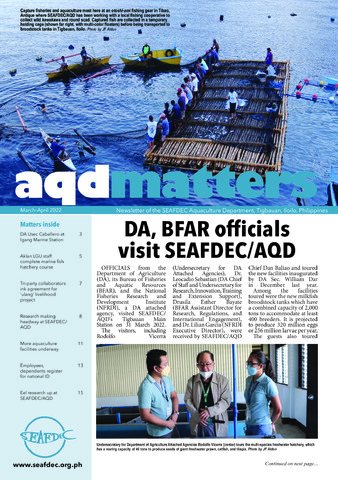
AQD Matters 2022 March - April
(Aquaculture Department, Southeast Asian Fisheries Development Center, 2022-05)In this issue: 1) DA Usec Caballero at Igang Marine Station; 2) Aklan LGU staff complete marine fish hatchery course; 3) Tri-party collaborators ink agreement for 'ulang' livelihood project; 4) Research making headway at ... -
Comparison of commercial Spirulina, live Navicula sp. and Chaetoceros calcitrans concentrate as settlement cues for sandfish, Holothuria scabra
Sibonga, Rema; ; Lebata-Ramos, Ma. Junemie Hazel ; Nievales, Marie ; Pedroso, Fiona (Springer, 2022-05-23)
The settlement of sea cucumbers is a crucial phase of larval development because the highest mortality occurs at this stage. Substrates and cues are commonly used to induce larval settlement. Commercial algae and live benthic diatoms are the most common settlement cues being used. The present study evaluated Chaetoceros calcitrans concentrate as a potential settlement cue for H. scabra. Three settlement cues, replicated three times, were compared: commercial ‘Spirulina’, live benthic diatom Navicula sp., and C. calcitrans concentrate. Settlement substrates without cue served as control. ‘Spirulina’ paste and C. calcitrans concentrate were painted onto the settlement substrates, while settlement substrates were introduced into a Navicula sp. culture tank to enable attachment of the benthic diatom. Faster and higher settlement was observed in the treatment with ‘Spirulina’ paste as cue at 89% five days post introduction of substrates, compared with live Navicula sp. and C. calcitrans concentrate at 74% and 63% seven days post introduction, respectively. For the control, only 25% of the larvae have settled eight days after introduction to the substrates. ‘Spirulina’ paste and live Navicula sp. showed better settlement rates, but these were not significantly different compared with C. calcitrans concentrate. Therefore, C. calcitrans concentrate can be a potential settlement cue for H. scabra larvae. -
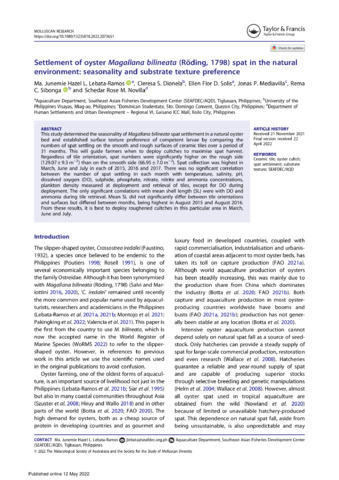
Settlement of oyster Magallana bilineata (Röding, 1798) spat in the natural environment: Seasonality and substrate texture preference
Lebata-Ramos, Ma. Junemie Hazel; ; Solis, Ellen Flor ; ; Sibonga, Rema ; (Malacological Society of Australasia; Society for the Study of Molluscan Diversity; Taylor and Francis, 2022-05-12)
This study determined the seasonality of Magallana bilineata spat settlement in a natural oyster bed and established surface texture preference of competent larvae by comparing the numbers of spat settling on the smooth and rough surfaces of ceramic tiles over a period of 31 months. This will guide farmers when to deploy cultches to maximise spat harvest. Regardless of tile orientation, spat numbers were significantly higher on the rough side (129.07 ± 9.3 m−2) than on the smooth side (66.95 ± 7.0 m−2). Spat collection was highest in March, June and July in each of 2015, 2016 and 2017. There was no significant correlation between the number of spat settling in each month with temperature, salinity, pH, dissolved oxygen (DO), sulphide, phosphate, nitrate, nitrite and ammonia concentrations, plankton density measured at deployment and retrieval of tiles, except for DO during deployment. The only significant correlations with mean shell length (SL) were with DO and ammonia during tile retrieval. Mean SL did not significantly differ between tile orientations and surfaces but differed between months, being highest in August 2015 and August 2016. From these results, it is best to deploy roughened cultches in this particular area in March, June and July. -
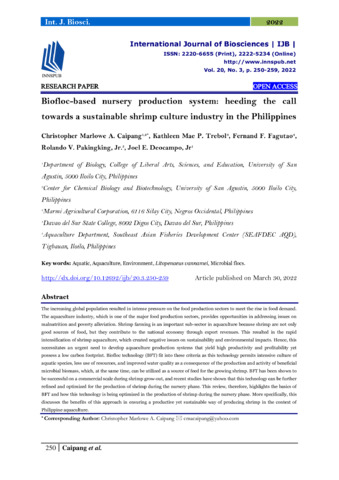
Biofloc-based nursery production system: Heeding the call towards a sustainable shrimp culture industry in the Philippines
Caipang, Christopher Marlowe; ; Fagutao, Fernand ; Pakingking, Rolando V., Jr. ; (International Network for Natural Sciences, 2022)
The increasing global population resulted in intense pressure on the food production sectors to meet the rise in food demand. The aquaculture industry, which is one of the major food production sectors, provides opportunities in addressing issues on malnutrition and poverty alleviation. Shrimp farming is an important sub-sector in aquaculture because shrimp are not only good sources of food, but they contribute to the national economy through export revenues. This resulted in the rapid intensification of shrimp aquaculture, which created negative issues on sustainability and environmental impacts. Hence, this necessitates an urgent need to develop aquaculture production systems that yield high productivity and profitability yet possess a low carbon footprint. Biofloc technology (BFT) fit into these criteria as this technology permits intensive culture of aquatic species, less use of resources, and improved water quality as a consequence of the production and activity of beneficial microbial biomass, which, at the same time, can be utilized as a source of feed for the growing shrimp. BFT has been shown to be successful on a commercial scale during shrimp grow-out, and recent studies have shown that this technology can be further refined and optimized for the production of shrimp during the nursery phase. This review, therefore, highlights the basics of BFT and how this technology is being optimized in the production of shrimp during the nursery phase. More specifically, this discusses the benefits of this approach in ensuring a productive yet sustainable way of producing shrimp in the context of Philippine aquaculture. -
Effect of background tank color in combination with sand substrate and shelters on survival and growth of Scylla tranquebarica instar
; Hamasaki, Katsuyuki; Shapawi, Rossita ; Kawamura, Gunzo ; Huervana, Joana Joy ; Yong, Annita Seok Kian (Elsevier, 2022-05)
Effect of tank color in combination with substrate-shelters on the survival and growth of the instar of purple mud crab, Scylla tranquebarica (initial body weight of 28.7 ± 2 mg) was investigated. Ten treatments were tested in triplicate with black (B) and white (W) tanks were set as the control, while other tanks were provided with a combination of sand substrate (S), and/or polyvinyl chloride pipes (P) as horizontal and nets (N) as vertical shelter, referred as B, BS, BSP, BSN, BSPN, W, WS, WSP, WSN and WSPN, respectively. Survival of the instar in black tanks (26.7 to 60.0%) was higher than in white tanks (20.0 to 46.7%) (P = 0.052). Survival in the horizontal shelter treatments (46.7 and 63.3%) exceeded that in the vertical shelter groups (30.0 and 50.0%) (P = 0.068). The final body weight of the instar in black tank (2.4 to 3.8 g) was significantly lower than white tank (2.6 to 4.8 g) (P = 0.02). Specific growth rate was significantly greater in sand substrate treatments (8.4 to 9.1%/day) than in controls (7.9 and 8.0%/day) (P = 0.015). In conclusion, horizontal shelter was better than vertical type, and black tank with substrate and horizontal shelter was more suitable for culture of purple mud crab instar. -
Phylogenetic analysis of tilapia lake virus (TiLV) isolates from the Philippines based on partial genome segment 3 sequences
Logronio, Dan Joseph; ; Romana-Eguia, Maria Rowena R. ; ; ; (College of Agriculture and Food Science, University of the Philippines Los Baños, 2022-03)
This study aimed to expand current knowledge on TiLV genetic diversity by sequence analysis of a portion of genome segment 3 of TiLV detected from the Philippines. This includes a recently deposited sequence in GenBank (Accession No. LC504279) and six new sequences from cases of infection reported from 2017 to 2020. Phylogenetic analysis of 179 bp fragment of segment 3 showed that the seven TiLV isolates from the Philippines can be divided into three phylogenetic groups. When comparing all sequences, unique nucleotide substitutions and amino acids were noted among these groups. Variation in mortality rates in naturally infected samples was also observed; however, poor environmental conditions during the disease outbreak may also contribute to the mortalities. These suggest the presence of at least three phylogenetic groups of TiLV in the Philippines which has significant implications for the future development of a vaccine, diagnostic kits, and genetic selection programs. -
Whole-genome sequencing for identification of bacterial isolates affecting local penaeid shrimp farms: A national survey for the Philippines
Saloma, Cynthia; Penir, Sarah Mae ; ; Amar, Edgar (5M Books Ltd, 2022)
The shrimp aquaculture industry is a major economic player in the food and livelihood sectors, both globally and in the Philippines. The development of industrialized shrimp farming methods has led to a rapid increase in cultured shrimp production since the 1980s, but the industry has also faced challenges from the introduction of opportunistic pathogens. These pose severe limitations in the success of shrimp culture in both hatcheries and grow-out ponds. We extracted genomic DNA from 423 bacterial isolates from shrimp disease outbreaks in local aquaculture farms throughout the Philippines and subjected them to Illumina paired-end whole-genome sequencing at 50–100-fold coverage. Reads were assembled using a de novo approach, and average nucleotide identity measurements were used to establish the identity of the isolates. Outbreak types encountered during the time of sampling include acute hepatopancreatic necrosis disease (AHPND), luminescent vibriosis, white spot disease, and outbreaks of unknown etiology. In both outbreak and non-outbreak sites, members of the genus Vibrio, particularly Vibrio parahaemolyticus, were observed to be the most abundant. The whole-genome sequence data obtained will aid in the design and implementation of novel shrimp bacterial disease outbreak management and control programs. -
Influence of water temperature on induced reproduction of milkfish during the off-season
; Mamauag, Roger Edward; (Aqua Research Pte Ltd, 2022)
Scientific studies on milkfish’s induced spawning and larval rearing by increasing water temperature in tanks are very limited. In order to increase the production capacity of milkfish fingerlings, a preliminary experiment was conducted at the Southeast Asian Fisheries Development Center, Aquaculture Department (SEAFDEC/AQD). This study was on the effect of increased water temperature in milkfish broodstock and larval tanks during the cold and off-breeding season (October to February). -
Economic analysis of stake and rack-hanging methods of farming oysters (Crassostrea iredalei) in the Philippines
; Davis, George (Elsevier, 1998)
The cost efficiency of stake and rack-hanging methods of farming oysters are compared. Annual costs and returns data for both methods were obtained from a socioeconomic survey conducted in 1991 at the Aquaculture Department of the Southeast Asian Fisheries Development Center (SEAFDEC/AQD). On average, 14 kg m−2 (shell-on) and 22 kg m−2 (shell-on) were produced using the stake and rack-hanging methods, respectively. The translog cost function for 58 oyster farms was estimated using iterative seemingly unrelated regression (SUR). Statistical analysis indicates that the higher production from the rack-hanging method is significantly different (α=0.10) from the production using the stake method. The cost-efficient method varied based on production levels. At output levels less that 9044 kg (shell-on), the rack-hanging method had lower average cost per unit, and for higher production levels the stake method had the lower average costs. Similar conclusions were drawn from the marginal cost analysis. Results imply when production is less than 9044 kg, then the most efficient technology is the rack-hanging method and if production is greater than 9044 kg, the most efficient method is the stake method. -
AQD Matters 2022 January - February
(Aquaculture Department, Southeast Asian Fisheries Development Center, 2022-03)In this issue: 1) Iloilo City gov’t seeks assistance from SEAFDEC/AQD; 2) Oyster spat deployed to ponds for rearing; 3) Japan-funded programs reviewed; 4) Cost-efficient feeds reap rich pompano harvest; 5) Let's talk about ... -
Commercially farmed Eucheumatoids
(GlobalSeaweedSTAR Philippines, 2021) -
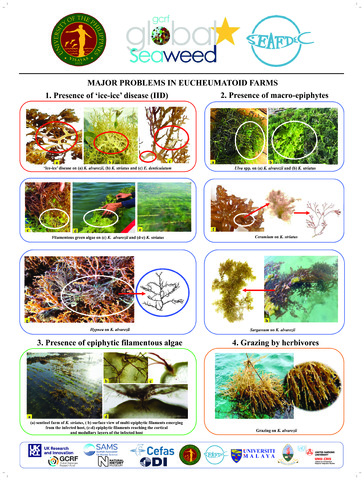
Major problems in Eucheumatoid farms
(GlobalSeaweedSTAR Philippines, 2021)