SEAFDEC/AQD Institutional Repository: Recent submissions
181-200 / 4221
-
Developmental historicity and saccharide heterotrophy of Schizochytrium sp. OT01: Implication of docosahexaenoic acid production for biotechnological applications
Batbatan, Christopher ; Hepowit, Nathaniel ; (Rushing Water Publishers, 2011)
Thraustochytrids have been targeted worldwide in search of highly oleaginous strains for industrial applications and newly collected holotypes are described based on life cycle developmental history and saccharide heterotrophy. Schizochytrium sp. OT01, a novel thraustochytrid protist from Panay, Philippines, distinguished from other reported strains by its asexual reproductive history - including the successive binary division of vegetative cells forming tetrads or octads, granular maturation of thalli into zoosporangia liberating heterokont motile zoospores and transformation of spheroidal thalli into amoeboid cells. Live-cell differential imaging and electron micrographs support its distinctive morphological features, such as hair-like pseudopodial astrals along hyaline margins of mature limaciform amoeboids and in motile zoospores prior to heterokont flagellum elongation. Moreover, its heterotrophic culture on certain saccharides (glucose, fructose, cellobiose, sucrose and starch) in continuously agitated fermentation condition was further investigated to determine hydrocarbon assimilative profiles as deduced from biomass yield and polyunsaturated fatty acid production. Increasing biomass yield was observed in increasing concentrations of saccharides; however, aside from glucose and fructose, a graphical drop of biomass was apparent beyond 15 gL, implying osmotic stress at these levels. Maximum biomass yield was observed at 30 gL- glucose and fructose concentration, reaching to about 6 g/l as expressed in freeze-dried weight of harvested cells, which indicates that OT01 could efficiently absorb and metabolize glucose and fructose compared to other hydrocarbons with relatively greater molecular weights. Even though biomass yield amounts were relatively low in cellobiose, sucrose and starch; however, docosahexaenoic acid (DHA) content in total fatty acids was relatively higher, amounting to 45.23, 46.25 and 48.86%, respectively. Moreover, oleagineity levels in glucose and fructose were highest, with lipid yield amounting to 655.55 and 609.38 mg, respectively, in every gram of freeze-dried weight cells. Consequently, DHA yield was significantly higher in both glucose and fructose, reaching respectively to 492.04 and 478.18 mg per liter of nutrient broth, which indicates higher absorption and metabolism efficiency of monosaccharides into fatty acids.
; Hepowit, Nathaniel ; (Rushing Water Publishers, 2011)
Thraustochytrids have been targeted worldwide in search of highly oleaginous strains for industrial applications and newly collected holotypes are described based on life cycle developmental history and saccharide heterotrophy. Schizochytrium sp. OT01, a novel thraustochytrid protist from Panay, Philippines, distinguished from other reported strains by its asexual reproductive history - including the successive binary division of vegetative cells forming tetrads or octads, granular maturation of thalli into zoosporangia liberating heterokont motile zoospores and transformation of spheroidal thalli into amoeboid cells. Live-cell differential imaging and electron micrographs support its distinctive morphological features, such as hair-like pseudopodial astrals along hyaline margins of mature limaciform amoeboids and in motile zoospores prior to heterokont flagellum elongation. Moreover, its heterotrophic culture on certain saccharides (glucose, fructose, cellobiose, sucrose and starch) in continuously agitated fermentation condition was further investigated to determine hydrocarbon assimilative profiles as deduced from biomass yield and polyunsaturated fatty acid production. Increasing biomass yield was observed in increasing concentrations of saccharides; however, aside from glucose and fructose, a graphical drop of biomass was apparent beyond 15 gL, implying osmotic stress at these levels. Maximum biomass yield was observed at 30 gL- glucose and fructose concentration, reaching to about 6 g/l as expressed in freeze-dried weight of harvested cells, which indicates that OT01 could efficiently absorb and metabolize glucose and fructose compared to other hydrocarbons with relatively greater molecular weights. Even though biomass yield amounts were relatively low in cellobiose, sucrose and starch; however, docosahexaenoic acid (DHA) content in total fatty acids was relatively higher, amounting to 45.23, 46.25 and 48.86%, respectively. Moreover, oleagineity levels in glucose and fructose were highest, with lipid yield amounting to 655.55 and 609.38 mg, respectively, in every gram of freeze-dried weight cells. Consequently, DHA yield was significantly higher in both glucose and fructose, reaching respectively to 492.04 and 478.18 mg per liter of nutrient broth, which indicates higher absorption and metabolism efficiency of monosaccharides into fatty acids. -
A proactive approach on shrimp culture: A farm experience in central Philippines
(Aqua Research Pte Ltd, 2022) -
Achieving high production of micropropagated seaweed through optimization of the culture protocol
; Faisan, Joseph P., Jr.; (Secretariat, Southeast Asian Fisheries Development Center, 2023-07)
Kappaphycus and Eucheuma are the two carrageenanproducing red algae extensively cultured and farmed in tropical and subtropical waters. Seaweed production accounted for 5.4 percent of the world’s aquaculture production in 2019, which was over USD 15 billion in value. With this value share, the production of seaweed farming was higher than other aquatic commodities, such as tilapia, carp, shrimps, and others (Cai et al., 2021). The red algae production of the Philippines started in the 1960s (Ronquillo & Gabral-Llana, 1989), and by the early 2000s, the country had become the world’s top supplier of seaweed, particularly Kappaphycus sp., until 2007, when Indonesia outperformed it. Problems and challenges in seaweed farming, including climate change, pests and diseases, and biosecurity issues, caused the continuous decline of the seaweed production yield (Faisan, Sollesta-Pitogo, & de la Peña, 2022). Furthermore, the deterioration of seaweed quality caused by the repetitive use of vegetative cutting methods has also become one of the most pressing concerns in seaweed farming. Unfortunately, this procedure of growing plantlets for farming is one of the most common methods many seaweed farms used in the Philippines and other countries. Research in SEAFDEC Aquaculture Department (AQD) looks into breaking from the conventional method of farming seaweed plantlets and optimizing laboratorybased production. With this, it hopes to create a more sustainable source of propagules, better growth and survival in grow-out, and a higher carrageenan quality in cultured Kappaphycus alvarezii. -
Susceptibility of Macrobachium rosenbergii to local white spot syndrome virus isolate using immersion assay
; Logronio, Dan Joseph; Romana-Eguia, Maria Rowena R. (De La Salle University, 2017)
White spot syndrome virus (WSSV) continue to be one of the leading causes of serious epizootic in cultured shrimp. Macrobrachium rosenbergii or giant freshwater prawns are found to be resistant in White spot syndrome virus (WSSV). However, conflicting studies have shown that pathogenicity of WSSV to M.rosenbergii may vary according to the life cycle of prawn, strain of WSSV and the source of the virus during passaging. On this preliminary study, the susceptibility of M. rosenbergii stocks to local strain of WSSV as exposed via immersion assay will be determined. Likewise, the pathogenicity of WSSV will be identified using the median lethal dose (LD50). The confirmation for the presence of WSSV on giant freshwater prawns will be done using nested PCR. The preliminary study will provide valuable data for the succeeding experiments. -
High amorphous poly-beta-hydroxybutyrate (PHB) content in a probiotic Bacillus strain displays better protective effects in Vibrio-challenged gnotobiotic Artemia
Laranja, Joseph Leopoldo; ; Ludevese-Pascual, Gladys ; Amar, Edgar ; Aerts, Maarten ; ; Bossier, Peter (Elsevier, 2018)
In this study, the Bacillus sp. JL47, a superior PHB-accumulating Bacillus strain identified from the previous work, was tested for its protective effects in gnotobiotic Artemia franciscana during a pathogenic Vibrio campbellii challenge. The utilization of gnotobiotic Artemia is important in this experiment because any possible microbial interference (which are naturally present in conventional culture system) are eliminated in this model culture system, hence the interpretation of the results in this mechanistic study can be more conclusive. The survival of the Artemia fed the Bacillus sp. JL47 at 1 × 10⁷ cells mL–1 was significantly higher as compared with the challenged control and the survival was almost doubled when the dose was increased to 5 × 10⁷ cells mL−1. However, feeding the Artemia at 106 cells mL−1 or lower showed no significant protective effects. Based on these densities, the estimated concentration of amorphous PHB showing a significant protection in Artemia was c. 2.44 mg L−1 and the effects were even better when the amorphous PHB level was increased to 12.19 mg L−1. Furthermore, feeding Bacillus sp. JL47 containing 55% amorphous PHB (on CDW) to Artemia showed a significantly higher survival in a Vibrio challenge relative to Bacillus containing 29% PHB. The data suggest that the amorphous PHB accumulated in the Bacillus sp. JL47 strain is an important determinant for the increased survival of challenged Artemia. -
Genetic research initiatives for sustainable aquaculture production in the Philippines
Romana-Eguia, Maria Rowena R.; Ablan Lagman, Ma. Carmen ; ; (Field Science Center, Graduate School of Agricultural Science, Tohoku University, 2019-03)
The Philippines is one of several countries in Southeast Asia that has, for several decades, made steady contributions to world aquaculture production both from inland and marine waters. In recent years, fish production has been on the decline mainly because of the lack of quality seedstock, limited stocks of captive breeders or spawners of major aquaculture commodities, adverse effects of climate change and other environmental factors on fish breeding and rearing, fish diseases caused by pathogenic organisms and prohibitive cost of aquaculture inputs such as feeds, etc. Genetic researches have been conducted mostly through local grants with the aim of addressing the aforementioned constraints. Such initiatives focused on developing and applying methods in (a) selective breeding; (b) marker-assisted genetic strain assessment for broodstock development and for monitoring inbreeding in farmed stocks and (c) genomics to understand and enhance on-farm stock performance through the identification of genes that are responsible for nutrition, stress and immune responses, among others. This paper highlights examples of local genetics applications in tilapia, mangrove crab, shrimp, milkfish and abalone aquaculture. The significance of implementing genetic interventions to boost and sustain aquaculture production in the Philippines is likewise discussed. -
Series: PNS/BAFS 70: 2023
Fresh chilled and fresh frozen shrimps and prawns – Product standard
(Bureau of Agriculture and Fisheries Standards, 2023)This Standard applies to fresh chilled and fresh frozen raw shrimps and prawns, which may be whole, deheaded, peeled, and peeled and deveined. This document applies to shrimps and prawns of the Penaeidae, Pandalidae, ... -
Series: PNS/BAFS 136:2023
Fresh chilled and fresh frozen cephalopods - Product standard
(Bureau of Agriculture and Fisheries Standards, 2023)This Standard applies to fresh chilled and fresh frozen cephalopods of the Loliginidae, Sepiidae and Octopodidae families for direct consumption or further processing. -
Series: PNS/BAFS 334:2022
Grouper - Code of good aquaculture practices (GAqP)
(Bureau of Agriculture and Fisheries Standards, 2022)Since 2014, the Bureau of Agriculture and Fisheries Standards-Department of Agriculture (BAFS-DA) has developed various Philippine National Standards (PNS) on the Code of Good Aquaculture Practices (GAqP) specific for ... -
Series: Aquaculture extension manual; No. 72
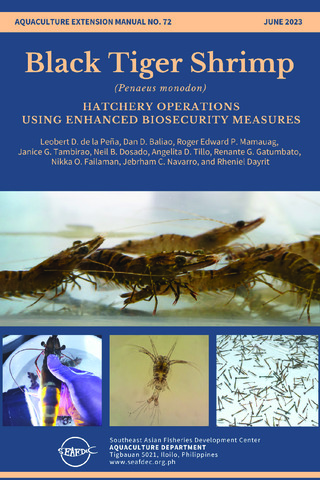
Black tiger shrimp (Penaeus monodon) hatchery operations using enhanced biosecurity measures
; ; Mamauag, Roger EdwardThis manual, titled “Black Tiger Shrimp (Penaeus monodon) Hatchery Operations Using Enhanced Biosecurity Measures,” includes modifications on shrimp hatchery operations done by the Aquaculture Department of the Southeast ...; ; ; ; ; ; ; (Aquaculture Department, Southeast Asian Fisheries Development Center, 2023-06)
-
Series: Aquaculture extension manual; No. 74
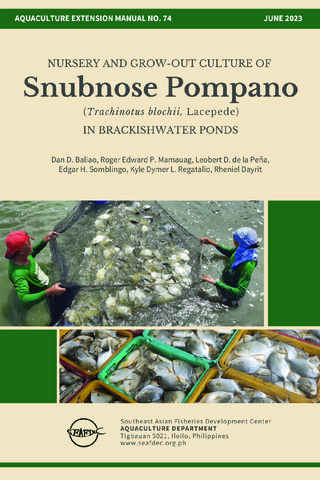
Nursery and grow-out culture of snubnose pompano (Trachinotus blochii, Lacepede) in brackishwater ponds
; Mamauag, Roger EdwardThis manual, titled “Nursery and Grow-out Culture of Snubnose Pompano (Trachinotus blochii, Lacepede) in Brackishwater Ponds,” includes culture techniques and good practices developed through extensive research done at the ...; ; ; ; (2023-06)
-
Series: Aquaculture extension manual; No. 73
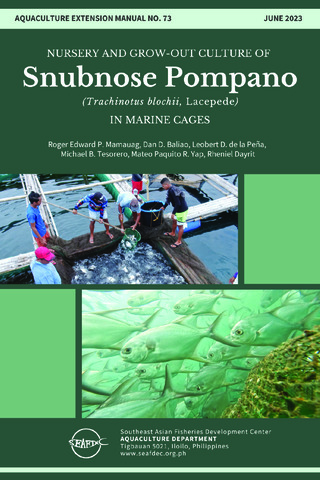
Nursery and grow-out culture of snubnose pompano (Trachinotus blochii, Lacepede) in marine cages
Mamauag, Roger EdwardThis manual, titled “Nursery and Grow-out Culture of Snubnose Pompano (Trachinotus blochii, Lacepede) in Marine Cages,” includes culture methods and good practices that are the product of research done at the Aquaculture ...; ; ; ; ; (2023-06)
-
Preliminary assessment of genetic variation in the Japanese endemic freshwater crab, Geothelphusa dehaani, based on mitochondrial DNA sequences
Huervana, Joana Joy; Kano, Yuichi ; ; Onikura, Norio ; (Pensoft Publishers, 2023-06-27)
Geothelphusa dehaani, a freshwater crab species endemic to Japan, has the largest distribution range amongst the 19 known species in the country. Due to its low dispersal capability and restricted habitat to freshwater, it serves as an excellent model for understanding gene flow between geographically isolated populations. In this study, we analysed the genetic relationships of 26 G. dehaani populations collected from different locations in the Japanese archipelago using two mitochondrial DNA regions - cytochrome oxidase subunit I (COI) and cytochrome b (cytB). Our results from the analysis of molecular variance (AMOVA) revealed high genetic variation amongst populations and the phylogenetic analysis identified four geographical groups: Clade I - Honshu and Shikoku, Clade II - north-eastern Kyushu, Clade III - southern Kyushu and Clade IV - north-western Kyushu. Notably, Clade IV exhibited the highest genetic distance amongst the observed groupings. These findings highlight the need for further examination of G. dehaani in Kyushu, including morphological and behavioural traits, to better understand the observed diversity within the species in the region. -
Reproductive quality evaluation of male Indian white prawn Penaeus indicus broodstock-fed diets supplemented with polychaete extracts (Marphysa sp.)
Santander-Avancena, Sheryll; Traifalgar, rex Ferdinand ; Estante-Superio, Erish ; ; Mamauag, Roger Edward ; Monteclaro, Harold ; ; Quinitio, Gerald (Taylor and Francis, 2023-06-23)
The present study determined the effect of different polychaete extracts, namely, total soluble fraction (TSF), neutral lipid fraction (NLF) and polar lipid fraction (PLF), in the maturation and sperm quality of male Penaeus indicus. Three levels (0.25, 0.50 and 1.00%) of extracts were included using a 3 × 3 factorial design. Groups fed the basal diet (BD) and fresh-frozen diet served as controls. Extracts in varying doses and control groups did not have a significant effect on broodstock survival (67–87%; p = 0.960), maturation rate (42–68%; p = 0.615), inter-spermatophore period (8–10 days; p = 0.505) or sperm viability (97–100%; p = 0.819). However, sperm counts of broodstock fed BD (11.70 × 10⁶ ±1.05 × 10⁶ per spermatophore) and those fed diets supplemented with polychaete extracts were significantly higher compared to that fed with control fresh diet at 0.73 × 10⁶± .09 × 106 (p = 0.001). Spermatophore crude lipid was highest in groups fed 0.25% TSF and 0.25% PLF of broodstock (p =1.0 x10⁻⁶ ). Inclusion of TSF (0.25–1.00%) significantly increased the spermatophore crude protein content of broodstock compared to those fed with other diets (p = 1.20 × 10⁻⁵). These results demonstrate that NLF and TSF extracts are bioactive components of polychaete which when fed to male P. indicus, can stimulate aspects of sperm production. -
Reproduction, early development, and larval rearing of the climbing perch Anabas testudineus (Teleostei: Anabantidae) in captivity
Aya, Frolan; ; Garcia, Luis Maria (College of Agriculture and Food Science, University of the Philippines Los Baños, 2023-06)
Induced spawning, early development, and larval rearing of the climbing perch Anabas testudineus were examined under captive conditions. Five female climbing perch [125.33 ± 3.27 mm standard length (SL); 70.67 ± 5.59 g body weight (BW)] were each paired with apparently mature males (108.50 ± 3.97 mm SL; 39.27 ± 4.70 g BW) and induced to spawn with 5,000 IU human chorionic gonadotropin (hCG) + 0.5 mL Ovaprim/kg BW. All hCG + Ovaprim-injected fish spawned 9 – 11 h after hormone administration but saline-injected fish (control group) failed to spawn. Mean egg production per female, fertilization and hatching rates, and larval production per female were 7,667 ± 1,313, 98.11 ± 1.63%, 61.01 ± 19.92%, and 4,435 ± 1,041, respectively. Fertilized eggs (1.52 – 1.96 mm in diameter) were almost spherical, non-adhesive, transparent, and buoyant due to a large, single oil globule (515 ± 33 µm in diameter). First cleavage appeared 30 min post-fertilization (MPF) and egg development lasted for 20 – 24 h post-fertilization (HPF) (29°C). Newly hatched climbing perch larvae [1.73 ± 0.08 mm in total length (TL)] with yolk volume (YV) and oil globule volume (OGV) of 0.545 ± 0.104 mm3 and 0.072 ± 0.013 mm3, respectively had no pigmented eyes or functional mouth parts and digestive tract, and immobile with the yolk sac pointed upward. Eyes became pigmented and both mouth and anus opened in 1 d old larvae (2.09 ± 0.04 mm TL) in preparation for exogenous feeding. Except for body depth (BD) and pre-anal length (PAL), a general increase in TL (1.73 – 3.72 mm), eye diameter (ED) (0.164 – 0.378 mm), head length (HL) (0.205 – 0.923 mm), and mouth gape (MG) size (0.308 – 0.552 mm) was observed, coinciding with yolk resorption in 7 d post-hatched larvae. Climbing perch larvae were reared at four stocking densities (25, 50, 75, 100 larvae L-1) and fed solely on live food (Brachionus rotundiformis from days 2 to 12 and Artemia nauplii from days 13 to 40) or co-fed live food and microparticulate diet (MPD) (Artemia nauplii from days 2 to 15 and Artemia + MPD from days 16 to 40). Mean survival rates at lower densities (25 – 50 larvae L-1) were significantly higher than those reared at 75 and 100 larvae L-1 (P < 0.05). Furthermore, climbing perch larvae co-fed Artemia nauplii and MPD showed better survival (28.67 – 81.00%) than those fed solely on live food (24.88 – 64.00%). However, at the end of the 40 d trial period, growth parameters did not vary significantly among densities (P > 0.05), except for the condition factor in larvae co-fed Artemia nauplii and MPD. Taken together, results demonstrate the effectiveness of hCG + Ovaprim for captive breeding and observations on the early development of climbing perch, and the feasibility of rearing the larvae at 25 – 50 L-1 on a combination of Artemia nauplii and MPD under laboratory conditions. -
Behavior changes and \(\mathsf{LC_{50}}\) of dried garlic (Allium sativum) acute toxicity in Nile tilapia (Oreochromis niloticus) juvenile
(College of Agriculture and Food Science, University of the Philippines Los Baños, 2023-06)Plant-based compounds are emerging substitutes for chemical treatments in aquaculture since they are known to cause less harm to both the environment and its organisms. Garlic (Allium sativum) is a popular herb that has a broad range of uses, especially in the control and treatment of bacterial and parasitic diseases. However, its toxicity to tilapia is not well-studied. Hence, this study was conducted to test the toxicity levels of garlic powder in juvenile Nile tilapia (Oreochromis niloticus) by determining the cumulative mortality and median lethal concentration (LC50). Test fish were exposed through immersion in 6 concentrations (150, 200, 250, 300, 350, and 400 mg L-1) of garlic powder with 25% allicin and a control in 96 h static bioassay. Within 24 h, test fish exposed to 250 mg L-1 garlic and above, exhibited abnormal behaviors such as lethargy, gasping for air, and weak responses to environmental stimuli. Cumulative mortality was highest at 100% in 400 mg L-1 garlic at 48 h. Mortalities were dependent on the concentration and duration of exposure. The 96 h LC50 of garlic powder to O. niloticus is 225.86 mg L-1 with lower and upper confidence limits of 210.37 and 242.50 mg L-1, respectively at 27°C. -
Lime application to condition soil to pH 11 controls growth of harmful vibrios and WSSV
Tendencia, Eleonor; (European Association of Fish Pathologists, 2023-05-26)
Shrimp farming has been devastated by several diseases. Disease outbreaks can be prevented by optimising environmental conditions or by eliminating risks factors including carrier organisms. These can be achieved through proper pond preparation. One important step in pond preparation is the application of hydrated lime. This paper describes the effect of hydrated lime application to condition pond soil to pH 11 on the pond ecosystem, more specifically on soil pH and biota. The experiment was done using three 600 m2 brackish water ponds. After hydrated lime application, the wet soil pH on the 1st-8th day was significantly higher (P<0.05) compared to the pH before liming to pH 11, and flushing after flooding for 24 h. Soil pH of 11 was observed 24-48h after lime application. Moreover, unwanted species like crabs and fish were found dead. Liming to pH 11 negatively affects the counts of green vibrio colonies thereby decreasing the percentage of green vibrios (PGV). In another experiment, three 750m2 earthen ponds were used. The pond soils were previously positive for the Whitespot Syndrome Virus (WSSV), hydrated lime were applied to bring the pond soil pH to 11. After lime application, WSSV was not detected in the pond soils. Results showed that increasing the soil pH to ≥11 positively affects the pond ecosystem. Liming encourages the proliferation of yellow vibrios and the eradication of carrier species (i.e. crabs) as well as predators (i.e. fish) in the ponds. Furthermore, liming to pH 11 may also eradicate White spot virus from the pond sediment. To implement a 1-unit increase in wet pH, hydrated lime should be applied at 2T/ha. -
Estimating the economic benefits and costs of conserving marine protected area in San Jose, Antique, Philippines
(Silliman University, 2023-03-27)The establishment of marine protected areas (MPAs) in the Philippines becomes a priority management strategy to conserve marine biodiversity and address the problem of declining marine resources. Economic studies can be a viable tool to determine MPA as a management option by evaluating their benefits and costs to the community. In order to determine the economic benefits of MPAs in San Jose, Antique, the total economic value of the resource consisting of direct and indirect use and non-use values was determined in 2016. Direct benefits from revenues and tourism amounted to Php 247,739.61 at the time of the study. Concurrently, the indirect functional benefits of MPA amounted to Php 2,162,235 using the benefit-transfer method. In measuring the non-use values of the MPA, the contingent valuation method was used to elicit the people’s willingness to pay for the MPA conservation program. The mean willingness to pay (WTP) of 260 participants equals Php 219.00, and the social WTP amounted to Php 5,725,136.89. The total benefits of managing the MPA amounted to Php 8,135,111.50, which exceeded the cost of conserving the MPA, which amounted to only Php 1,235,363.30. The net present values across 25 year period and different interest rates generated positive results. -
The pawikan album: The sea turtles captured around Panay and Guimaras Islands, Philippines
Bagarinao, Teodora; ; (Aquaculture Department, Southeast Asian Fisheries Development Center, 2010)
SEAFDEC FishWorld worked with fishers and government officers to document 93 sea turtles captured by fishing gears along the coasts of Panay and Guimaras Islands, Philippines in 2000-2009: three leatherbacks Dermochelys coriacea (128-150 cm curved carapace length), two loggerheads Caretta caretta (77 cm), 18 olive ridleys Lepidochelys olivacea (47-69 cm), 18 hawksbills Eretmochelys imbricata (20-89 cm), and 52 green turtles Chelonia mydas (30-108 cm). Most green turtles were caught in near shore fish corrals, and most olive ridleys by gill nets and long lines. Of the 18 hawksbills, 2 adults were caught in fish corrals, 3 juveniles were entangled in nets in Iloilo Strait, 6 were pets off our people,and 7 were captives at a turtle feeding station near a known hawksbill nesting site in Lawi, Guimaras. Sixty documented turtles were released, 47 of them with monel or inconel tags of the Pawikan Conservation Project, Department of Environment and Natural Resources. The others died from entanglement, serious injuries, slaughter for market, and diseases. Six female green turtles had multiple fibropapillomas; two died, three were released, and the latest one healed well after the surgical removal of several large tumors and was released. One green turtle brought to FishWorld has advanced shell rot, is unable to submerge, but is doing well on a diet of red seaweed Gracilaria. Three pet hawksbills were retrained for life at sea; one was released after 17 months, another after 57 months, but one is still at FishWorld as Conservation Ambassador. The most important result of FishWorld's work in the past 10 years is that many captured sea turtles were checked for health condition, treated where necessary or possible, tagged, and released back to sea. In addition, data on 93 sea turtles were gathered that can be used in the continuing effort to monitor the locations, risks and threats, health and diseases, and movements of these endangered species. -
Histidine requirement of snubnose silver pompano Trachinotus blochii
Mamauag, Roger Edward; (Elsevier, 2023-05-25)
Histidine is necessary for the formation and repair of tissues to mitigate the effects of cataract on some fish species. Although the requirements for dietary amino acids of several Trachinotus species have been reported, the quantitative histidine requirement for a cost-effective diet for snubnose pompano or Trachinotus blochii, a high value finfish species in the Philippines, has been limited. A 90-day growth experiment determined the dietary histidine requirement of juvenile snubnose pompano (0.19±0.03 g). Six isonitrogenous, isolipidic, and isoenergetic diets consisted of a control diet with 0% histidine inclusion level (basal histidine level of 0.65%) and five diets with histidine inclusion levels of 0.15 (0.80%), 0.3 (1.1%), 0.45 (1.55%), 0.6 (2.15%), and 0.75% (2.9%). To simulate the pompano whole-body amino acid composition, essential amino acids were added in the diet. Fifteen pompano juveniles per tank in three replicates were stocked randomly in 250-L fiberglass tanks and were fed to satiation for 90 d. When the dietary histidine level and percent weight gain were analyzed via quadratic regression, a dietary histidine level of 1.61 g per 100 g diet or 0.357 g per 100 g protein is required for juvenile snubnose pompano. Moreover, the occurrence of cataracts was not observed in fish fed all dietary treatments.