SEAFDEC/AQD Institutional Repository: Recent submissions
Now showing items 161-180 of 4221
-
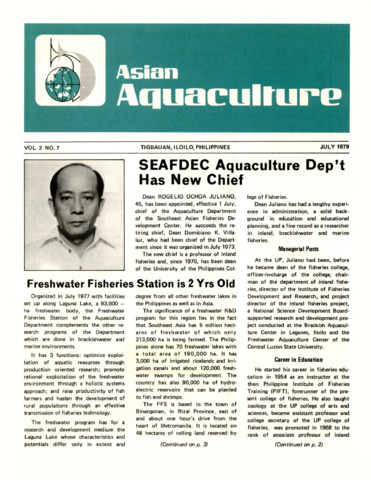
Asian Aquaculture Volume 2(7) July 1979
(Aquaculture Department, Southeast Asian Fisheries Development Center, 1979-07)In this issue: SEAFDEC Aquaculture Dep't has new chief; Freshwater Fisheries Station is 2 yrs old; Cage farming of Penaeus monodon in freshwater; Cage fish culture in Nepal; ADB provides assistance to Nepal Aquaculture Project -
A survey of stock of the donkey’s ear abalone, Haliotis asinina L. in the Sagay Marine Reserve, Philippines: Evaluating the effectiveness of marine protected area enforcement
Maliao, Ronald ; Webb, Edward ; (Elsevier, 2004)
Marine protected areas (MPA) are tools for integrated coastal management (ICM); they have gained worldwide acceptance as a strategy for resource restoration and conservation. Research must gauge the effectiveness of MPA implementation in promoting fisheries recovery. This study investigated the effectiveness of enforcement in the Sagay Marine Reserve (SMR), western Philippines, in promoting the recovery of abalone stock. Enforcement of protection in the SMR is accomplished through the bantay-dagat (sea patrol), which utilizes reef watchtowers to deter illegal activities. The abalone populations in two protected reefs (well-enforced protection) and two open access reefs (poorly enforced protection) in the SMR were surveyed using 50m x 2m belt transects. Abalone density was significantly greater, and abalone were larger, on protected than on unprotected reefs. However, we found that recruitment appeared limited at all sites, and that abalone tended to be sexually mature at small sizes. This may indicate that the population has been near a critical threshold, that recent climatic events may have suppressed recovery rates, and/or that enforcement and rule compliance was low and with continued poaching. Nevertheless, the results of this study agree with findings of other research that a properly enforced no-take MPA can promote recovery of local stocks. Moreover, the investment of funds by the local government in monitoring activities (in this case, watchtowers) is necessary to achieve MPA objectives.
; Webb, Edward ; (Elsevier, 2004)
Marine protected areas (MPA) are tools for integrated coastal management (ICM); they have gained worldwide acceptance as a strategy for resource restoration and conservation. Research must gauge the effectiveness of MPA implementation in promoting fisheries recovery. This study investigated the effectiveness of enforcement in the Sagay Marine Reserve (SMR), western Philippines, in promoting the recovery of abalone stock. Enforcement of protection in the SMR is accomplished through the bantay-dagat (sea patrol), which utilizes reef watchtowers to deter illegal activities. The abalone populations in two protected reefs (well-enforced protection) and two open access reefs (poorly enforced protection) in the SMR were surveyed using 50m x 2m belt transects. Abalone density was significantly greater, and abalone were larger, on protected than on unprotected reefs. However, we found that recruitment appeared limited at all sites, and that abalone tended to be sexually mature at small sizes. This may indicate that the population has been near a critical threshold, that recent climatic events may have suppressed recovery rates, and/or that enforcement and rule compliance was low and with continued poaching. Nevertheless, the results of this study agree with findings of other research that a properly enforced no-take MPA can promote recovery of local stocks. Moreover, the investment of funds by the local government in monitoring activities (in this case, watchtowers) is necessary to achieve MPA objectives. -
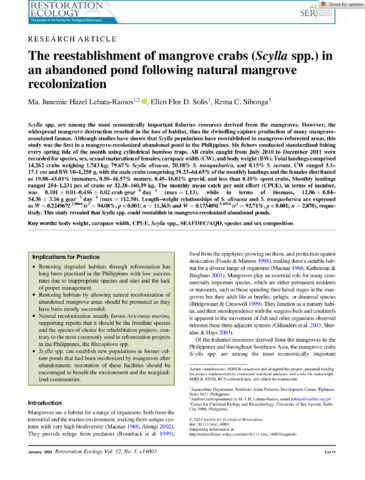
The reestablishment of mangrove crabs (Scylla spp.) in an abandoned pond following natural mangrove recolonization
Lebata-Ramos, Ma. Junemie Hazel; ; Sibonga, Rema (Wiley, 2024-01)
Scylla spp. are among the most economically important fisheries resources derived from the mangroves. However, the widespread mangrove destruction resulted in the loss of habitat, thus the dwindling capture production of many mangrove-associated faunas. Although studies have shown that Scylla populations have reestablished in mangrove-reforested areas, this study was the first in a mangrove-recolonized abandoned pond in the Philippines. Six fishers conducted standardized fishing every spring tide of the month using cylindrical bamboo traps. All crabs caught from July 2010 to December 2011 were recorded for species, sex, sexual maturation of females, carapace width (CW), and body weight (BW). Total landings comprised 14,262 crabs weighing 1,743 kg; 79.67% Scylla olivacea, 20.18% S. tranquebarica, and 0.15% S. serrata. CW ranged 3.1–17.1 cm and BW 10–1,250 g, with the male crabs comprising 39.23–64.65% of the monthly landings and the females distributed as 19.88–45.01% immature, 0.50–16.57% mature, 0.45–16.02% gravid, and less than 0.10% spent crabs. Monthly landings ranged 254–1,231 pcs of crabs or 32.38–160.59 kg. The monthly mean catch per unit effort (CPUE), in terms of number, was 0.101 ± 0.01–0.456 ± 0.02 crab gear−1 day−1 (max = 1.13), while in terms of biomass, 12.86 ± 0.84–54.36 ± 3.16 g gear−1 day−1 (max = 112.50). Length–weight relationships of S. olivacea and S. tranquebarica are expressed as W = 0.224967L2.9864 (r2 = 94.08%, p < 0.001; n = 11,363) and W = 0.173409L3.1074 (r2 = 92.71%, p < 0.001; n = 2,878), respectively. This study revealed that Scylla spp. could reestablish in mangrove-recolonized abandoned ponds. -
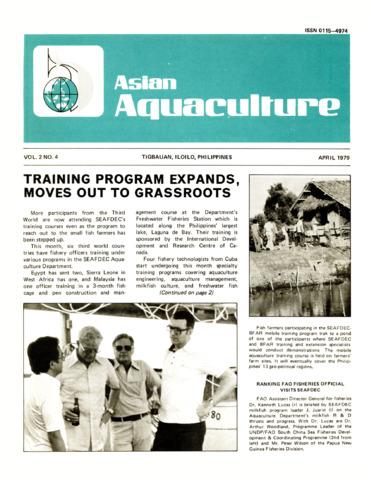
Asian Aquaculture Volume 2(4) April 1979
(Aquaculture Department, Southeast Asian Fisheries Development Center, 1979-04)In this issue: 1) Training program expands, moves out to grassroots; 2) Cage and pen culture in India; 3) Aquaculture in Hawaii: Species and systems; 4) Available technology, technology gaps, and production potentials of ... -
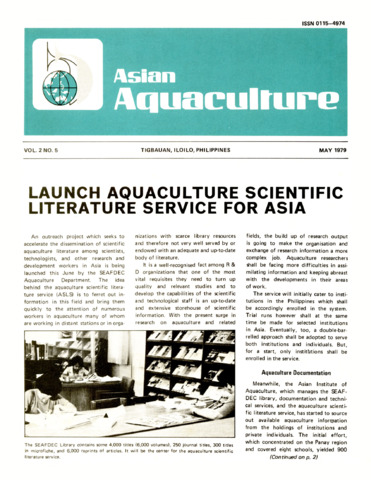
Asian Aquaculture Volume 2(5) May 1979
(Aquaculture Department, Southeast Asian Fisheries Development Center, 1979-05)In this issue: Launch aquaculture scientific literature service for Asia; Available technology, technology gaps, and production potentials in mollusc aquaculture; Development of aquaculture in Sierra Leone with a brief ... -
Asian Aquaculture Volume 2(6) June 1979
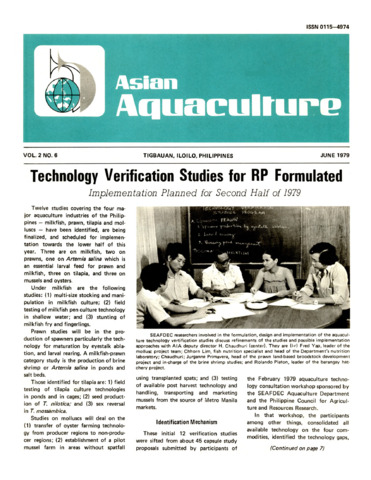
(Aquaculture Department, Southeast Asian Fisheries Development Center, 1979-06)In this issue: Technology verification studies for RP formulated; Available technology and technology gaps in tilapia farming in the Philippines; The use of aquatic plants as feed for Tilapia nilotica in floating cages; ... -
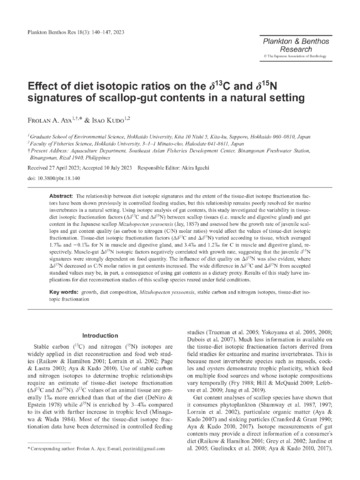
Effect of diet isotopic ratios on the \(\mathsf{\delta^{13}C}\) and \(\mathsf{\delta^{15}N}\) signatures of scallop-gut contents in a natural setting
Aya, Frolan; Kudo, Isao (The Plankton Society of Japan, 2023)
The relationship between diet isotopic signatures and the extent of the tissue-diet isotope fractionation factors have been shown previously in controlled feeding studies, but this relationship remains poorly resolved for marine invertebrates in a natural setting. Using isotope analysis of gut contents, this study investigated the variability in tissue-diet isotopic fractionation factors (Δδ13C and Δδ15N) between scallop tissues (i.e. muscle and digestive gland) and gut content in the Japanese scallop Mizuhopecten yessoensis (Jay, 1857) and assessed how the growth rate of juvenile scallops and gut content quality (as carbon to nitrogen (C/N) molar ratios) would affect the values of tissue-diet isotopic fractionation. Tissue-diet isotopic fractionation factors (Δδ13C and δ15N) varied according to tissue, which averaged 1.7‰ and −0.1‰ for N in muscle and digestive gland, and 3.4‰ and 1.2‰ for C in muscle and digestive gland, respectively. Muscle-gut δ15N isotopic factors negatively correlated with growth rate, suggesting that the juvenile δ15N signatures were strongly dependent on food quantity. The influence of diet quality on δ15N was also evident, where δ15N decreased as C/N molar ratios in gut contents increased. The wide difference in Δδ13C and δ15N from accepted standard values may be, in part, a consequence of using gut contents as a dietary proxy. Results of this study have implications for diet reconstruction studies of this scallop species reared under field conditions. -
Series: JIRCAS Working Report; No. 56
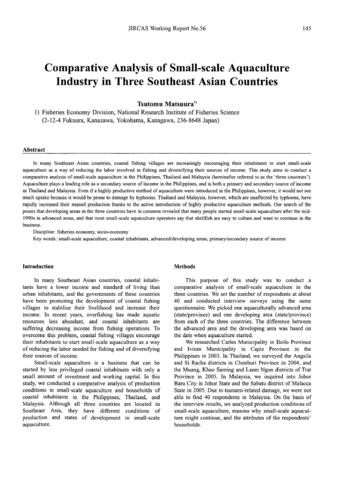
Comparative analysis of small-scale aquaculture industry in three Southeast Asian countries
(Japan International Research Center for Agricultural Sciences, 2007)In many Southeast Asian countries, coastal fishing villages are increasingly encouraging their inhabitants to start small-scale aquaculture as a way of reducing the labor involved in fishing and diversifying their sources of income. This study aims to conduct a comparative analysis of small-scale aquaculture in the Philippines, Thailand and Malaysia (hereinafter referred to as the ‘three countries’). Aquaculture plays a leading role as a secondary source of income in the Philippines, and is both a primary and secondary source of income in Thailand and Malaysia. Even if a highly productive method of aquaculture were introduced in the Philippines, however, it would not see much uptake because it would be prone to damage by typhoons. Thailand and Malaysia, however, which are unaffected by typhoons, have rapidly increased their mussel production thanks to the active introduction of highly productive aquaculture methods. Our search of the points that developing areas in the three countries have in common revealed that many people started small-scale aquaculture after the mid-1990s in advanced areas, and that most small-scale aquaculture operators say that shellfish are easy to culture and want to continue in the business. -
Series: JIRCAS Working Report; No. 56
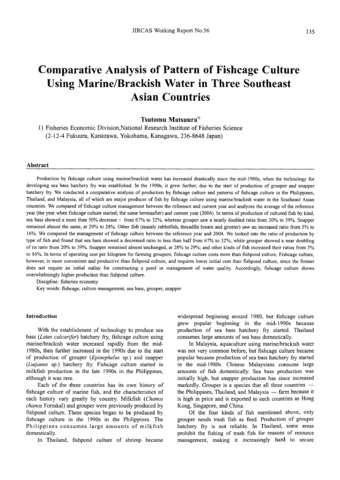
Comparative analysis of pattern of fishcage culture using marine/brackish water in three Southeast Asian countries
(Japan International Research Center for Agricultural Sciences, 2007)Production by fishcage culture using marine/brackish water has increased drastically since the mid-1980s, when the technology for developing sea bass hatchery fry was established. In the 1990s, it grew further, due to the start of production of grouper and snapper hatchery fry. We conducted a comparative analysis of production by fishcage culture and patterns of fishcage culture in the Philippines, Thailand, and Malaysia, all of which are major producer of fish by fishcage culture using marine/brackish water in the Southeast Asian countries. We compared of fishcage culture management between the reference and current year and analyzes the average of the reference year (the year when fishcage culture started; the same hereinafter) and current year (2004). In terms of production of cultured fish by kind, sea bass showed a more than 50% decrease - from 67% to 32%, whereas grouper saw a nearly doubled ratio from 20% to 39%. Snapper remained almost the same, at 29% to 28%. Other fish (mainly rabbitfish, threadfin bream and grunter) saw an increased ratio from 5% to 16%. We compared the management of fishcage culture between the reference year and 2004. We looked into the ratio of production by type of fish and found that sea bass showed a decreased ratio to less than half from 67% to 32%; while grouper showed a near doubling of its ratio from 20% to 39%. Snapper remained almost unchanged, at 28% to 29%; and other kinds of fish increased their ratios from 5% to 16%. In terms of operating cost per kilogram for farming groupers, fishcage culture costs more than fishpond culture. Fishcage culture, however, is more convenient and productive than fishpond culture, and requires lower initial cost than fishpond culture, since the former does not require an initial outlay for constructing a pond or management of water quality. Accordingly, fishcage culture shows overwhelmingly higher production than fishpond culture. -
Series: JIRCAS Working Report; No. 44
Detection of betanodaviruses from different organs of broodstocks and wild juveniles of orange-spotted grouper, Epinephelus coioides
(Japan International Research Center for Agricultural Sciences, 2006)Aquaculture of grouper including orange-spotted grouper suffers losses from viral nervous necrosis (VNN). This disease usually occurs in larval stage resulting in a high rate of mortality. It is conceivable that vertical transmission from subclinically infected broodstock fish to the brood is the major route of infection. However, there are only a few studies regarding the fish subclinically infected with VNN and the evidence for a causal relationship between subclinically infected adult fish and vertical transmission remains tenuous. The purpose of this study is to reveal the distribution of the virus in asymptomatically infected fish. Six healthy broodstocks of orange-spotted groupers with body weights ranging from 5 to 12 kg were used and 14 different organs were collected. Cell culture and PCR methods were used to detect the virus. Additionally, 8 wild juveniles with body weights ranging from 2 to 4 g were also analyzed. In our results, the virus was detected by means of PCR but not by the cell culture method. All the broodstocks and wild juveniles were positive in the PCR test except for one juvenile. The highest detection rate of the virus among organs was the brain. However, the virus gene was also amplified from organs other than the central nervous system (CNS). We hypothesize that the virus was latently retained in the CNS of subclinically infected fish and when the fish immune system was weakened such latent virus was released from CNS to the peripheral organs including the gonad. This mechanism might provoke the vertical transmission infection. -
Series: JIRCAS Working Report; No. 44
Arachidonic acid enrichment of rotifers and effects of dietary arachidonic acid on broodstock performance of rabbitfish Siganus guttatus
(Japan International Research Center for Agricultural Sciences, 2006)Rotifers (Brachionus sp.) were cultured with various combinations of baker’s yeast, Nannochloropsis sp., Culture selco, and DHAPS with or without supplementation of arachidonic acid (triacylglycerol form). Rotifers were able to be enriched with emulsified- arachidonic acid supplemented to culture media. Considered the reciprocal ratios of arachidonic acid, EPA and DHA in rotifers, rotifers pre-cultured in Culture selco and then cultured in DHAPS had the best balance of essential fatty acids, and the optimum level of arachidonic acid supplementation to DHAPS appeared between 0% and 5%. A feeding test was conducted to investigate the effects of arachidonic acid on the broodstock performance of rabbitfish (Siganus guttatus), one of the commercially valuable species in mangrove areas. A diet with 1.5% of arachidonic acid supplementation appeared to affect negatively the reproductive performance of S. guttatus broodstock, perhaps due to the excessive supplementation. Considered together with results of mangrove red snapper in 2003, the optimum supplementation of arachidonic acid in broodstock diets might be around 0.5%. -
Series: JIRCAS Working Report; No. 44
Arachidonic acid distribution in mangrove organisms in the Philippines, Malaysia and Japan
(Japan International Research Center for Agricultural Sciences, 2006)There has been little information on the importance of arachidonic acid (20:4n-6, ArA) in fish and other aquatic animals, although the importance of eicosapentaenoic acid (20:5n-3, EPA) and docosahexaenoic acid (22:6n-3, DHA) has been highlighted. The present study was conducted to investigate essential fatty acid composition, especially ArA distribution in mangrove organisms in the Philippines, Malaysia and Japan. The overall results revealed that ArA was not a minor component in mangrove organisms, and that the existence of ArA in mangrove organisms is widespread, irrespective of the differences in species, geography and environment. Both mangrove green and dead leaves were rich in linoleic acid (18:2n-6 LA) and linolenic acid (18:3n-3 LNA), which are respectively precursors of ArA and EPA & DHA, although ArA, EPA and DHA were not detected in these leaves. Mangrove invertebrates contained intermediate to high ArA. Especially, mangrove snails had very high ArA levels with low DHA levels, and thus the snails appeared promising as a new dietary source rich in ArA. Most of fishes in mangrove areas showed entirely higher ArA levels than EPA levels. As overall traits, ArA/EPA ratios of mangrove animals were higher than those of cold and temperate water species .The present results suggest that ArA may be nutritionally more important for egg and larval development, and that its supplementation in diets can enhance the development of broodstock management and fry production technologies in mangrove areas. The information of the present report can be used as a guideline for development of appropriate broodstock and/or larval diets in mangrove areas. -
Series: JIRCAS Working Report; No. 44
Analysis of the sustainability of extensive and intensive methods in brackish water fishpond culture primarily producing shrimp in three Southeast Asian countries
(Japan International Research Center for Agricultural Sciences, 2006)This study is an investigation of the aquaculture methods used in brackish water fishpond culture mainly producing shrimp in the Philippines, Thailand and Malaysia. Extensive methods are practiced in the Philippines and Thailand (2 tons/ha and below for annual production of shrimp with no or few feeding method), while the intensive method is used in all the 3 countries (2 tons/ha and over for the annual production of shrimp with more feeding method). Most of the production of cultured shrimp relies on the intensive method. The yield of shrimp using the extensive method is relatively high in the Philippines, but small in Thailand due to declining water quality. With regard to the intensive method, the Philippines has a low death rate for monodon (Penaeus monodon) because it has adopted the Green water system as a measure against bacterial disease (luminous bacteria). On the other hand, Thailand and Malaysia have low survival rates owing to the lack of effective measures to prevent virus disease (White spot). For this reason, an increasing number of farms have changed their main cultured species from monodon to vanamei (P. vanamei) in Thailand and Malaysia. Consequently, the price of monodon has been falling as a result of high production of vanamei at lower prices, and the profits of monodon farms continue to decrease. If the cultivation of vanamei, which is a species introduced from South America, continues to increase, it is expected to have a negative effect on monodon farming. In order to protect monodon, a native species, it is necessary to focus on cultivating this species in Southeast Asia. In Thailand, there is a need to ensure the supply of good quality seedlings, since the quality of monodon seedlings has been deteriorating. In Malaysia, it is necessary to equalize the level of aquacultural techniques within the country because there is a disparity in techniques among fish farms. In the Philippines, both extensive and intensive methods are conducted in a sustainable manner. -
Series: JIRCAS Working Report; No. 54
Changes in farm management and production systems: Response to shrimp culture problems in the Philippines
(Japan International Research Center for Agricultural Sciences, 2007) -
A special feed for maturing Penaeus indicus broodstock
(Intellectual Property Office of the Philippines, 2022-06-03)The present utility model relates to a special feed for maturing Penaeus indicus broodstock comprising of 55% protein and 12% lipid. The said formulation per 100 grams is further comprising of: Shrimp meal (19.7 -24.6g), Danish Fish meal (19.7-24.6g), Squid meal (19.7-24.6g), Cod liver oil (0-13g), Cholesterol (1.0g), Wheat flour (7.2-14.9g), Gluten (6.0g), Vitamin mix (2.0g), Vitamin C (1.0g), Choline chloride (1.0g), and Mineral mix (2.0g). The said special feed promotes gonad maturity and egg diameter and is comparably effective than using fresh maturation diets. The special feed has a survival rate of 90-96% which is relatively higher compared to the usual 93%. Specific growth rate per daily basis (SGR (%day-1) is at 23-24% while the Maturation Rate is at 50-55% which means the growth of the fish is now directed toward gonadal maturation. -
Development and sustainability of Philippine aquaculture
Primavera, Jurgenne (Royal Academy of Overseas Sciences, 2006)
Aquaculture plays a predominant role in the Philippines, an archipelago of 7,150 islands with 36,300 km of coastline, 26.6 million ha of coastal waters, and 250,000 ha of lakes, rivers and reservoirs over which are spread 239,000 ha of brackish-water ponds and 14,500 ha of freshwater ponds. From a mere 25,500 mt valued at P33.1 million in 1950, aquaculture production has increased to 38.2 million mt valued at P35.4 billion in 2002, and employs some 258,500 persons. Aquaculture contribution to total fisheries’ production in the 1950-2002 period has similarly increased from 11.6 % to 38.2 % by volume, and from 15.4 % to 31.3 % by value. Next to yields of 894,858 mt of seaweeds and bivalves from mariculture, Philippine aquaculture was dominated in 2002 by brackish-water pond production of 246,937 mt, followed by 94,697 mt from marine and freshwater pens/cages and 70,425 mt from freshwater ponds. Notwithstanding its major contribution to the Philippine economy, aquaculture development has come with many environmental and social costs. Foremost among these is mangrove conversion to culture ponds, mainly for milkfish — around half of the 279,000 ha of mangroves lost from 1951 to 1988 were developed into culture ponds. Ninety-five percent of Philippine brackish-water ponds in 1952-1987 were derived from mangroves. Mangroves have contributed significantly to the well-being of coastal communities for centuries through products used for fuel, construction, fishing, agriculture, forage, and food items mainly fish, crustaceans and mollusks. Mangroves also provide a variety of ecosystem services such as coastal protection provided by a buffer zone during typhoons and storm surges, reduction of shoreline and riverbank erosion, stabilizing sediments, control of flooding and recycling of nutrients. Other environmental impacts are pollution of lake and coastal waters from intensive pond, pen and cage culture; dependence on fish meal and fish oil for feeds; use of chemicals and antibiotics; spread of parasites and diseases; excessive harvesting of wild seed and adults and loss of bycatch. Socioeconomic consequences have the greatest effect on rural communities — loss of mangrove goods and services, blocked access to coastal resources, navigational hazards, privatization of lands and waterways, fishery decline, food insecurity, rural unemployment and urban migration, social disruption and conflicts. The future sustainability of Philippine aquaculture depends not only on farm level practices but also on the integrated management of the coastal zone and government action to prevent or redress environmental and socioeconomic damage. Pond, pen and cage systems for growout need to reduce and mitigate negative impacts and become more environmentally responsible through the development and/or wider dissemination of available onfarm technologies. These cover water management (closed/semiclosed cycles with low to zero water exchange, reservoir/treatment-settling ponds, greenwater techniques), feed management (reduced fishmeal/fish oil levels, lower N, P in effluents), effluent management (biofilters using seaweed, oysters and external filters such as mangroves, sludge processing and disposal, fallowing), and reduced use of antibiotics and chemicals. Aquaculture needs greater integration, e.g. the polyculture of more than one species in the same pond, or aquasilviculture where fish/shrimp/crab culture is integrated with mangroves. Only one among the many uses of the coastal zone, aquaculture should develop within the framework of Integrated Coastal Zone Management (ICZM). For example, siting of aquaculture farms should be based on the ecological footprint of the farming technology, and farm density should not exceed environmental capacity of a given area. ICZM features coastal zonation based on carrying or assimilative capacity of the environment; valuation of alternative resource uses; buffer zones between aquafarms and villages, rice paddies, rehabilitation of mangroves and other degraded habitats; participation of various stakeholders, e.g. fishers, aquafarmers; protection of communal resources, rights and access of marginalized groups; and mechanisms for conflict resolution. The government should enforce existing laws; institute a clear national aquaculture policy with corresponding institutional arrangements such as resource use fees for land, groundwater use, and penalties to fund environmental rehabilitation and compensate socioeconomic damage and become mangrovefriendly by adopting silvofisheries (or aquasilviculture where crabs/fish/shrimp are reared at low density in mangrove ponds and pens) or integrating mangroves filter adjacent to intensive fish/shrimp ponds. All these require a paradigm shift from the short-sighted common exploitation of water, mangroves and other resources to the ecological footprint approach incorporating not only inputs such as feed and seed, but also outputs, e.g. effluent treatment facilities. -
For the record: The fate of libraries and records offices in the Visayas, Philippines devastated by the typhoon Haiyan
Alayon, Stephen; Superio, Daryl ; Alenzuela, Reysa ; ; ; ; Bunyaphiphat, Tunchira ; Enomae, Toshiharu ; ; ; (National Library of Thailand, 2015)
A year after Typhoon Haiyan (local name: Yolanda) hit central Philippines, traces of destruction are still evident. Libraries and records offices were not spared from the damage. Recovery efforts on lives and properties have been attended to but the salvage of records that establish the existence of lives and properties have earned little attention. This paper described the result of the survey, assessment and documentation on the extent of damage to selected academic libraries and government offices in Eastern and Western Visayas, Philippines conducted five and nine months respectively after the disaster. It also identified the recovery, restoration and conservation initiatives done by librarians, archivists, records officers, office managers and volunteers. It further documented innovative ways done to recover flood-damaged documents. The study also determined the disaster preparedness and the level of knowledge of the library staff on disaster management. Despite the delay in the recovery efforts and assessment of the damages, the findings of the study are useful in sharing the lessons learned and identifying common areas in need of improvement. The findings can serve as baseline data for disaster preparedness projects and researches, document recovery initiatives, capacity building of records officers and librarians on disaster management, and in building back better libraries and records offices. -
AQD Matters 2023 May - June
(Aquaculture Department, Southeast Asian Fisheries Development Center, 2023-08)In this issue: 1) Training empowers fisherfolks to boost abalone production; 2) Chief Baliao's opinion sought on proposed gov't hatcheries; 3) Backyard fish farmers upgrade skills through training on freshwater aquaculture; ... -
Fatty acid composition of Nile tilapia Orechromis niloticus muscles: A comparative study with commercially important tropical freshwater fish in Philippines
; ; ; ; El-Haroun, Ehab (AquaFish Collaborative Research Support Program, 2008)
Six tropical freshwater species were collected from Philippines in order to study the characteristic of polyunsaturated fatty acids distributions. 16:0 and 18: l n-9 were the predominant saturated fatty acid (SFA) and monounsaturated fatty acid (MUFA) in both neutral lipids (NL) and polar lipids (PL). There was an absence or very low values of n3 highly unsaturated fatty acid (HUFA) in NL of all species. However these fatty acids found in PL of all species studied with higher levels. The high proportions of docosahexaenoic acid (DHA) in PL were found with catfish Arius (20.71%), ayungin (17.64%), and snakehead (17.09%) whereas anabas (4.21%) gave lower DHA content. In PL, arachidonic acids (ARA) was found in high proportions, and also is superior to eicosapentaenoic acid (EPA) (ranged from 3.35 to 10.67% and from 0.42 to 4.74%, respectively). Tilapia lipid appears to be intermediate in nutritional quality between all species studied; the proportions of DHA, EPA and ARA in PL were 16.27%, 4.52% and 9.36%, respectively. According to the n-3/n-6 ratio in both fractions, only ayungin is in the range typical of freshwater fish. Our results indicate that the wild tropical freshwater fish studied here are not good sources of n-3 HUFA fatty acids. Therefore, aquatic nutritionists and farmers should combine their efforts in order to manipulate the nutritional quality of these species to enhance their n-3 HUFAs concentrations especially when these species are reared in captivity system. The wash-out strategy may provide an adequate description of the changes in the fillet lipid fatty acid profiles of fatty fish. -
The ACIAR-BFAR Rinconada Lakes project: Improving fish culture practices for sustainability and profitability
Cuvin-Aralar, Maria Lourdes; ; ; ; (Ocean Press, 2011)
An ACIAR-funded project was conducted in the Rinconada Lakes area of the Bicol Region in the Philippines to improve fish cage management by fish farmers not only to improve economic returns but also to reduce the negative impact of aquaculture on the lakes’ environment The area is prone to devastating typhoons and other catastrophic events which have adversely affected the livelihood of the communities. The study consisted of stocking density and feeding trials with the cooperation of local fish farmers with the aim of shortening the culture period from the traditional 8-12 months as commonly practiced by fish farmers to enable multiple crops annually. This would enable them to harvest their stocks safely in at least one cropping prior to the advent of adverse climatic conditions. Training of the fish farmers and subsequent verification trials were also conducted as part of the study.