SEAFDEC/AQD Institutional Repository: Recent submissions
Now showing items 121-140 of 4221
-
Microbial diversity assessment in milkfish culture ponds
Dalmacio, Leslie Michelle ; ; ; ; ; ; ; ; (Sciencedomain International, 2020-02)
Aims: To determine bacterial diversity in milkfish culture ponds that contain different life-cycle stages of the milkfish (pond A: fry, pond B: juveniles and pond C: adults) by DNA sequence analysis of organisms and compare that microbial diversity to organisms found in soil adjacent to the ponds. Study Design: Comparative metagenomic study of aquatic and terrestrial biodiversity based on DNA sequence analysis of water and soil DNA. Place and Duration of Study: SEADEC milkfish ponds in Tigbauan, Iloilo, Philippines. All water and soil samples were collected over a three-day period. Methodology: DNA sequence analysis of nucleic acids extracted from water samples collected from the three types of milkfish ponds along with soil adjacent to the ponds. DNA was extracted and PCR was performed using the 11F-1492R primer pair to amplify 16S rRNA gene. Purified 16S rDNA amplicons were cloned in using the TOPO-TA cloning kit for DNA sequencing. 16s rRNA gene sequences were analyzed with the use of software tools at the National Center for Biotechnology Information website and imported into the ARB phylogenetic analysis software. Distance matrices were exported using the neighbor-joining algorithm in ARB, in the form of PHYLIP-formatted lower triangular matrices. The distance matrices were then used to calculate Shannon-Weaver and Simpson diversity indices to evaluate the richness and evenness of the sampled populations. Rarefaction curves were determined to evaluate sampling efficiency. Results: Rarefaction curves indicated that the sampling effort was sufficient to reveal the majority of phyla present in the sample. Shannon-Weaver and Simpson indices suggested that the diversities of all the groups were statistically different from each other. It was observed that pond A was least diverse, followed by pond C and pond B. The soil was most diverse. DNA sequence analysis identified the various species of bacteria in soil and water. Conclusion: All three pond communities were significantly different in diversity. This study did not identify any significant human pathogens such as Vibrios, Salmonella or Shigella. Bacterial diversity of sites decreased in the following order: soil > fry pond > fingerling pond > adult pond.
; ; ; ; ; ; ; ; (Sciencedomain International, 2020-02)
Aims: To determine bacterial diversity in milkfish culture ponds that contain different life-cycle stages of the milkfish (pond A: fry, pond B: juveniles and pond C: adults) by DNA sequence analysis of organisms and compare that microbial diversity to organisms found in soil adjacent to the ponds. Study Design: Comparative metagenomic study of aquatic and terrestrial biodiversity based on DNA sequence analysis of water and soil DNA. Place and Duration of Study: SEADEC milkfish ponds in Tigbauan, Iloilo, Philippines. All water and soil samples were collected over a three-day period. Methodology: DNA sequence analysis of nucleic acids extracted from water samples collected from the three types of milkfish ponds along with soil adjacent to the ponds. DNA was extracted and PCR was performed using the 11F-1492R primer pair to amplify 16S rRNA gene. Purified 16S rDNA amplicons were cloned in using the TOPO-TA cloning kit for DNA sequencing. 16s rRNA gene sequences were analyzed with the use of software tools at the National Center for Biotechnology Information website and imported into the ARB phylogenetic analysis software. Distance matrices were exported using the neighbor-joining algorithm in ARB, in the form of PHYLIP-formatted lower triangular matrices. The distance matrices were then used to calculate Shannon-Weaver and Simpson diversity indices to evaluate the richness and evenness of the sampled populations. Rarefaction curves were determined to evaluate sampling efficiency. Results: Rarefaction curves indicated that the sampling effort was sufficient to reveal the majority of phyla present in the sample. Shannon-Weaver and Simpson indices suggested that the diversities of all the groups were statistically different from each other. It was observed that pond A was least diverse, followed by pond C and pond B. The soil was most diverse. DNA sequence analysis identified the various species of bacteria in soil and water. Conclusion: All three pond communities were significantly different in diversity. This study did not identify any significant human pathogens such as Vibrios, Salmonella or Shigella. Bacterial diversity of sites decreased in the following order: soil > fry pond > fingerling pond > adult pond. -
Subsistence aquaculture and technology transfer among developed and developing countries
(Louisiana State University, 1979-03)Subsistence-level and small-scale aquaculture systems dominate the aquaculture industry of most developing countires. Characterized by low material and management inputs, low level of technology, and low output, subsistence-level aquaculture is a system of farming that gives an inadequate economic return to the operator. It is argued that subsistence-level and small-scale aquaculturists must be given adequate government attention and institutional support: first, because these farming systems can be greatly improved; second, because they provide employment opportunities for the rural poor; and third, because aquaculture is a potential significant source of protein food for the poorer majority. The status of aquaculture in several developing countries is reviewed. Small-scale fishfarming characterized by traditional practices predominates in India, Bangladesh, Indonesia, Nepal, Thailand, Malaysia, and the Philippines. The pattern is similar in some African countries like Nigeria, Kenya, and the Sudan. A socioeconomic profile of the small fishfarmer is drawn. Aside from his low level of application of production and management inputs and his low output, he is highly susceptible to the vagaries of the market. His capacity to acquire improved technology on his own is low. To augment his earnings, he works in non-aquaculture occupations. The paper calls for a policy as well as a research and development bias for the subsistence fishfarmer. An aquaculture industry development support model is presented and a pilot-scale implementation scheme of this model is described. Finally, a mechanism is described for the transfer of local and borrowed aquaculture technology within a given country and among countries. -
Food colour preference of hatchery-reared juveniles of African catfish Clarias gariepinus
; Bagarinao, Teodora; ; (Elsevier, 2017)
Food colour preference is a fundamental aspect of food recognition and has practical application in the formulation of artificial diets and the design of visual baits. Food colour affects growth performance and feed efficiency in captive fishes. This study determined the food colour preference of the juveniles of the African catfish Clarias gariepinus under natural light in a roofed hatchery. A group of 20 juveniles were held in a transparent aquarium whose background colour was made white, blue, green, red, or black. The test food was diced shrimp flesh dyed blue, green, red, and yellow, with non-dyed natural flesh as the white control. In the food colour preference test, the catfish were presented the shrimp flesh in a pair of different colours at a time. The colour of the food that was first approached and ingested, i.e., the first response, was recorded. All the 10 possible food colour pairs were tested against five background colours. Quantitative analysis of the frequency of first response was done by χ2 test and Thurstone’s law of comparative judgment. The juveniles exhibited clear food colour preference that varied with the background colours. Against the black background, the first response was significantly biased to red shrimp flesh. Against the red and blue backgrounds, red and blue shrimp flesh were significantly preferred. Against the white and green backgrounds, no significant color preference was detected. Overall, juvenile African catfish preferred red and blue coloured shrimp flesh. This distinct preference for red and blue food could not be explained by associative learning (brown feed in the hatchery) and seemed innate. -
Susceptibility of different weight ranges of Epinephelus coioides to piscine nodavirus
; ; ; ; ; Faisan, Jr., Joseph (European Association of Fish Pathologists, 2017)
The susceptibility of different weight ranges of orange-spotted grouper (Epinephelus coioides) to piscine nodavirus was studied by experimental infection. Size ranges of 1-2 g, 6-8 g, 10-13 g, 30-60 g, and 90-120 g were intramuscularly injected with 50 µL 106 TCID50/mL of the cell culture supernatant. Clinical signs were observed and mortality occurred from 4 days post infection (dpi) for weight range 1-2 g to 7 dpi for weight range 30-60 g. Fish with weight ranges 1-2 g and 6-8 g showed highest susceptibility with mortality rate of 80% while fish with weight range 90-120 g were no longer susceptible. Mortality rates for weight ranges 10-13 g and 30-60 g were 50% and 20%, respectively. No mortality was observed in the 90-120 g weight range and the control group. These data show that the susceptibility of orange-spotted grouper to VNN is weight-dependent. -
AQD Matters 2023 November - December
(Aquaculture Department, Southeast Asian Fisheries Development Center, 2024-02)In this issue: 1) Aquaculture commodities featured in national science exhibition; 2) SEAFDEC/IFRDMD explores collaborative anguillid eel study with SEAFDEC/AQD; 3) Construction underway for aquaculture feed mill facility; ... -
Female mate choice for male size in a freshwater goby under experimental conditions eliminating inter-male interference
Ito, Sayaka; Iguchi, Kei'ichiro (Brill Academic Publishers, 2024-01-29)
The preference of females for male body size was examined in an experimental environment where direct interference between males was eliminated. In this environment, females preferred to spawn with larger males. To understand the preference of females for larger males, paternal care and egg defence abilities and paternal cannibalism intensity were further tested with respect to the body size of males. The dead egg rate for an egg mass during the paternal care period was not related to the body size of the paternal males. However, larger males could defend their egg masses more successfully against nest intruders than smaller ones. During the paternal egg care period, paternal males often consumed eggs in their nests. In particular, smaller males compared to females caused paternal brood cannibalism. High egg defence ability and low paternal cannibalism intensity are the most plausible reasons for females to choose larger males. -
Evaluation of various leguminous seeds as protein sources for milkfish, Chanos chanos Forsskal, juveniles
(Asian Fisheries Society, 1987)The nutritive value of four leguminous plant seeds: pigeonpea (Cajanus cajan), mungo (Phaseolus radiatus), kidneybean (Phaseolus vulgaris) and soybean (Glycine max), were evaluated as protein sources for milkfish (Chanos chanos) juveniles in isonitrogenous and isocaloric diets containing 40% protein. The legumes were heat-treated and added at different levels so that their protein contributed 25% of total dietary protein; peruvian fishmeal supplied the remaining portion. A diet with all protein contributed by fishmeal was used as a control. Substitution of 25% of the total 40% animal protein in the control diet by mungo and soybean meal did not adversely affect (P > 0.05) fish growth and the efficiency of feed conversion. Diets with 25% of protein contributed by pigeonpea and kidneybean meal resulted in significantly depressed (P ≤ 0.05) growth and efficiency of feed conversion. Milkfish survival rate was more than 97% throughout the six-week experimental period. We conclude that mungo and soybean meal, contributing at least 25% of dietary protein, can be used to replace fishmeal to reduce the cost of feed without adverse effect on the growth, survival and efficiency of feed conversion of juvenile milkfish. -
Seasonal growth, carrageenan properties, and resistance to disease and epiphytic pests between Kappaphycus alvarezii (Rhodophyta) var. tambalang (brown) tissue-cultured and farm-sourced seaweeds
Faisan, Jr., Joseph; ; ; ; ; (Springer, 2024-01-08)
Growth performance (specific growth rate [SGR] and biomass yield), carrageenan properties (yield, viscosity, and gel strength), and disease and pest incidence were compared between Kappaphycus alvarezii var. tambalang (brown) tissue-cultured (TC) plantlets and farm-sourced (FS) seedlings. Seedlings used in the trials were propagules (4‒19 g pieces) and these were deployed on lines in sea cages over three separate runs of 60 days. The highest growth rate was recorded in TC plantlets and the SGRs were significantly higher (1.5‒6.5x) in TC than FS after Day of Culture (DOC) 15 (i.e., measurements taken every 15 days in each cycle). The carrageenan properties did not differ between treatments, with the exception of viscosity at DOC 45, where TC was higher than FS. “Ice-ice” disease (IID) was observed in both FS and TC in May‒June and August‒October at DOC 45 to 60, coinciding with changes in environmental conditions (i.e., dry‒wet and wet seasons). IID in FS had a moderate to very high incidence (31.2‒86.2%), while TC IID had a lower range of incidence (12.8‒60.6%). On the other hand, epiphytic filamentous algae (EFA) were observed only in August‒October with a low incidence (≤25%). However, EFA appeared earlier in FS than in TC. Taken together, these results highlight that tissue-cultured seaweeds had higher growth performance without compromising carrageenan quality and may be more resistant to health problems than farm-sourced seedlings. Studies should now assess the long-term viability of using tissue-cultured seaweeds over farm-sourced seedlings scaling to allow testing in standard farm settings, including the size of the initial seed. -
The aquaculture supply chain in the time of covid-19 pandemic: Vulnerability, resilience, solutions and priorities at the global scale
Mangano, Maria Cristina; Berlino, Manuel ; Corbari, Laura ; Milisenda, Giacomo ; Lucchese, Marta ; ; Bosch Belmar, Maria del Mar ; ; Babarro, Jose ; Bakiu, Rigers ; ; Buschmann, Alejandro ; Christofoletti, Ronaldo ; DONG, Yunwei ; Glamuzina, Branko ; ; ; Nogueira, António ; Palomo, Maria Gabriela ; Dineshram, Ramadoss ; Sanchez-Jerez, Pablo ; Sevgili, Hüseyin ; Troell, Max ; AbouelFadl, Khaled ; Azra, Mohamad Nor ; Britz, Peter ; Carrington, Emily ; ; ; Qin, Chuanxin ; ; ; Galli, Paolo ; Giannetto, Daniela ; Grabowski, Jonathan ; Helmuth, Brian ; Lebata-Ramos, Ma. Junemie Hazel ; Lim, Po Teen ; ; Llorens Gumbau, Susana ; Mirto, Simone ; Pecarevic, Marijana ; Pita, Cristina ; Ragg, Norman ; Ravagnan, Elisa ; ; ; Shaltout, Mohamed ; ; Thiyagarajan , Vengatesen ; (Elsevier, 2022)
The COVID-19 global pandemic has had severe, unpredictable and synchronous impacts on all levels of perishable food supply chains (PFSC), across multiple sectors and spatial scales. Aquaculture plays a vital and rapidly expanding role in food security, in some cases overtaking wild caught fisheries in the production of high-quality animal protein in this PFSC. We performed a rapid global assessment to evaluate the effects of the COVID-19 pandemic and related emerging control measures on the aquaculture supply chain. Socio-economic effects of the pandemic were analysed by surveying the perceptions of stakeholders, who were asked to describe potential supply-side disruption, vulnerabilities and resilience patterns along the production pipeline with four main supply chain components: a) hatchery, b) production/processing, c) distribution/logistics and d) market. We also assessed different farming strategies, comparing land- vs. sea-based systems; extensive vs. intensive methods; and with and without integrated multi-trophic aquaculture, IMTA. In addition to evaluating levels and sources of economic distress, interviewees were asked to identify mitigation solutions adopted at local / internal (i.e., farm-site) scales, and to express their preference on national / external scale mitigation measures among a set of a priori options. Survey responses identified the potential causes of disruption, ripple effects, sources of food insecurity, and socio-economic conflicts. They also pointed to various levels of mitigation strategies. The collated evidence represents a first baseline useful to address future disaster-driven responses, to reinforce the resilience of the sector and to facilitate the design reconstruction plans and mitigation measures, such as financial aid strategies. -
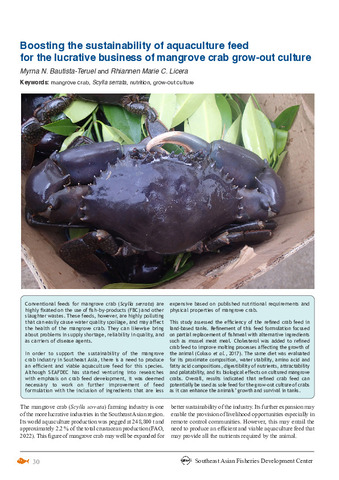
Boosting the sustainability of aquaculture feed for the lucrative business of mangrove crab grow-out culture
(Secretariat, Southeast Asian Fisheries Development Center, 2023-12)Conventional feeds for mangrove crab (Scylla serrata) are highly fixated on the use of fish-by-products (FBC) and other slaughter wastes. These feeds, however, are highly polluting that can easily cause water quality spoilage, and may affect the health of the mangrove crab. They can likewise bring about problems in supply shortage, reliability in quality, and as carriers of disease agents. In order to support the sustainability of the mangrove crab industry in Southeast Asia, there is a need to produce an efficient and viable aquaculture feed for this species. Although SEAFDEC has started venturing into researches with emphasis on crab feed development, it was deemed necessary to work on further improvement of feed formulation with the inclusion of ingredients that are less expensive based on published nutritional requirements and physical properties of mangrove crab. This study assessed the efficiency of the refined crab feed in land-based tanks. Refinement of this feed formulation focused on partial replacement of fishmeal with alternative ingredients such as mussel meat meal. Cholesterol was added to refined crab feed to improve molting processes affecting the growth of the animal (Coloso et al., 2017). The same diet was evaluated for its proximate composition, water stability, amino acid and fatty acid compositions, digestibility of nutrients, attractability and palatability, and its biological effects on cultured mangrove crabs. Overall, results indicated that refined crab feed can potentially be used as sole feed for the grow-out culture of crabs as it can enhance the animals’ growth and survival in tanks. -
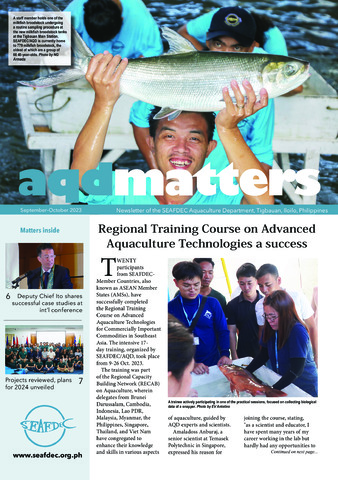
AQD Matters 2023 September - October
(Aquaculture Department, Southeast Asian Fisheries Development Center, 2023-12)In this issue: 1) Regional Training Course on Advanced Aquaculture Technologies a success; 2) SEAFDEC Secretary-General explores AQD stations in Iloilo, Guimaras; 3) SEAFDEC/AQD readies future tiger shrimp breeders as ... -
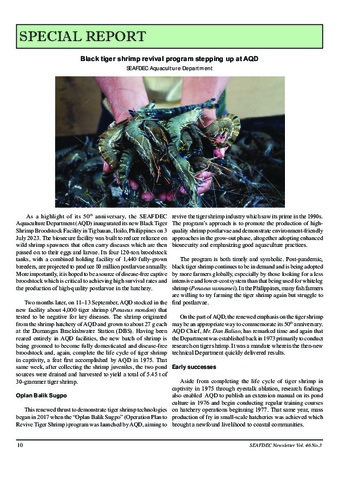
Black tiger shrimp revival program stepping up at AQD
(Secretariat, Southeast Asian Fisheries Development Center, 2023-11)As a highlight of its 50th anniversary, the SEAFDEC Aquaculture Department (AQD) inaugurated its new Black Tiger Shrimp Broodstock Facility in Tigbauan, Iloilo, Philippines on 3 July 2023. The biosecure facility was built to reduce reliance on wild shrimp spawners that often carry diseases which are then passed on to their eggs and larvae. Its four 120-ton broodstock tanks, with a combined holding facility of 1,440 fully-grown breeders, are projected to produce 80 million postlarvae annually. More importantly, it is hoped to be a source of disease-free captive broodstock which is critical to achieving high survival rates and the production of high-quality postlarvae in the hatchery. -
Metazoan parasites of Glossogobius giurus (Hamilton-Buchanan) from Naujan Lake, Oriental Mindoro, Philippines
(National Academy of Science and Technology, 1992)Thirty-five specimens of Glossogobius giurus (TL = 10.8-23.4 cm, wt. = 8.8-66.3 g) collected from Naujan Lake, Oriental Mindoro from May 1991 to February 1992 were examined for metazoan parasites. The parasite species recovered (their organ location in the host, prevalence (%) and intensity of infection range and mean number of parasites per infected fish) were Neochasmus microvatus (Tubangui, 1928) Tubangui and Masilungan, 1944, (Digenea: Cryptogonimidae), stomach and intestine, 48.6, 1-279 (45.1); Opegaster minima (Tubangui, 1928) Yamaguti, 1934, (Digenea: Opecoelidae), stomach and intestine, 37.1, 1-33 (8.7); larval Diplostomulum sp. Hughes, 1929 (Digenea: Diplostomidae), eyes, 25.7, 1-5 (1.8); and Lernaea cyprinacea L. (Crustacea: Copepoda), skin and muscle, 8.6, 1-2 (13). -
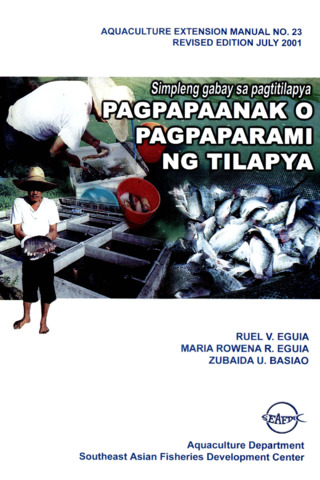
Series: Aquaculture extension manual; No. 23
Pagpapaanak o pagpaparami ng tilapya
; Eguia, Maria Rowena R.; Basiao, Zubaida U. (Aquaculture Department, Southeast Asian Fisheries Development Center, 2001-07)
The manual discusses spawning tilapia (Oreochromis spp.) in concrete tank hatcheries, and hapa hatcheries in ponds and lakes in the Philippines. Also included in the manual is a list of agencies involved in tilapia research, a glossary of technical terms, and useful references. -
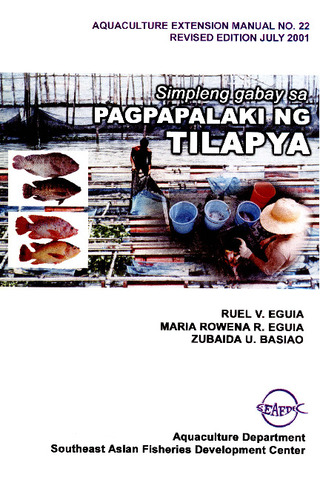
Series: Aquaculture extension manual; No. 22
Pagpapalaki ng tilapya
; Romana-Eguia, Maria Rowena R.; Basiao, Zubaida (Aquaculture Department, Southeast Asian Fisheries Development Center, 2001-07)
The manual discusses tilapia culture methods in concrete tanks, net cages, and fishponds. It details the species of tilapia cultured in the Philippines, which include Oreochromis niloticus, O. mossambicus, O. aureus. It covers the following: site selection; construction of netcages and its modules; fishpond construction and pond preparation; criteria for fry selection; stocking; netcage and pond management including water quality management; and harvest. The manual also lists the agencies involved in tilapia research and development in the Philippines; defines some technical terms in a glossary, and lists some useful references. -
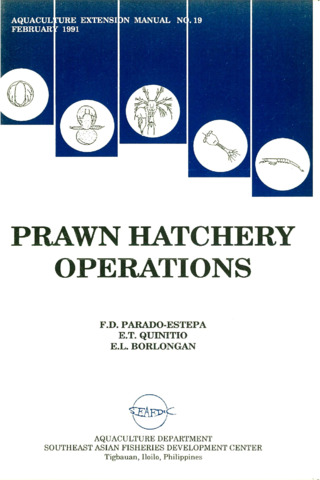
Series: Aquaculture extension manual; No. 19
Prawn hatchery operations
; Quinitio, Emilia T.; (Aquaculture Department, Southeast Asian Fisheries Development Center, 1991-02)
The manual, an updated version of the 1984 SEAFDEC/AQD manual, presents the underlying principles and step-by-step instructions of prawn larval and post-larval rearing. The techniques described are not only applicable to Penaeus monodon, but may also be modified and applied to other penaeid and metapenaeid species. The following aspects are covered: Site selection; Life cycle; Hatchery design and planning; Hatchery operations; Diseases; and Economics. -
Series: Aquaculture extension manual; No. 6
Manual on mussel farming
(Aquaculture Department, Southeast Asian Fisheries Development Center, 1979-09)Following a brief account of the biology of the green mussel (Perna viridis), a review is made of mussel farming techniques in the Philippines. The basic principles behind mussel farming are described, considering spatfall, site selection, and selection of suitable collector material. Farm construction and operation procedures are also described, and an examination is made of the economic aspects of mussel farming. -
Souvenir silver anniversary programme: 1973-1998 SEAFDEC AQD 25 years
(Aquaculture Department, Southeast Asian Fisheries Development Center, 1998)SEAFDEC Aquaculture Department was established in July 1973. It was mandated to (1) promote, undertake, and coordinate research that is necessary for the development of the aquaculture industry in the region; (2) train ... -
Distribution pattern and habitat use of the protandrous shrimp Pandalus latirostris in relation to environmental characteristics in Akkeshi waters on the pacific coast of eastern Hokkaido, Japan
Ito, Sayaka; ; ; ; ; ; ; ; (Elsevier, 2023-09)
A sampling of the protandric shrimp, Pandalus latirostris, was conducted at fixed sites from July 2015 to March 2020 in Akkeshi Bay and the connecting Lake Akkeshi on the Pacific coast of eastern Hokkaido. Based on the occurrence pattern of P. latirostris, most individuals begin mating as males at Age-1, followed by a sex change to females, spawn eggs as females at Age-2, and hatch their eggs in the spring of Age-3. Pre-hatching ovigerous females were mainly found in eelgrass beds near and in Lake Akkeshi, where the water temperature was relatively high. The females probably migrate there to hatch their eggs, making sure of the high survival and growth of the hatched larvae. Juveniles and small males were also abundant in near and in Lake Akkeshi, indicating that many larvae remained in the eelgrass beds where they hatched. These eelgrass beds play an important role in the maintenance of the shrimp population as a major egg-hatching site and nursery habitat in Akkeshi waters. With ontogenetic development, the occurrence rate of P. latirostris gradually increased on the offshore side of Akkeshi Bay, with its body size being larger. As P. latirostris grow, they will probably disperse to the offshore side of Akkeshi Bay. However, the density of P. latirostris in the eelgrass bed in the bay near the lake was extremely high, with its strong preference at all ontogenetic stages. This eelgrass bed would help maintain the shrimp population as a “key habitat” for the shrimp. The site-specific environmental characteristics of vegetation beds influence the distribution and abundance of individuals within a population of P. latirostris through their growth and the associated change in habitat preference. In this study, the importance of maintaining the diverse habitats of P. latirostris will be discussed as part of the shrimp stock management measures. -
Aquaculture governance: Five engagement arenas for sustainability transformation
Partelow, Stefan; Asif, Furqan ; Béné, Christophe ; Bush, Simon ; Manlosa, Aisa ; Nagel, Ben ; Schlüter, Achim ; ; Choudhury, Afrina ; Cole, Steven ; Cottrell, Richard ; ; Gentry, Rebecca ; Gephart, Jessica ; Glaser, Marion ; ; Jonell, Malin ; ; Kunzmann, Andreas ; Kuehnhold, Holger ; ; Marschke, Melissa ; ; Paramita, Adiska Octa ; ; ; Stentiford, Grant ; ; Troell, Max ; Turchini, Giovanni (Elsevier, 2023-12)
A greater focus on governance is needed to facilitate effective and substantive progress toward sustainability transformations in the aquaculture sector. Concerted governance efforts can help move the sector beyond fragmented technical questions associated with intensification and expansion, social and environmental impacts, and toward system-based approaches that address interconnected sustainability issues. Through a review and expert-elicitation process, we identify five engagement arenas to advance a governance agenda for aquaculture sustainability transformation: (1) setting sustainability transformation goals, (2) cross-sectoral linkages, (3) land–water–sea connectivity, (4) knowledge and innovation, and (5) value chains. We then outline the roles different actors and modes of governance can play in fostering sustainability transformations, and discuss action items for researchers, practitioners, and policymakers to operationalize activities within their engagement arenas.