SEAFDEC/AQD Institutional Repository: Recent submissions
Now showing items 141-160 of 4221
-
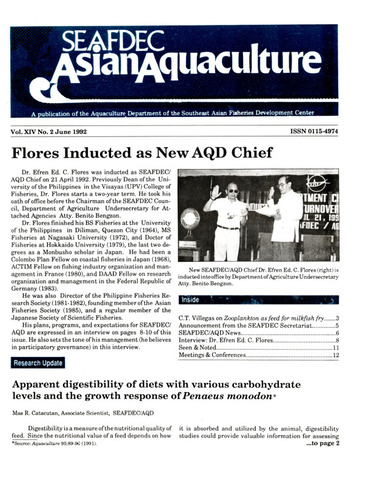
SEAFDEC Asian Aquaculture Volume 14(2) June 1992
(Aquaculture Department, Southeast Asian Fisheries Development Center, 1992-06)In this issue: 1) Flores inducted as new AQD Chief; 2) Research Update: Apparent digestibility of diets with various carbohydrate levels and the growth response of Penaeus monodon; 3) Zooplankton (Brachionus plicatilis and ... -
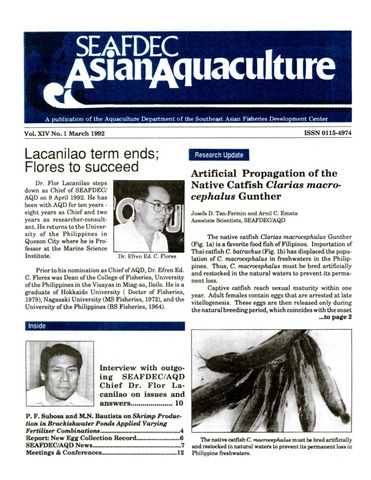
SEAFDEC Asian Aquaculture Volume 14(1) March 1992
(Aquaculture Department, Southeast Asian Fisheries Development Center, 1992-03)In this issue: 1) Lacanilao term ends; Flores to succeed; 2) Research Update: Artificial propagation of the native catfish Clarias macrocephalus Gunther; 3) Shrimp (Penaeus monodon Fabricius) production in brackishwater ... -
Comparison of reproductive aspects of the tropical eel Anguilla bicolor (McClelland 1884) in freshwater and estuarine habitats
; Susilo, Untung ; Aya, Frolan (Marine Science Department, Diponegoro University, 2023-09-07)
The tropical anguillid eel, Anguilla bicolor McClelland, experiences significant growth up to the adult size in both freshwater and estuarine ecosystems, encountering salinity gradients that may impact their reproduction. Therefore, this study aimed to investigate the reproductive aspects of A. bicolor collected from Serayu River (freshwater) and Segara Anakan (estuary), Cilacap, Central Java, during July 2020 field surveys. The examined parameters included eye index (EI), fin index (FI), gonadosomatic index (GSI), hepatosomatic index (HSI), and sex ratio of eel specimens in freshwater and estuary. Furthermore, the total length (TL) and body weight (BW) ranged from 260 - 630 mm and 18 - 419 g in freshwater, and 260 - 630 mm and 18 - 447 g in estuary. Significant differences (P<0.01) were observed in the reproductive characteristics between the two habitats (P<0.01), with higher eye index, fin index, gonadosomatic index, and hepatosomatic index in freshwater-caught eels than the values obtained in estuary inhabitants. The mean of these four parameters were 6.99 ± 2.98%, 4.08 ± 0.71%, 1.70 ± 1.13%, and 1.92% ± 1.07 in freshwater, while 3.48 ± 1.60%, 3.45 ± 0.479%, 1.12 ± 0.23%, and 0.28 ± 0.19% were found in estuary. The sex ratio was significantly affected by habitat, with female eels dominating in freshwater (62.5%) compared to estuary (32%). These results suggested that eels in freshwater habitats might exhibit early gonadal maturation compared to those in estuary.
; Aya, Frolan (Marine Science Department, Diponegoro University, 2023-09-07)
The tropical anguillid eel, Anguilla bicolor McClelland, experiences significant growth up to the adult size in both freshwater and estuarine ecosystems, encountering salinity gradients that may impact their reproduction. Therefore, this study aimed to investigate the reproductive aspects of A. bicolor collected from Serayu River (freshwater) and Segara Anakan (estuary), Cilacap, Central Java, during July 2020 field surveys. The examined parameters included eye index (EI), fin index (FI), gonadosomatic index (GSI), hepatosomatic index (HSI), and sex ratio of eel specimens in freshwater and estuary. Furthermore, the total length (TL) and body weight (BW) ranged from 260 - 630 mm and 18 - 419 g in freshwater, and 260 - 630 mm and 18 - 447 g in estuary. Significant differences (P<0.01) were observed in the reproductive characteristics between the two habitats (P<0.01), with higher eye index, fin index, gonadosomatic index, and hepatosomatic index in freshwater-caught eels than the values obtained in estuary inhabitants. The mean of these four parameters were 6.99 ± 2.98%, 4.08 ± 0.71%, 1.70 ± 1.13%, and 1.92% ± 1.07 in freshwater, while 3.48 ± 1.60%, 3.45 ± 0.479%, 1.12 ± 0.23%, and 0.28 ± 0.19% were found in estuary. The sex ratio was significantly affected by habitat, with female eels dominating in freshwater (62.5%) compared to estuary (32%). These results suggested that eels in freshwater habitats might exhibit early gonadal maturation compared to those in estuary. -
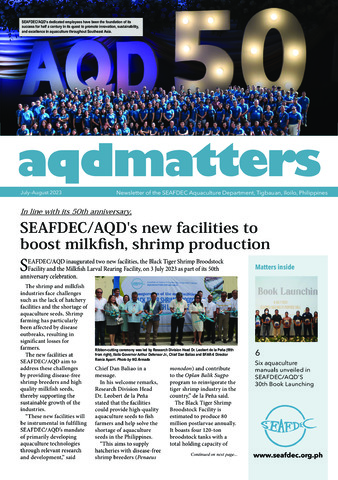
AQD Matters 2023 July - August
(Aquaculture Department, Southeast Asian Fisheries Development Center, 2023-10)In this issue: 1) SEAFDEC/AQD's new facilities to boost milkfish, shrimp production; 2) Chief Baliao graces bilateral talk between PH, Papua New Guinea; 3) Executive Committee members engage in dialogue at global aquaculture ... -
Incorporation of fatty acids from dietary neutral lipid in eye, brain and muscle of postlarval turbot fed diets with different types of phosphatidylcholine
Geurden, Inge; ; ; ; (Springer, 1998)
Previous results demonstrated the stimulating effect of soybean phosphatidylcholine (PC) on the utilization of dietary neutral lipid in larval and postlarval fish. The present study further investigated the effect of the degree of saturation of dietary PC on the enhancement of dietary fatty acid incorporation in lipids of turbot. Newly-weaned turbot were fed for 20 days on four isolipidic diets containing the same amount of highly unsaturated fatty acids (HUFA), presented either as neutral lipid, i.e. fish oil ethyl esters, or as polar lipid. Diet FO was a phospholipid-free control diet. Diets HPC, SPC and FPC were supplemented with 3% hydrogenated soybean PC, 3% native soybean PC and 3% marine fish roe PC, respectively. The three PC-supplemented diets resulted in better growth and higher muscle triacylglycerol levels than the PC-free diet FO. The fish fatty acids were determined in 3 lipid classes (neutral lipid, PC, phosphatidylethanolamine) of 3 organs or tissues (eye, brain and muscle). Despite the identical amounts of n-6 and n-3 fatty acids provided by the soybean oil and by the HUFA ethyl esters, the substitution of 3% hydrogenated coconut oil in diet FO by 3% hydrogenated PC in diet HPC caused, averaged over the various tissues and lipid classes, a 7 to 12% higher incorporation of 18:2n-6, 20:4n-6, 20:5n-3 and a 32% higher 22:6n-3 level in turbot lipid. Diet HPC appeared as efficient as diet SPC for enhancing the incorporation of the n-3 HUFA from the ethyl esters. Feeding diet FPC, in which the n-3 HUFA were provided through the marine PC source, resulted in slightly higher levels of these fatty acids in the fish than feeding the ethyl ester HUFA diets, even if supplemented with PC. Present results confirm the positive effect of PC, either hydrogenated or native, on the utilization of fatty acids provided in the diet as neutral lipid. The slightly higher incorporation of HUFA, when esterified on dietary PC instead of neutral lipid, raises the question regarding the form of intestinal absorption of PL in fish. -
Asian Aquaculture Volume 3(8) August 1980
(Aquaculture Department, Southeast Asian Fisheries Development Center, 1980-08)In this issue: 1) Philippine aquaculture scenario revisited; 2) Sexual maturation of milkfish in floating cages; 3) The induced spawning of captive milkfish; 4) Edible crustaceans in the Philippines; 5) Staffing of aquaculture ... -
Asian Aquaculture Volume 3(9) September 1980
(Aquaculture Department, Southeast Asian Fisheries Development Center, 1980-09)In this issue: 1) Training program becomes broader; 2) Philippine aquaculture scenario revisited; 3) Fishpen and cage farming in the Philippines; 4) Growth and survival of milkfish in a polyculture system; 5) Edible ... -
Asian Aquaculture Volume 3(7) July 1980
(Aquaculture Department, Southeast Asian Fisheries Development Center, 1980-07)In this issue: 1) The inception of the Aquaculture Department: 7th Anniversary background report; 2) Japanese ambassador expresses interest in aquaculture programs; 3) Staffing of aquaculture business projects; 4) Edible ... -
Asian Aquaculture Volume 3(5) May 1980
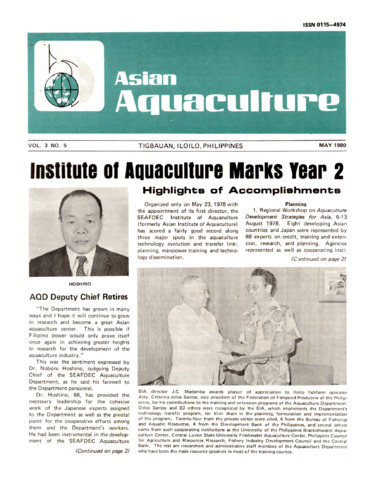
(Aquaculture Department, Southeast Asian Fisheries Development Center, 1980-05)In this issue: 1) Institute of Aquaculture marks year 2: Highlights of accomplishments; 2) AQD Deputy Chief retires; 3) Aquaculture credit schemes; 4) Management of fishponds with acid sulfate soils; 5) Edible crustaceans ... -
Asian Aquaculture Volume 3(6) June 1980
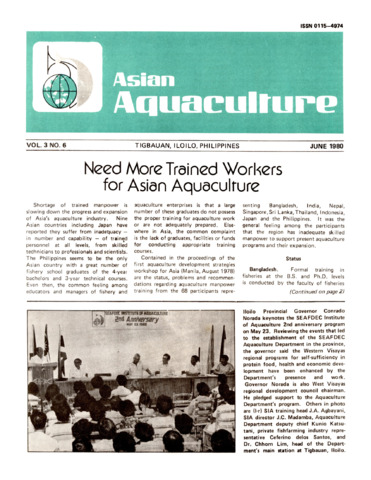
(Aquaculture Department, Southeast Asian Fisheries Development Center, 1980-06)In this issue: 1) Need more trained workers for Asian aquaculture; 2) 29 Asians attend international training programs of AQD; 3) Management of fishponds with acid sulfate soils; 4) Edible crustaceans in the Philippines; ... -
Asian Aquaculture Volume 3(4) April 1980
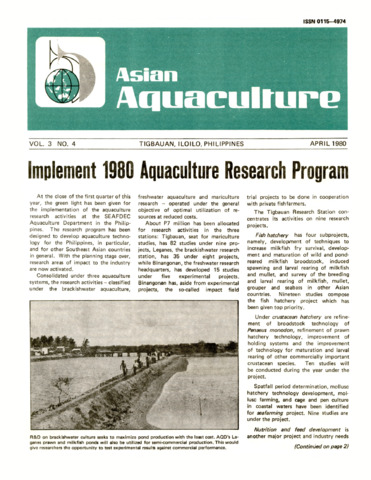
(Aquaculture Department, Southeast Asian Fisheries Development Center, 1980-04)In this issue: 1) Implement 1980 Aquaculture Research Program; 2) Aquaculture credit schemes; 3) Management of fishponds with acid sulfate soils; 4) Edible crustaceans in the Philippines; 5) New fish hatchery for third ... -
Asian Aquaculture Volume 3(1) January 1980
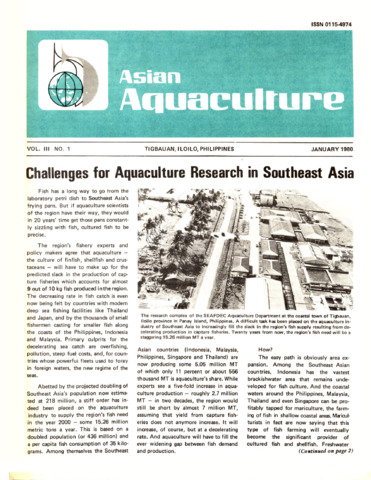
(Aquaculture Department, Southeast Asian Fisheries Development Center, 1980-01)In this issue: 1) Challenges for aquaculture research in Southeast Asia; 2) Mindanao farmers train in aquaculture; 3) Integrated crop-livestock-fish farming in the Philippines; 3) Edible crustaceans in the Philippines; 4) ... -
Asian Aquaculture Volume 3(2) February 1980
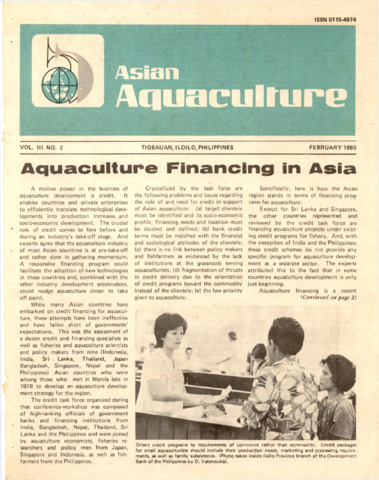
(Aquaculture Department, Southeast Asian Fisheries Development Center, 1980-02)In this issue: 1) Aquaculture financing in Asia; 2) Aquaculture in Guatemala; 3) Economic analysis of single-commodity and integrated farming in Taiwan; 4) Edible crustaceans in the Philippines; Notes from our readers -
Asian Aquaculture Volume 3(3) March 1980
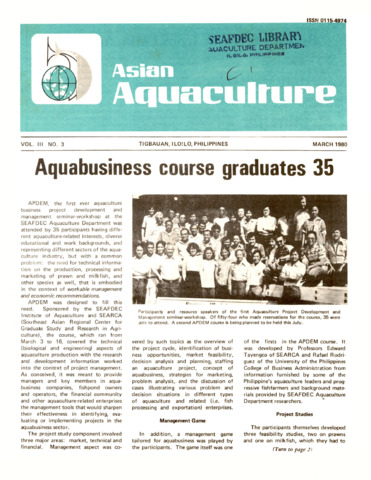
(Aquaculture Department, Southeast Asian Fisheries Development Center, 1980-03)In this issue: 1) Aquabusiness course graduates 35; 2) Research news from Latin America; 3) Integrated farming with fish as the major enterprise; 4) Prospects of cage and pen culture in Sri Lanka; 5) Edible crustaceans in ... -
Alternate day feeding as a cost-effective strategy for tank culture of the Pacific shortfin eel Anguilla bicolor pacifica
Aya, Frolan; ; Romana-Eguia, Maria Rowena R. ; (College of Agriculture and Food Science, University of the Philippines Los Baños, 2023-09)
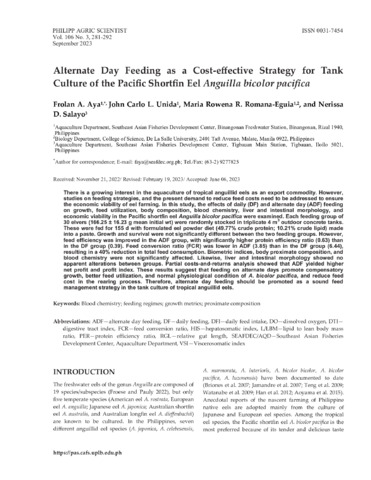
There is a growing interest in the aquaculture of tropical anguillid eels as an export commodity. However, studies on feeding strategies, and the present demand to reduce feed costs need to be addressed to ensure the economic viability of eel farming. In this study, the effects of daily (DF) and alternate day (ADF) feeding on growth, feed utilization, body composition, blood chemistry, liver and intestinal morphology, and economic viability in the Pacific shortfin eel Anguilla bicolor pacifica were examined. Each feeding group of 30 elvers (166.25 ± 16.23 g mean initial wt) were randomly stocked in triplicate 4 m3 outdoor concrete tanks. These were fed for 155 d with formulated eel powder diet (49.77% crude protein; 10.21% crude lipid) made into a paste. Growth and survival were not significantly different between the two feeding groups. However, feed efficiency was improved in the ADF group, with significantly higher protein efficiency ratio (0.63) than in the DF group (0.39). Feed conversion ratio (FCR) was lower in ADF (3.85) than in the DF group (6.44), resulting in a 40% reduction in total feed consumption. Biometric indices, body proximate composition, and blood chemistry were not significantly affected. Likewise, liver and intestinal morphology showed no apparent alterations between groups. Partial costs-and-returns analysis showed that ADF yielded higher net profit and profit index. These results suggest that feeding on alternate days promote compensatory growth, better feed utilization, and normal physiological condition of A. bicolor pacifica, and reduce feed cost in the rearing process. Therefore, alternate day feeding should be promoted as a sound feed management strategy in the tank culture of tropical anguillid eels. -
Asian Aquaculture Volume 2(12) December 1979
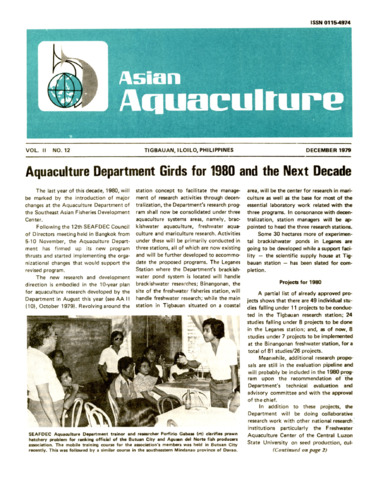
(Aquaculture Department, Southeast Asian Fisheries Development Center, 1979-12)In this issue: 1) Aquaculture Department girds for 1980 and the next decade; 2) Integrated crop-livestock-fish farming in Malaysia; 3) Sawdust shows promise as shipping medium for prawns; 4) Edible crustaceans in the ... -
Asian Aquaculture Volume 2(10) October 1979
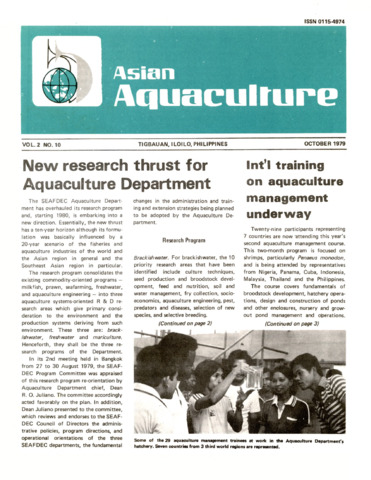
(Aquaculture Department, Southeast Asian Fisheries Development Center, 1979-10)In this issue: 1) New research thrust for Aquaculture Department; 2) Int'l training on aquaculture management underway; 3) Manual on mussel farming off the press; 4) Some general guides and cost estimates for a small-scale ... -
Asian Aquaculture Volume 2(11) November 1979
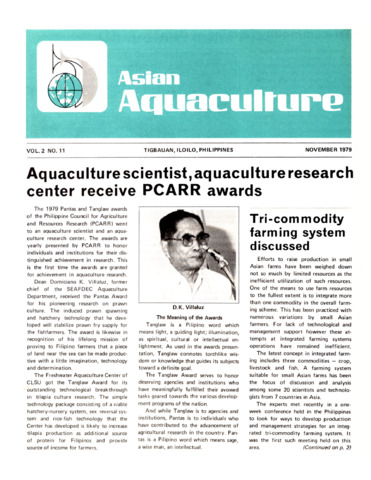
(Aquaculture Department, Southeast Asian Fisheries Development Center, 1979-11)In this issue: 1) Aquaculture scientist, aquaculture research center receive PCARR awards; 2) Tri-commodity farming system discussed; 3) Integrated fish farming in Thailand; 4) Some general guides and cost estimates for a ... -
Asian Aquaculture Volume 2(8) August 1979
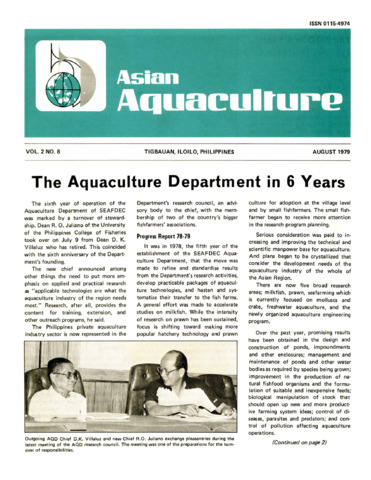
(Aquaculture Department, Southeast Asian Fisheries Development Center, 1979-08)In this issue: The Aquaculture Department in 6 years; Raising quality fish seed in floating nurseries in India; Edible crustaceans in the Philippines; D.K. Villaluz: Pioneer; How to test hatchability of Artemia cysts -
Asian Aquaculture Volume 2(9) September 1979
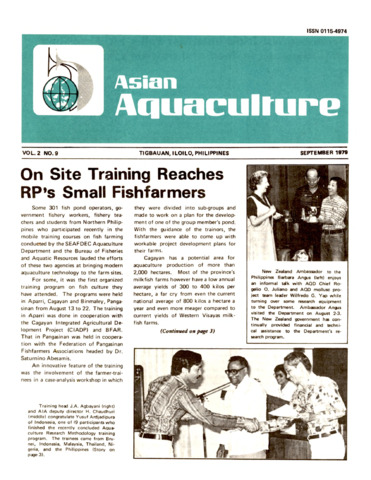
(Aquaculture Department, Southeast Asian Fisheries Development Center, 1979-09)In this issue: On site training reaches RP's small fishfarmers; Japanese nutrition scientist talks on directions and advances in feed and nutrition research; Farming lobsters in compartments; 18 from Asia, 1 from Africa ...