SEAFDEC/AQD Institutional Repository: Recent submissions
Now showing items 61-80 of 4221
-
Resistance to heavy metal mixture in Oreochromis niloticus progenies of parents chronically exposed to the same metals
Cuvin-Aralar, Maria Lourdes ; (Elsevier, 1995)
Our inland waters continue to suffer from pollution. This has resulted in prolonged exposure of fish and other organisms to pollutants. This study was carried out to determine some of the possible long-term effects of exposure to heavy metals in the Nile tilapia, Oreochromis niloticus. One month old 0. nifoticus fingerlings were exposed for 2 months to a mixture of 0.01 mg per 1 Hg, 0.1 mg per 1 Cd and 1.0 mg per 1 Zn. The survivors were grown to sexual maturity in a natural environment (lake) then spawned. Results showed that the exposed 0. niloticus can recover from the prolonged exposure to the metals as demonstrated by their spawning success and fry survival which was comparable to the unexposed group. This could be because the accumulated heavy metals were eliminated by the fish during the lake grow-out phase. By the time the fish were spawned, they have eliminated the 85 to 98% of the heavy metals from their body. The progenies of the exposed parents (EP) were subsequently exposed to another mixture of the three metals: 3.0 mg per 1 Zn, 0.30 mg per 1 Cd and 0.01 mg per 1 Hg, in both static and static-renewal system. Another group from unexposed parents( UP) received the same treatment. Results showed that in both exposure systems, the survival of the progeny of EP was significantly higher (P < 0.05) than the those from UP. Survival was three to five times better in the progenies of EP than those of UP. Exposure of the parental stock resulted in the culling out of individuals which were more susceptible to the heavy metals. The more resistant members of the population (the survivors) which have the ability to adapt to the toxicants were able to pass on the resistance to their offspring. The results are supported by other studies which demonstrate high resistance in populations of organisms living in contaminated sites.
; (Elsevier, 1995)
Our inland waters continue to suffer from pollution. This has resulted in prolonged exposure of fish and other organisms to pollutants. This study was carried out to determine some of the possible long-term effects of exposure to heavy metals in the Nile tilapia, Oreochromis niloticus. One month old 0. nifoticus fingerlings were exposed for 2 months to a mixture of 0.01 mg per 1 Hg, 0.1 mg per 1 Cd and 1.0 mg per 1 Zn. The survivors were grown to sexual maturity in a natural environment (lake) then spawned. Results showed that the exposed 0. niloticus can recover from the prolonged exposure to the metals as demonstrated by their spawning success and fry survival which was comparable to the unexposed group. This could be because the accumulated heavy metals were eliminated by the fish during the lake grow-out phase. By the time the fish were spawned, they have eliminated the 85 to 98% of the heavy metals from their body. The progenies of the exposed parents (EP) were subsequently exposed to another mixture of the three metals: 3.0 mg per 1 Zn, 0.30 mg per 1 Cd and 0.01 mg per 1 Hg, in both static and static-renewal system. Another group from unexposed parents( UP) received the same treatment. Results showed that in both exposure systems, the survival of the progeny of EP was significantly higher (P < 0.05) than the those from UP. Survival was three to five times better in the progenies of EP than those of UP. Exposure of the parental stock resulted in the culling out of individuals which were more susceptible to the heavy metals. The more resistant members of the population (the survivors) which have the ability to adapt to the toxicants were able to pass on the resistance to their offspring. The results are supported by other studies which demonstrate high resistance in populations of organisms living in contaminated sites. -
Integration of aquaculture and mangroves
Primavera, Jurgenne (University of Miami - Rosenstiel School of Marine, Atmospheric & Earth Science, 2007)
Southeast Asia has the highest concentration of mangroves and brackish water aquaculture ponds. This paper describes studies that integrate mangroves as biofilters, and as pen culture sites for mud crab farming. In one study, passing shrimp pond effluents through a natural mangrove stand reduced levels of TSS, sulfide, NH3-N and NO3-N by 18.7%–64.2%. Estimates show that 1.4–6.5 ha of mangroves are needed to assimilate nitrogen wastes from one hectare of shrimp pond. Mangrove biomass increase was 2.5 times greater with effluents compared to a control mangrove, although plant numbers remained similar. Present mud crab Scylla spp. farming still depends on raw (“trash”) fish and wild seed. To lessen such dependence, another study compared the stocking of hatchery vs wild juveniles, and feeding of pellet + raw fish (“trash fish”) vs fish alone. Preliminary results show that low-cost pellets can reduce raw fish requirement, and that hatchery crab juveniles need immediate feeding whereas wild crabs can subsist on natural mangrove productivity for one month. Mud crab pen culture is commercially viable but technological refinements and land tenure issues remain. -
Fish breeding and seed production research in the Philippines: Status, constraints and prospects
(Elsevier, 1995)Five marine fish species (milkfish, Chunos chanos; Asian sea bass, Lates calcarifer; grouper, Epinephelus coioides; rabbitfish, S&anus guttatus; snapper, Lutjanus argentimuculatus) and three freshwater fish species (tilapia, Oreochromes niloticus; bighead carp, Aristichthys nobilis; Asian catfish, Clarias macrocephalus) of commercial importance are currently the subjects of breeding and seed production research in the Philippines, primarily at the SEAFDEC Aquaculture Department. Natural and induced spawning of milkfish have been achieved. Although seed production is now a commercial enterprise, work on hormonal induction of off-season maturation is being pursued to obtain fry during periods when these are scarce. Hormone regimes to manipulate spawning and advance maturation in sea bass have been developed, while hormone-induced spawning of rabbitfish and snapper have been achieved. Studies on hormonal induction of sex inversion in juvenile and adult groupers are being undertaken. Research programs to develop and select improved tilapia strains and chromosomal manipulation for production of all-male tilapia hybrids are under way in several aca- demic and research institutions. Work on induced and spontaneous spawning of the Asian catfish, an endangered species in the Philippines, has recently started while research on bighead carp addresses problems such as alternative agents for spawning and declining reproductive performance of inbred stocks. With few exceptions, fish breeding research in the Philippines is production-oriented and empha- sizes development of practical methods adapting those developed for other fish species. Because of technical, institutional, and funding constraints, very limited work can be done to investigate the physiological mechanisms regulating reproduction, development and growth in any of these species. Attempts to apply information gathered from other species to our local species have met with both success and failure, and reasons to explain these results have been mainly speculative. Because of the varied species available for research, there is a wide room in which to investigate specific problems that are currently of interest to comparative endocrinologists. This can only be done in collaboration with other institutions in developed countries carrying out similar research. -
Bioremediation of oil spills: Current status, challenges, and future prospects
Navarro, Jebrham; Caipang, Christopher Marlowe (Faculty of Biotechnology and Food Sciences, Slovak University of Agriculture in Nitra, 2024-03-22)
The petrochemicals produced from refining oil have become a large part of human life, making oil a valuable and expensive commodity. As a non-renewable resource, extraction and transport efforts have intensified to keep up with the demand, increasing the occurrences of oil spills. Such accidents have devastating impacts on the environment, the health of organisms, and a country's economy like the Philippines, and thus, need to be resolved immediately. One way to deal with oil spills is through bioremediation but the process is still facing several challenges. For one, the toolbox for bioremediation is limited. About 79 genera of bacteria were observed to degrade oil but there are only a small number of bacterial species and/or strains that have been recognized as useful for bioremediation. Second is that most oil-degrading bacteria found have low oil degradation efficiencies. Another challenge is keeping the bacteria alive to carry out the process. Fortunately, progress has been made in solving these challenges. Researchers are now testing different consortia, including bacteria–bacteria, bacteria–fungi, bacteria–microalgae, that can complement each other such as biosurfactant-producing bacteria with different oil-degrading microorganisms or microalgae or fungi that enhance the growth of oil-degrading bacteria. A consortium like this improves the survivability of each microorganism and enhances the oil-degrading efficiency. Moreover, the search for additional oil-degrading and biosurfactant-producing bacteria and other microorganisms to add to the bioremediation toolbox has been improved with the emergence of high-throughput sequencing. Aside from microorganisms, seaweeds have shown potential for bioremediation. The seaweed Caulerpa prolifera has been demonstrated to degrade diesel up to a certain concentration with the help of the bacteria growing on its surface. Bioremediation has a long way to go, but recent developments have shown promise and it remains to be the cheapest, most environment-friendly, and most effective way of dealing with oil spills. -
AQD Matters 2024 September - October
(Aquaculture Department, Southeast Asian Fisheries Development Center, 2024-11)In this issue: SEAFDEC-NFRDI collab reaps 3 tons of shrimp; Scientist completes study visit in Japan to enhance SEAFDEC/AQD's research on eels; SEAFDEC/AQD collects seaweeds for tissue propagation; SEAFDEC/AQD explores ... -
In vivo fitness correlates with host-specific virulence of infectious hematopoietic necrosis virus (IHNV) in sockeye salmon and rainbow trout
(Elsevier, 2011)The relationship between virulence and overall within-host fitness of the fish rhabdovirus Infectious hematopoietic necrosis virus (IHNV) was empirically investigated in vivo for two virus isolates belonging to different IHNV genogroups that exhibit opposing host-specific virulence. U group isolates are more virulent in sockeye salmon and M group isolates are more virulent in rainbow trout. In both single and mixed infections in the two fish hosts, the more virulent IHNV type exhibited higher prevalence and higher viral load than the less virulent type. Thus, a positive correlation was observed between higher in vivo fitness and higher host-specific virulence in sockeye salmon and rainbow trout. Comparisons of mean viral loads in single and mixed infections revealed no evidence for limitation due to competition effects between U and M viruses in either rainbow trout or sockeye salmon co-infections. -
SEAFDEC International Workshop on Emerging Fish Diseases in Asia, Bangkok, Thailand, 6-7 December 2007: Overview
(Society of Israeli Aquaculture and Marine Biotechnology, 2009) -
SEAFDEC International Workshop on Emerging Fish Diseases in Asia, Bangkok, Thailand, 6-7 December 2007: Message from Hiroshi Ogata
(Society of Israeli Aquaculture and Marine Biotechnology, 2009) -
Vegetation's role in coastal protection: Response
; ; ; ; ; Primavera, Jurgenne; ; ; ; ; ; ; ; ; ; (American Association for the Advancement of Science, 2008)
-
Commercial pelleted milkfish (Chanos chanos Forsskal) feeds: Physical characteristics and nutrient contribution to water quality in milkfish farming
(University Research Office, St. Paul University Iloilo, 2006)In milkfish farming, when food wastage is high and assimilation is poor, most of the nutrients added to the culture species may ultimately pollute the environment. Assessment of water dispersion from ponds and cages rarely take into account the physical properties of feeds. This study dealt with settling velocity, physical stability, and the amount of nutrients (nitrogen and phosphorus) generated by milkfish feeds alone in water. Four locally manufactured milkfish (Chanos chanos) pelleted feeds labeled as: Grower A, Grower B, Grower C, and Finisher D were tested, with freshwater, brackishwater and seawater as test media. Settling velocities of the four feeds were generally greater in freshwater than in brackishwater and in seawater, ranging from 11.0-11.5 cm s-1 for 6-8. mm long pellets, and 12.8.0-13.0 cm s-1 for 9-11 mm pellets with Milkfish Finisher D. In brackishwater, settling velocities of size ranges 6-8 and 9-11 mm long were 9.8-10.0 and 11.0-11.6 cm s-1 respectively. In seawater, settling rates of milkfish feeds were 8.0-8.5 and 9.8-10.1 cm s-1, for the same size ranges. There was no significant difference on the settling velocities among feed brands tested but significantly different within water types (P> 0.05). Water stability of these pellets was tested within 15, 30, 60 and 120 minutes immersion time. The four-feeds tested showed a range of water stability of 84.4-87% for the first 15 min in seawater, 70-82 % in brackishwater and 74-82% in freshwater. They are not that water stable after one hour with water stability of 35-40%. Nutrient contribution assessment of these feeds was also carried out by submersion test. Total ammonia nitrogen (TAN) concentrations in freshwater generated by the four feeds were low and were not that significant during the first two days. Values abruptly rose above the initial concentrations of 0.04 to 3.25-6.97 mg l-1 on the6th day of submersion. In freshwater, Grower A had the highest TAN concentration value of 6.97 mg l-1 and Grower D had the lowest value of 0.1 mg l-1. Nitrite concentration was low at a range of 0.01-0.04 mg l-1 while nitrate ranged from 0.1-0.76 mg l-1 for all the feeds. In brackishwater, TAN concentrations steadily rose to a range of 2.5-3.5 mg l-1 in all feeds, while in seawater a lower concentration than the brackishwater of 0-1.2 mg l-1 within 7 days of submersion was obtained. Phosphate-P concentrations rose on the second day of submersion in all test media and abruptly fell on the fifth day. Grower B gave the highest phosphate concentration of 1.55 mg l-1 in freshwater and 1.44 mg l-1 in brackishwater by the same feed and 2.0 mg l-1 by Grower A in seawater. ANOVA showed no significant differences among the feeds in terms of N and P concentrations obtained within seven days of submersion (P< 0.05). Nutrient inputs from feed undergo nutrient transformation and nutrient buildup was very apparent especially in freshwater and in brackishwater. The results of this study are measures of the significance of physical properties and nutrient releases of commercial feeds on the water quality of milkfish culture system. Data gathered can be applied into feeding management techniques, selection of good quality feeds and can be incorporated into models defining the impact of pollution from commercial feeds on the environment. -
Daily expression patterns for mRNAs of GH, PRL, SL, IGF-I and IGF-II in juvenile rabbitfish, Siganus guttatus, during 24-h light and dark cycles
(Elsevier, 2006)Most animals respond to changes in the external environment in a rhythmic fashion. In teleost fishes, daily rhythms are observed in plasma concentrations of some hormones but it is not clear whether these rhythms are exogenous or are entrained by predictable cues. We investigated whether the expression patterns for the mRNAs of growth hormone (GH), prolactin (PRL) and somatolactin (SL) in the pituitary gland, and insulin-like growth factor-I and II (IGF-I and IGF-II) in the liver, follow a daily rhythm when juvenile rabbitfish (Siganus guttatus) are reared under a normal 24-h light and dark cycle (LD), and when they are exposed to either continuous light (LL) or darkness (DD). Hormone mRNA levels were determined by real time PCR. Under LD conditions, GH mRNA expression in the pituitary was significantly lower during the light phase than during the dark phase suggesting a diurnal rhythm of expression. The rhythm disappeared when fish were exposed to LL or DD conditions. PRL mRNA expression pattern was irregular in all 3 conditions. Very low levels of SL mRNA were observed during the mid day under LD conditions. The expression pattern of SL mRNA became irregular under LL and DD conditions. No pattern could be observed in the expression profile of IGF-I and II mRNA in the liver during LD and LL conditions but a single peak in mRNA level was observed under DD conditions in both IGF-I and II. The results indicate that except for GH, the daily expression pattern for the mRNAs of the hormones examined do not seem to follow a rhythm according to light and dark cycles. -
Localization of enzymes in the digestive tract during the larval to early juvenile stages of sea bass (Lates calcarifer Bloch)
Minjoyo, Herno; ; (Agency for Marine and Fisheries Research and Development, 2003)
The onset of digestive enzymes in the various regions of the digestive tract of sea bass, Lates calcarifer (Bloch) at days 0. 2, 5, 10, 20, 30, and 40 after hatching was investigated. This study aims to correlate which enzymes are detectable in stated regions of the developing gut and to relate this pattern to the feeding habit of sea bass. Alkaline phosphatase and esterase were localized in the intestine of the 2 day old larvae. At 5 days post-hatching, esterase was present in the esophagus. At the beginning of metamorphosis (20-days post-hatching), alkaline phosphatase, esterase, and amino peptidase were localized in the pyloric caeca. Aminopeptidase's and lipase were observed in the brush border of the intestinal epithelial cells. At the end of metamorphosis (30-days-post-hatching), all enzymes investigated in this study were present. Esterase was demonstrated in the columnar cells of the stomach while lipase and amylase were observed in both columnar cells and gastric glands. Protease and amylase were present in the pyloric caeca and intestine. During the early juvenile stage (40-days-post-hatching), esterase was localized in the gastric glands of the stomach. The appearance of esterase activity as early as day 2 was correlated with endogenous to zooplanktivorous feeding. In the same manner, the presence of aminopeptidase's, lipase, protease, and amylase at day 20 to 30 onwards was related to a change in feeding habit of sea bass from zooplanktivorous to real carnivorous. The findings of this study demonstrate the need for basic studies for feed formulation and management of the fish. -
SEAFDEC/AQD highlights 2023
(Aquaculture Department, Southeast Asian Fisheries Development Center, 2024-11)SEAFDEC/AQD highlights 2023 is SEAFDEC/AQD's annual report updating on its accomplishments and progress for the year 2023. -
Comparative morphology and function of feeding appendages in food intake behaviour of the whiteleg shrimp, Litopenaeus vannamei, and the giant freshwater prawn, Macrobrachium rosenbergii
; Bagarinao, Teodora; ; Yong, Annita Seok Kian ; (Universiti Malaysia Sabah (UMS), 2018-12-04)
Combining feeding appendage morphology and behavioural observation of the motion pattern of the feeding appendages clarified many aspects underlying the feeding processes of the giant freshwater prawn (Macrobrachium rosenbergii) and the marine whiteleg shrimp (Litopenaeus vannamei) in aquaria. The food intake behaviour was video recorded during eating pellet food, pieces of fresh squid and fish. While M. rosenbergii took pellet one by one, L. vannamei picked up many pellets at one time and held them at the mouth with the 3rd maxilliped endopods and the 1st walking legs. Both species used the right chelate walking legs rather than the left walking legs to pick up the food. The 3rd walking legs of L. vannamei were longest and heaviest among the chelate walking legs but their major role was not for feeding but for feeding contests aggression. While M. rosenbergii easily crunched pellets by the mandibles, L. vannamei did not crunch pellets due to the softer and not strong mandibles and frequently spat out them, indicating that the present hard pellets are not suitable for L. vannamei. Both species kept a piece of elastic fresh squid or fish flesh at the mouth and tore the food into small pieces with the help of repeated pulling down motion of the 3rd maxilliped endopods. However, the mandible teeth of the two spices were not sharp enough to gnaw off the fibrous muscle in one bite. The 2nd and 3rd maxilliped endopods were used for holding food at the mouth and did not contribute to mastication of food. The 2nd and 3rd maxilliped exopods exhibited the horizontal fanning motion, which a unidirectional water flow moving backwards in the gill chamber (visualized with milk). The maxilliped exopods were found to contribute not to feeding but ventilation. Based on the results obtained, development of softer pellets was recommended for L. vannamei. -
Shrimp health management and disease control to sustain fish production in Thailand
(Society of Aquaculture Engineers of the Philippines, Inc., 1997)This technology search was funded by the Global Technology Search (GTS) Program of the Department of Science and Technology (DOST) through the Technology Application and Promotion Institute (TAPI) upon recommendation and endorsement of the Philippine Council for Aquatic and Marine Research and Development (PCAMRD). The program expands the research and development (R&D) arena outside the country. Through a well-planned and thoroughly developed scheme, appropriate technologies are obtained from outside sources to shorten the R&D process and keep the country abreast on the most recent developments in science and technology (S&T). The search for technologies on sustainable shrimp culture in ponds was successfully undertaken in Thailand by the authors during the period 02-15 September 1997. Travel arrangements and funding were arranged by sponsoring agency. Researchers from the Thai National Institute of Coastal Aquaculture (NICA) and the Aquatic Animal Health Research Institute (AAHRI), who were responsible for sustainable shrimp culture in Thailand guided us in our search. Information were gathered from small- medium- and large-scale shrimp farming operators in south, central and east Thailand. -
Tilapia in natural waters of the Philippines
(Society of Aquaculture Engineers of the Philippines, Inc., 1996)Contribution of Mr. Alejandro E. Santiago as Discussant to the Workshop on Freshwater Aquaculture, 11th Annual Meeting of the Society of Aquaculture Engineers. -
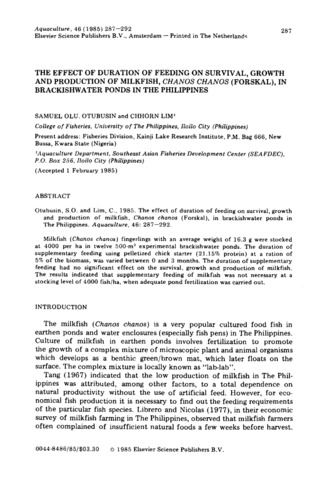
The effect of duration of feeding on survival, growth and production of milkfish, Chanos chanos (Forskal), in brackishwater ponds in the Philippines
(Elsevier, 1985-06)Milkfish (Chanos chanos) fingerlings with an average weight of 16.3 g were stocked at 4000 per ha in twelve 500-m2 experimental brackishwater ponds. The duration of supplementary feeding using pelletized chick starter (21.15% protein) at a ration of 5% of the biomass, was varied between 0 and 3 months. The duration of supplementary feeding had no significant effect on the survival, growth and production of milkfish. The results indicated that supplementary feeding of milkfish was not necessary at a stocking level of 4000 fish/ha, when adequate pond fertilization was carried out. -
Sea cucumber hatchery and nursery production
(Aquaculture Department, Southeast Asian Fisheries Development Center, 2024)Contains information on the hatchery and nursery culture of the sea cucumber, Holothuria scabra. -
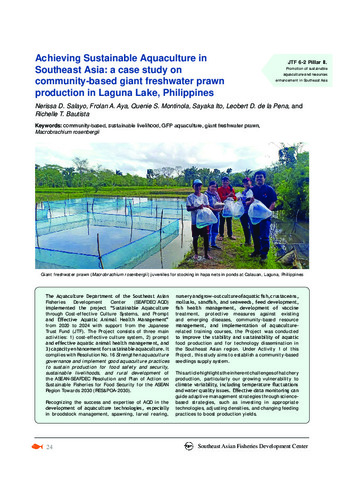
Achieving sustainable aquaculture in Southeast Asia: A case study on community-based giant freshwater prawn production in Laguna Lake, Philippines
; Aya, Frolan; ; Ito, Sayaka ; ; (Secretariat, Southeast Asian Fisheries Development Center, 2024-10)
The Aquaculture Department of the Southeast Asian Fisheries Development Center (SEAFDEC/AQD) implemented the project “Sustainable Aquaculture through Cost-effective Culture Systems, and Prompt and Effective Aquatic Animal Health Management” from 2020 to 2024 with support from the Japanese Trust Fund (JTF). The Project consists of three main activities: 1) cost-effective culture system, 2) prompt and effective aquatic animal health management, and 3) capacity enhancement for sustainable aquaculture. It complies with Resolution No. 16 Strengthen aquaculture governance and implement good aquaculture practices to sustain production for food safety and security, sustainable livelihoods, and rural development of the ASEAN-SEAFDEC Resolution and Plan of Action on Sustainable Fisheries for Food Security for the ASEAN Region Towards 2030 (RES&POA-2030). Recognizing the success and expertise of AQD in the development of aquaculture technologies, especially in broodstock management, spawning, larval rearing, nursery and grow-out culture of aquatic fish, crustaceans, mollusks, sandfish, and seaweeds, feed development, fish health management, development of vaccine treatment, protective measures against existing and emerging diseases, community-based resource management, and implementation of aquaculture related training courses, the Project was conducted to improve the stability and sustainability of aquatic food production and for technology dissemination in the Southeast Asian region. Under Activity 1 of this Project, this study aims to establish a community-based seedlings supply system. This article highlights the inherent challenges of hatchery production, particularly our growing vulnerability to climate variability, including temperature fluctuations and water quality issues. Effective data monitoring can guide adaptive management strategies through science-based strategies, such as investing in appropriate technologies, adjusting densities, and changing feeding practices to boost production yields. -
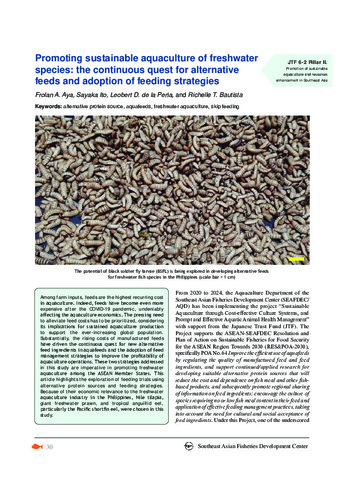
Promoting sustainable aquaculture of freshwater species: The continuous quest for alternative feeds and adoption of feeding strategies
Aya, Frolan; Ito, Sayaka ; ; (Secretariat, Southeast Asian Fisheries Development Center, 2024-10)
Among farm inputs, feeds are the highest recurring cost in aquaculture. Indeed, feeds have become even more expensive after the COVID-19 pandemic, undeniably affecting the aquaculture economics. The pressing need to alleviate feed costs has to be prioritized, considering its implications for sustained aquaculture production to support the ever-increasing global population. Substantially, the rising costs of manufactured feeds have driven the continuous quest for new alternative feed ingredients in aquafeeds and the adoption of feed management strategies to improve the profitability of aquaculture operations. These two strategies addressed in this study are imperative in promoting freshwater aquaculture among the ASEAN Member States. This article highlights the exploration of feeding trials using alternative protein sources and feeding strategies. Because of their economic relevance to the freshwater aquaculture industry in the Philippines, Nile tilapia, giant freshwater prawn, and tropical anguillid eel, particularly the Pacific shortfin eel, were chosen in this study.