SEAFDEC/AQD Institutional Repository: Recent submissions
Now showing items 81-100 of 4221
-
AQD Matters 2024 July - August
(Aquaculture Department, Southeast Asian Fisheries Development Center, 2024-10)In this issue: 1) SEAFDEC expands aquaculture research complex; 2) AQD participates in USAID Southeast Asia Fisheries Partnership Workshop; 3) SEAFDEC/AQD connects with stakeholders at international exhibition; 4) SEAFDEC/AQD ... -
Isolation of potential probionts from brackishwater enriched with high levels of carbon source
Caipang, Christopher Marlowe ; ; Pakingking, Rolando ; (Faculty of Biotechnology and Food Sciences, Slovak University of Agriculture in Nitra, 2023-08)
The majority of shrimp producers utilize probiotics derived from terrestrial sources as part of their aquaculture management. The beneficial effects of terrestrial probiotics on shrimp may be affected due to environmental differences between the cultivated species and the source of the probiotics. To ensure maximum effects on the host, it is essential to use probionts derived from the host or the environment of the cultured organism. Consequently, the objective of this study was to isolate and characterize potential probionts from brackishwater by enriching the water with organic sources containing a high ratio of carbon to nitrogen (C:N). Six 10-li containers were filled with brackishwater from an estuary for a mesocosm experiment. To stimulate bacterial growth, water was enriched with either molasses or brown sugar at a C:N ratio of 15. After twenty days, all heterotrophic bacteria in the enriched water were enumerated. The in vitro antagonistic activities of distinct bacterial colonies against Vibrio harveyi, a crustacean pathogen, were evaluated on fresh Nutrient Agar plates containing 1% sodium chloride. There were 10 bacterial isolates with in vitro antibacterial activity. These bacterial isolates are categorized as belonging to the putative genera Acinetobacter, Pseudomonas, Sphingobium, and Rheinheimera. The implications of this study suggest that enriching brackishwater with organic carbon sources at high C:N ratios may increase the likelihood of isolating and developing potential probionts for shrimp aquaculture.
; ; Pakingking, Rolando ; (Faculty of Biotechnology and Food Sciences, Slovak University of Agriculture in Nitra, 2023-08)
The majority of shrimp producers utilize probiotics derived from terrestrial sources as part of their aquaculture management. The beneficial effects of terrestrial probiotics on shrimp may be affected due to environmental differences between the cultivated species and the source of the probiotics. To ensure maximum effects on the host, it is essential to use probionts derived from the host or the environment of the cultured organism. Consequently, the objective of this study was to isolate and characterize potential probionts from brackishwater by enriching the water with organic sources containing a high ratio of carbon to nitrogen (C:N). Six 10-li containers were filled with brackishwater from an estuary for a mesocosm experiment. To stimulate bacterial growth, water was enriched with either molasses or brown sugar at a C:N ratio of 15. After twenty days, all heterotrophic bacteria in the enriched water were enumerated. The in vitro antagonistic activities of distinct bacterial colonies against Vibrio harveyi, a crustacean pathogen, were evaluated on fresh Nutrient Agar plates containing 1% sodium chloride. There were 10 bacterial isolates with in vitro antibacterial activity. These bacterial isolates are categorized as belonging to the putative genera Acinetobacter, Pseudomonas, Sphingobium, and Rheinheimera. The implications of this study suggest that enriching brackishwater with organic carbon sources at high C:N ratios may increase the likelihood of isolating and developing potential probionts for shrimp aquaculture. -
Effect of stocking density on growth, biochemical composition and blood parameters in the Pacific shortfin eel Anguilla bicolor pacifica elvers
Aya, Frolan; ; Garcia, Luis Maria ; Romana-Eguia, Maria Rowena R. (College of Agriculture and Food Science, University of the Philippines Los Baños, 2024-09)
This study examined the effect of stocking density on growth, biochemical composition, and blood parameters of the Pacific shortfin eel Anguilla bicolor pacifica. Elvers (1.95 ± 0.14 g body weight) were randomly stocked in indoor tanks and reared over 186 d at three stocking densities (0.3, 0.6, and 0.9 kg m-3) set up in triplicates. Except for survival and biometric indices, elvers maintained at 0.3 and 0.6 kg m-3 densities exhibited higher growth and feed utilization than those held at 0.9 kg m-3. Yield increased with stocking density, which were significantly higher at 0.6 and 0.9 kg m-3. RNA/DNA ratio did not reflect growth rate, but trends in survival and RNA/DNA ratio with stocking density were positively related. In contrast to body proximate composition, increasing stocking density resulted in significantly higher erucic acid (22:1n-9) and total saturated fatty acid levels at 0.6 and 0.9 kg m-3 densities, respectively. Serum glutamic pyruvic transaminase activity was significantly elevated at 0.6 kg m-3, while total protein, glucose, and triglycerides slightly decreased with increasing stocking density. Results suggest that Pacific shortfin eel elvers can be reared in indoor tanks at a stocking density of 0.3 – 0.6 kg m-3 to achieve acceptable growth, feed performance, and health condition. -
Pathogenicity of Aeromonas veronii from Nile tilapia (Oreochromis niloticus) and efficacy of fish oral vaccine against motile aeromonad septicemia in tank trials
Argayosa, Anacleto; ; Argayosa, Vina ; Pakingking, Rolando ; ; ; (MDPI, 2024-08-15)
Motile aeromonad septicemia (MAS), caused by the Aeromonas species, has been a serious problem in fish health management, particularly in Nile tilapia (Oreochromis niloticus). This study characterized an Aeromonas species isolated from farmed tilapia fingerlings in Binangonan, Rizal, Philippines, and tested for its pathogenicity in tank trials. The isolate, designated as Aeromonas veronii DFR01 (Diseased Fish Rizal), was identified based on 16S rRNA phylogenetic analysis, 16S rRNA homology, and MALDI-TOF mass spectrometry. Its biochemical profile was generated from API and Biolog Gen III systems. A median lethal dose of A. veronii DFR01 was determined to be 107 CFU/mL in tank trials and was utilized as a whole-cell inactivated antigen for oral vaccine development. The immunized tilapia fingerlings produced elevated levels of immunoglobulin M (IgM) in the blood as determined by an enzyme-linked immunosorbent assay (ELISA). There was a significant increase in IgM levels 14 days post-vaccination. A quantitative polymerase chain reaction (qPCR) showed increasing levels of IgM gene expression after vaccination until 38 days of culture. Vaccinated fish showed 25–35% cumulative mortality after the challenge, while non-vaccinated-challenged fish showed 75% mortality. The findings of this research suggest that the fish oral vaccine may prove beneficial for farmed tilapia populations. The vaccine elicited improved immune responses in the fish and resulted in higher survival rates. -
Seaweed health problems: Major limiting factors affecting the sustainability of the seaweed aquaculture industry in the Philippines
Faisan, Jr., Joseph; (Springer International Publishing, 2024)
The Philippines remains one of the top eucheumatoid seaweed producers worldwide. However, the reported seaweed health problems affecting farms have been one of the reasons for the decline in seaweed production in the country. Outbreaks of “ice-ice” disease (IID), epiphytic pests, and grazing problems have significantly reduced biomass yields and compromised carrageenan quality, directly affecting the livelihood of tens of thousands of families dependent on seaweed farming. In this chapter, we listed seaweed health problems based on type-association with the host seaweed plant and highlighted factors contributing to farm problems. Additionally, recommendations are presented that are relevant to the protection of the long-term sustainability of the eucheumatoid seaweed farming industry in the Philippines. -
Isolation, purification and characterization of extracullular vibriolytic factors from Pseudomonas species
Dalisay, Doralyn (1999-04)
Pseudomonas spp. P. aeruginosa JP4, P. aeruginosa CD2 and P. fluorescens isolated from aquatic environments produce extracellular vibriolytic factors when grown in nutrient broth. Production of vibriolytic factors was noted during the logarithmic phase of bacterial growth. Vibriolytic activity was examined based on the decrease in the optical density of a standard suspension of Vibrio harveyi, a causative agent of luminescent vibriosis in shrimp pond and hatchery systems. Five extracellular vibriolytic factors of Pseudomonas aeruginosa JP4 were isolated and partially purified by ammonium sulfate fractionation, followed by a combination of column chromatography with DEAE-Cellulose and gel filtration in Sephadex G-100. The molecular weights of the vibriolytic factors were estimated to be 27, 90, 98, 120 and 135 kDa by gel filtration column chromatography. Two of the five vibriolytic factors possessed proteolytic activity. This is the first report of vibrioytic factors of Pseudomonas aeruginosa JP4 that possess proteolytic activity at the same time. Vibriolytic activity was optimum at 30°C and pH 7.0. The vibriolytic factors were unstable to heat, and were completely inactivated when exposed to pH<4 and pH>8. The study reveals that the Pseudomonas species can possibly exert their probiotic activity by having a battery of vibriolytic factors which target V. harveyi. This provides a better understanding of the mechanism of the lytic action of Pseudomonas spp. against V. harveyi, which eventually lead to possible measures to control V harveyi infection in shrimp hatchery and pond systems. -
Nutritional studies on the different life stages of cultured abalone, Haliotis asinina Linne and prawn, Penaeus monodon Fabricius in the Philippines
(2008-03)Nutrition and feeding studies were conducted on the various life stages of tropical farmed abalone, Haliotis asinina and cultured shrimp, Penaeus monodon. Studies were focused on diet development and feed evaluation with emphasis on protein/energy levels and protein sources for juvenile abalone. Reproductive performance of abalone broodstock using artificial diet was assessed, Shrimp studies were centered on the quality assessment of feeds and feed ingredients focusing more on the levels of thiobarbituric acid, aflatoxin, urease activity, and calcium:phosphorus ratio and their effects on juvenile and adult shrimp. Utilization of feed pea meal as an ingredient for juvenile shrimp and the response of these animals at this stage to varying protein/energy ratios in the diet were assessed. Testing of diets for the shrimp larvae was likewise done both in small and large scale hatcheries. 1. Abalone Studies. Various diets containing different protein/energy levels were evaluated for abalone juveniles diet development. Biological evaluation included weight gain, increase in shell length, specific growth rate, protein efficiency ratio, feed conversion ratio and for physical evaluation in terms of shell coloration of the animal. Regression analysis showed that growth rate as a function of protein content was optimum at 27% with an energy level of 3150 kcal/kg ME for juvenile abalone, Haliotis asinina. Animals fed the formulated diets produced shells with light bluish green color while those fed seaweed retained the original brown color. Diet formulation containing 27% protein, 5% lipid and 40% carbohydrates with an energy value of 3150 kcal/kg ME was found to be best as basal diet for the rearing of juvenile abalone, Haliotis asinina.. Despite the herbivorous nature of the juvenile Haliotis asinina, a combination of dietary plant and animal protein sources is best in feed preparation for juvenile abalone to attain maximum growth rate. This could be attributed to the fact that some limiting amino acids in plant protein sources such as methionine and lysine may be compensated by the availability of these amino acids in the animal protein sources, thus resulting in a better profile of the diet formulation and better growth for the abalone. Reproductive performance of broodstock abalone was notably high in those fed the formulated diet alone or in combination with natural diet. Results would suggest that the nutritional quality of the feed has a marked effect on reproductive capability of the animal. Although, it is possible to mature and spawn abalone using natural feed, the provision of an effective artificial diet, given solely or in combination with natural diet may greatly enhance reproductive performance, thus may further result in the production of good quality seeds for abalone hatcheries. Dietary nutrients, especially in terms of proteins, lipids, and fatty acids such as 20:4n-6, 20:5n-3, and 22:6n-3 which are found to be insufficient in natural diet may be compensated with the addition of high quality artificial diet supplement. Fatty acid analysis showed that the n-3/n-6 fatty acid ratios of abalone hepatopancreas reflected those of their diets. The formulated diet had more or less simulated that of mature abalone ovary with an n-3/n-6 ratio of 1.3. The formulated diet developed not only enhanced growth and reproduction but was also used as a marker for sea ranching and stock enhancement purposes. An experimental release in outdoor tanks with natural growth of seaweeds and diatoms, and in marine reserve showed that the shell band remained clear and distinct, indicating the usefulness of the shell marking method using the artificial diet formulated for abalone juveniles. II. Shrimp Studies. The performance of an artificial practical diet, kappa-carrageenan microbound diet (C-MBD) was assessed on Penaeus monodon larvae both in small and large scale hatchery operations. Prawns were reared from zoea1 to post-larvae1 using five dietary treatments: (a) natural food, Chaetoceros calcitrans and Artemia salina; (b) C-MBD; (c) combination of natural food and C-MBD; (d) commercial diet (microencapsulated, MED); (e) combination of natural food and commercial diet. Results showed slow development with larvae fed the commercial diet. Feeding with C-MBD in combination with natural food resulted in the highest % survival among treatments (69.6%), but this was not significantly different (P>0.05) from those obtained with larvae fed natural food alone, C-MBD alone or their combination. While mean values for survival of larvae fed the commercial diet, either alone or in combination, was significantly lower (P<0.05) than all treatments, their mean growth indices were comparable with larvae fed C-MBD alone or in combination. The low levels of protein, lipid, and essential fatty acids (which are considered important nutrients during larval development) contained in the commercial diet may well justify the results on metamorphosis, survival and growth of the larvae fed this diet. Same results were noted when larval diets were tested in large scale hatchery operations. Kappa Carrageenan Microbound diet (C-MBD) can be used as partial or total replacement to the traditional algal food. Field surveys were done and experiments were conducted to assess the quality of shrimp feeds and feed ingredients in the Philippine market. Researches touched mainly on thiobarbituric acid value, aflatoxin level, urease activity, and their biological effects on Penaeus monodon. Experiments on the effects of antioxidants on feed quality and growth of Penaeus monodon juveniles showed that omission of antioxidants from the diet is possible if the feed is to be used within 60 days under ambient conditions. Results may benefit both the feed millers and shrimp growers as it may lower feed production costs. Studies conducted on the response of Penaeus monodon, both pre-adult (ABW=17.5 ± 0.6g) and juvenile (ABW = 5.65 ± 0.13g) stages showed that based on growth performance of the prawns, both stages can tolerate up to 50µg/kg of aflatoxin B1 (AFLB1). Survey results of commercial prawn feed and feed ingredients in the Philippine market showed that 92% contained 40pg/kg and below indicating an acceptable though narrow margin of safety for the end users. Experiments on shrimp quality changes which were monitored through physical evaluation, thiobarbituric acid values (TBA), fatty acid composition and histological examination showed that fat oxidation levels expressed in terms of TBA values of up to 828 mg mal/kg diet did not show detrimental effect on growth of Penaeus monodon. The feed that contained 1262 mg mal/kg diet showed signs of physical deterioration after 6-8 weeks. Urease activity bioassay showed lowest body weight gain with shrimp fed diet containing the unprocessed soybean. This ingredient has been found to contain trypsin inhibitor parallel to this urease activity which if not properly removed or stopped through proper processing may cause concomitant loss of endogenous protein and thus may retard growth of the animal. Adequate heat treatment that need to be applied to soybean meal in order to be an effective shrimp ingredient is 120°C for 20 minutes. Experiments to control the chronic soft-shell syndrome in Penaeus monodon through dietary manipulation were done. Adult shrimp (17.0-20.0g) collected from brackishwater ponds were induced to become soft-shelled in the laboratory for 3-4 weeks. Eight isocaloric and isonitrogenous diets containing 0:0, 0:1, 1:0, 1:0.2, 1:1, 1:2, 0.2:1, and 2:1 ratios of Ca to P were fed to soft-shelled shrimp.. Shell quality, survival, and growth of shrimp were observed biweekly. The hepatopancreas, exoskeleton, and residual tissues were analyzed to determine the levels of Ca:P. Shrimp fed diet with 1:1 Ca:P ratio gave the best response in terms of weight gain (62%) and recovery from soft-shelling (89%). Soft-shelled prawns fed Ca:P deficient diet did not improve in shell quality. Survival ranged from 50-100% and was significantly low with shrimp fed the Ca or P deficient diets. The highest levels of both Ca and P occurred in the exoskeleton of the normal shrimp. The increased levels of these minerals in the hepatopancreas and depressed levels in the exoskeleton in soft-shelled shrimp indicated impaired mobilization of these mineral elements from the former to the latter for use in the formation and hardening of the shell. The potential of feed pea meal as an alternative protein source to soybean meal for the juvenile Penaeus monodon was assessed. Protein from the feed pea meal replaced 0%, 20%, 40%, 60%, 80%, and 100% of the protein from the defatted soybean meal in the diets. These values were equivalent to 0%, 5%, 10%, 15%, 20%, 25%, respectively of the total protein in the diet. No significant differences (P>0.05) were observed in weight gain, feed intake, feed conversion ratio (FCR) and protein efficiency ratio (PER) of shrimp fed diet 0 up to the highest level of replacement. Survival was high between 75% and 100%. The apparent dry matter (ADMD) and protein (APD) digestibilities of the dry feed pea in Penaeus monodon were high at 73.38 ± 4.98 and 92.74 ± 2.62, respectively. Digestibility coefficients for dry matter and protein for the feed pea meal-based diets increased with increasing level of feed pea replacement. Feed pea meal could be a substitute protein source up to 100% of the protein from defatted soybean meal which is equivalent to 25% of the total protein in the diet. An inclusion level of up to 42% in the juvenile shrimp, Penaeus monodon practical diet did not manifest any adverse effects on growth, feed intake, FCR, survival, body composition, and digestibility coefficients fro dry matter and protein of the shrimp. The response of Penaeus monodon juveniles to varying protein/energy ratios in test diets was assessed in two sets of factorial experiments. One set of experiment used casein as the sole protein source while the other used a combination of 70%:30% casein:gelatin for its protein source. A two-fold increase in body weight was achieved for shrimp fed diet combinations of 40-50% protein, 5-10% lipid and 20% carbohydrate with energy values of 285-370 kcal/100g regardless of the protein used. Reduction of protein content of the diet from 50% to 40% while maintaining the total energy level at 330 kcal/100g resulted in a non-significant decrease in growth. The inclusion of 15% lipid in the diet produced adverse effects on the animal while sucrose levels beyond 20% resulted in a decreased growth rate. An increase in energy level, at constant dietary protein level resulted in improved utilization of protein and feed conversion efficiency. Shrimp survival was higher with diets containing casein and gelatin as the protein sources than with those containing casein as the sole protein source -
Population genetic variation and genetic structure of widely distributed Japanese endemic freshwater crustaceans: Geothelphusa dehaani and Gammarus nipponensis
Huervana, Joana Joy (2024)
Freshwater crustaceans, Geothelphusa dehaani (White 1847) and Gammarus nipponensis (Ueno 1940), are commonly found in rivers, streams and lakes in Japan. The distribution range of G. nipponensis is concentrated in the Western portion of Japan while G. dehaani exhibits a more widespread distribution. Both species undergo direct development from eggs to juveniles and have limited migratory abilities, as they are intolerant to brackish and marine environments. This restricted dispersal capability leads to geographical isolation among populations, making these freshwater crustaceans as ideal models for studying gene flow. Despite their significance, there were scarcity of studies that clarified genetic patterns in these two widely distributed crustaceans. Thus, the objectives of this thesis were to conduct genetic assessments on both G. dehaani and G. nipponensis to understand their population structure and variation, and to provide insights into past geological events that have contributed to these variations. Here, mitochondrial DNA sequence data were utilized to infer the relationships between the local populations of these species. Results of this study revealed substantial genetic variations among populations in both crustaceans. In G. dehaani, distinct haplotypes were observed in most populations, while G. nipponensis exhibited remarkably high mitogenome sequence variability across different localities. These findings implied extremely limited gene flow within each population and a reduced capacity for migration over extended periods, a characteristic that distinguishes them from other strictly freshwater species. The time to most recent common ancestor (TMRCA) estimates proposed that the ancestor lineage of G. dehaani was introduced more recently in Japan, approximately around the Pleistocene (~1 million years ago), while that of G. nipponensis predates the separation of Japan from mainland Asia around late Oligocene (~24 million years ago). Despite these differences, the structural patterns of populations in both species appeared relatively similar. Based on the phylogenetic analysis, the populations in both species are considered highly monophyletic with several geographical groups detected. In G. dehaani, four distinct geographic groups formed: Clade I (Honshu and Shikoku), Clade II (Eastern Kyushu), Clade III (Southern Kyushu and a portion of Eastern Honshu) and Clade IV (Western Kyushu). In G. nipponensis, the three identified groups were Clade I (Honshu and Shikoku), Clade II (Eastern Kyushu) and Clade III (Western Kyushu). The geological boundaries separating these major clades consisted of ancient lowlands such as the present Seto Inland Sea and the Chikushi and Fukuoka plains, acting as barriers for gene flow. The Seto Inland Sea potentially contributes to the divergence of Clade I from the Kyushu group. Despite the Seto Inland Sea acting as a barrier, Honshu and Shikoku displayed closer genetic relationships, possibly attributed to their more recent separation. Likewise, the Chikushi and Fukuoka plains was a significant barrier, defining distinct genetic groups in Kyushu. In conclusion, this study emphasized the importance of these two freshwater crustaceans in understanding genetic relationships characterized with limited gene flow and the impact of geological events on their population dynamics in the Japanese Archipelago. The need for further examination of morphological and behavioral characteristics based on the genetically detected groups of G. dehaani and G. nipponensis is suggested. -
Resiliency of Gracilariopsis heteroclada (Zhang et. Xia) carpospores at different salinity and temperature levels
Mateo, Jonalyn (2019-07)
Environmental factors like temperature and salinity play an important role in the growth and reproduction of aquatic organisms. The change in these two factors will be a major challenge in the future. Development of different culture techniques for Gracilariopsis heteroclada (Zhang et. Xia), a species usually found in the Philippines are being undertaken due to its increasing demand, however, there is a rapid depletion of natural populations. This study tested the resiliency of Gp. heteroclada to different water temperatures and salinities. Diploid spores from mature cystocarpic thalli of Gp. heteroclada were shed and grown at different temperatures and salinities under laboratory condition. Higher germination rate was obtained at 20°C (152.21 ± 69.88 carpospores) and 30°C (155.58 ± 66 carpospores) than at 40°C (7.56±6.54 carpospores) and 10°C (no spores were shed). Carpospores shed at 40°C degraded after 3 days. Growth rates of carpospores cultured on slides at 20 °C ranged from 2.37 to 5.92% day-1 while carpospores at 30°C ranged from 2.02 to 3.44% day-1. When carpospores were transferred to aerated vessels, growth rates decreased. At 20 °C, growth rates ranged from 0.84 to 2.96 % day-1 while at 30°C, growth rates ranged from 1.65 to 2.56 % day-1. Development rates had a wide range from 0.51 to 27.27% at 20 °C while at 30 °C, development rates ranged from 1.27 to 30 %. These results showed that Gp. heteroclada can shed carpospores at a range of 20-40 °C and 20-40 ppt. However, carpospores cannot fully develop at 40 °C. Optimum temperature for growth was at 20 °C and can grow at a wide range of salinity (20-40 ppt). -
Nutritional strategies for efficient reproductive performance of captive Indian white prawn, Penaeus indicus (H. Milne Edwards, 1837)
Santander-Avancena, Sheryll (2021-08)
Broodstock nutrition in penaeid is a vital component of a successful hatchery operation, however, there are still gaps in our present understanding of the nutrient requirements and strategies to optimize successful seed production. The first study determined the influence of different nutrient levels on the maturation of Indian white prawn, Penaeus indicus. Results showed maturation diet with 55/12 protein/lipid combination resulted in best reproductive performance of P. indicus in terms of maturation and offspring quality similar to that achieved in broodstock fed with fresh diet. Experimental maturation diet with the lowest nutritional inclusion resulted in poor maturation rates of broodstock, while treatments with high lipid supplementation resulted in higher lipid accumulation in the hepatopancreas and low survival. The second and third components of the dissertation determined the effect of polychaete extract supplementation on male and female broodstock maturation, respectively. Results showed inclusion (0.25% and 0.50%) of polar lipid fraction (PLF) in the diet resulted in best ovarian maturation with significantly increased ovarian vitellogenin (Vg) expression of female P. indicus. Neutral lipid fraction (NLF) and total soluble fraction (TSF) at 0.50% and 1.00% inclusion levels equally promoted ovarian maturation of female P. indicus broodstock but with lower ovarian Vg expression. All dietary treatments except for 0.25% NLF and TSF improved P. indicus ovarian maturation compared to those fed basal or fresh feed diets. Meanwhile, the lowest inclusion of TSF and NLF resulted in higher sperm counts while PLF did not improve sperm production. Polychaete extract supplementation in the maturation diet of male P. indicus broodstock did not significantly increase sperm count compared to those fed with the basal diet. Male and female broodstock have different reproductive responses to polychaete supplementation, suggesting differences in their requirements, hence, nutritional manipulation should be made sex-specific. Rearing broodstock, either monosex or mixed sex did not influence gonad maturation, sperm quantity and quality, and mating behavior and success. Overall these findings indicate that a sex-specific nutritional intervention is a practical approach to attain efficient gonad maturation and reproductive success in the breeding of P. indicus. -
On-the-Job Training and Internship
(Aquaculture Department, Southeast Asian Fisheries Development Center, 2024) -
PrimoAlga
(Aquaculture Department, Southeast Asian Fisheries Development Center, 2024) -
Analytical Services
(Aquaculture Department, Southeast Asian Fisheries Development Center, 2024) -
Fish Health Laboratory Services
(Aquaculture Department, Southeast Asian Fisheries Development Center, 2024) -
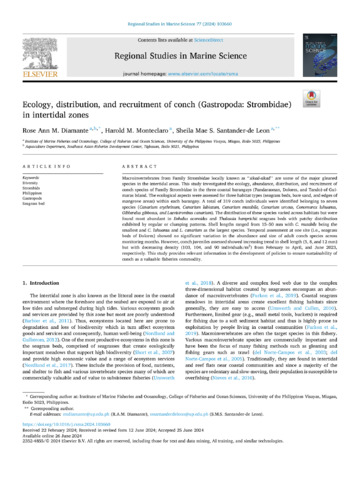
Ecology, distribution, and recruitment of conch (Gastropoda: Strombidae) in intertidal zones
; Monteclaro, Harold; Santander - de Leon, Sheila Mae (Elsevier, 2024-12)
Macroinvertebrates from Family Strombidae locally known as "sikad-sikad" are some of the major gleaned species in the intertidal areas. This study investigated the ecology, abundance, distribution, and recruitment of conch species of Family Strombidae in the three coastal barangays (Pandaraonan, Dolores, and Tando) of Guimaras Island. The ecological aspects were assessed for three habitat types (seagrass beds, bare sand, and edges of mangrove areas) within each barangay. A total of 319 conch individuals were identified belonging to seven species (Canarium erythrinum, Canarium labiatum, Canarium mutabile, Canarium urceus, Conomurex luhuanus, Gibberelus gibbosus, and Laevistrombus canarium). The distribution of these species varied across habitats but were found most abundant in Enhalus acoroides and Thalassia hemprichii seagrass beds with patchy distribution exhibited by regular or clumping patterns. Shell lengths ranged from 15–50 mm with C. mutabile being the smallest and C. luhuanus and L. canarium as the largest species. Temporal assessment at one site (i.e., seagrass beds of Dolores) showed no significant variation in the abundance and size of adult conch species across monitoring months. However, conch juveniles assessed showed increasing trend in shell length (5, 8, and 12 mm) but with decreasing density (103, 104, and 90 individuals/m2) from February to April, and June 2023, respectively. This study provides relevant information in the development of policies to ensure sustainability of conch as a valuable fisheries commodity. -
Pompano culture
(Aquaculture Department, Southeast Asian Fisheries Development Center, 2024) -
AQD Matters 2024 May - June
(Aquaculture Department, Southeast Asian Fisheries Development Center, 2024-07)In this issue: 1) Seizing the El Niño advantage in aquaculture; 2) Agreement inked for multi-species marine hatchery in Davao Occidental; 3) 56th SEAFDEC Council Meeting highlights key fisheries management initiatives; 4) ... -
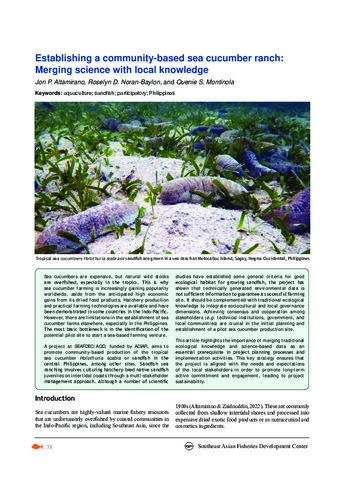
Establishing a community-based sea cucumber ranch: Merging science with local knowledge
(Secretariat, Southeast Asian Fisheries Development Center, 2024-07)Sea cucumbers are expensive, but natural wild stocks are overfished, especially in the tropics. This is why sea cucumber farming is increasingly gaining popularity worldwide, aside from the anticipated high economic gains from its dried food products. Hatchery production and practical farming technologies are available and have been demonstrated in some countries in the Indo-Pacific. However, there are limitations in the establishment of sea cucumber farms elsewhere, especially in the Philippines. The most basic bottleneck is in the identification of the potential pilot site to start a sea-based farming venture. A project at SEAFDEC/AQD, funded by ACIAR, aims to promote community-based production of the tropical sea cucumber Holothuria scabra or sandfish in the central Philippines, among other sites. Sandfish sea ranching involves culturing hatchery-bred native sandfish juveniles on intertidal coasts through a multi-stakeholder management approach. Although a number of scientific studies have established some general criteria for good ecological habitat for growing sandfish, the project has shown that technically generated environmental data is not sufficient information to guarantee a successful farming site. It should be complemented with traditional ecological knowledge to integrate sociocultural and local governance dimensions. Achieving consensus and cooperation among stakeholders (e.g. technical institutions, government, and local communities) are crucial in the initial planning and establishment of a pilot sea cucumber production site. This article highlights the importance of merging traditional ecological knowledge and science-based data as an essential prerequisite in project planning processes and implementation activities. This key strategy ensures that the project is aligned with the needs and expectations of the local stakeholders in order to promote long-term active commitment and engagement, leading to project sustainability. -
Series: Aquaculture extension manual; No. 76
Manual on important marine parasites and their hosts in the Philippines
(Aquaculture Department, Southeast Asian Fisheries Development Center, 2024-07)This manual gives basic information on some parasites of different infected fish submitted to the Southeast Asian Fisheries Development Center/ Aquaculture Department (SEAFDEC/AQD) Diagnostic Service Laboratory in Tigbauan, Iloilo, Philippines. It is intended as a reference for those working in aquaculture in the Philippines. It is also designed to be a valuable reference for students, researchers, and enthusiasts eager to delve into the captivating field of parasitology and parasitic disease management. -
Morphological and genetic diversity assessment of freshwater prawns (Macrobrachium spp.) in the Cairawan river, Antique province, Panay island, Philippines
; Wowor, Daisy; ; Padilla, Philip Ian ; Romana-Eguia, Maria Rowena R. (National Fisheries Research and Development Institute, 2024)
Freshwater prawns of the genus Macrobrachium are among the most valuable cultured aquatic species in the world. The systematic study of Macrobrachium species in the Philippines has often been based on morphological trait assessment. Here, we combined morphology and molecular approaches to study the presence and actual distribution of Macrobrachium species along the Cairawan River in Laua-an, Antique Province, Panay Island. Using morphological characteristics, we identified 11 Macrobrachium species, the highest number of species reported from a single river. Molecular results based on the cytochrome oxidase subunit I (COI) mitochondrial DNA (mtDNA) sequences confirmed the morphological identification. The analysis revealed eight major clades with 19 distinct haplotypes within the species. Our results provide information on the identification of Macrobrachium species inhabiting the Cairawan River. The baseline information can be helpful for future genetic studies involving freshwater prawns with potential use in aquaculture. It can provide scientific data to facilitate the formulation of selective breeding plans and direct governance policies in freshwater prawn resource conservation and management in the Philippines.