Localisation of enzymes in the digestive system during early development of the grouper (Epinephelus coioides)

Share
Abstract
This study was undertaken to investigate the occurrence of some digestive enzymes in the gastrointestinal tract during early development in the grouper. This work was conducted to provide information on formulating an appropriate feeding scheme and an artificial diet for the early development of the grouper, Epinephelus coioides. Larvae of E. coioides were reared in 5 tonne rectangular concrete tanks. The digestive enzymes localized were acid phosphatase (ACP), alkaline phosphatase (ALP), nonspecific esterase (NSE), aminopeptidase (AMP), trypsin (TRP), maltase (MAL) and lipase (LIP). Weak enzyme activity occurred during the yolk sac stage. High AMP activity started at day 14 prior to Artemia feeding at day 16. Fluctuations in TRP activity might be related to stomach formation. Occurrence of MAL during early development demonstrated a capacity to digest carbohydrates. An increase in LIP activity coincided with the occurrence of gastric glands. Insignificant changes in digestive enzymes were observed in the metamorphosing grouper larvae from day 40 to 60.
Suggested Citation
Quinitio, G. F., Sa-an, A. C., Toledo, J. D., & Tan-Fermin, J. D. (2004). Localisation of enzymes in the digestive system during early development of the grouper (Epinephelus coioides). In M. A. Rimmer, S. McBride, & K. C. Williams (Eds.), Advances in grouper aquaculture (pp. 30–34). Canberra: Australian Centre for International Agricultural Research.
Type
Book chapterISBN
9781863204385Series
ACIAR Monograph 110Koleksi
- Books and Book Chapters [123]
Related items
Showing items related by title, author, creator and subject.
-
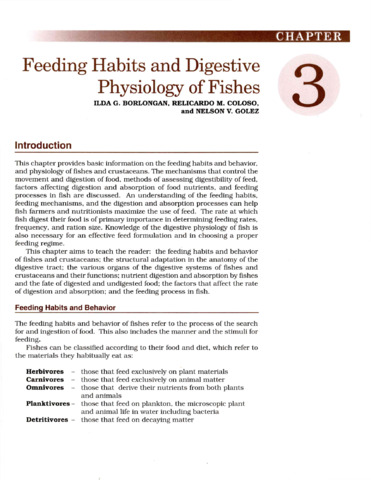
Feeding habits and digestive physiology of fishes
(Aquaculture Department, Southeast Asian Fisheries Development Center, 2002)This chapter provides basic information on the feeding habits and behavior, and physiology of fishes and crustaceans. The mechanisms that control the movement and digestion of food, methods of assessing digestibility of feed, factors affecting digestion and absorption of food nutrients, and feeding processes in fish are discussed. An understanding of the feeding habits, feeding mechanisms, and the digestion and absorption processes can help fish farmers and nutritionists maximize the use of feed. The rate at which fish digest their food is of primary importance in determining feeding rates, frequency, and ration size. Knowledge of the digestive physiology of fish is also necessary for an effective feed formulation and in choosing a proper feeding regime. This chapter aims to teach the reader: the feeding habits and behavior of fishes and crustaceans; the structural adaptation in the anatomy of the digestive tract; the various organs of the digestive systems of fishes and crustaceans and their functions; nutrient digestion and absorption by fishes and the fate of digested and undigested food; the factors that affect the rate of digestion and absorption; and the feeding process in fish. -
Evaluation of leguminous seed meals and leaf meals as plant protein sources in diets for juvenile Penaeus indicus
(Society of Israeli Aquaculture and Marine Biotechnology, 1998)The potential of locally available legumes (white cowpea, Vigna unguiculata, and green mung-bean, Vigna radiata) and leaf meals (papaya, Carica papaya, and cassava, Manihut esculenta) in combination with defatted soybean meal as protein sources was evaluated in juvenile Penaeus indicus. The feedstuffs were included in practical diets for P. indicus, replacing 9% of the protein in the basal diet. Juvenile P. indicus (mean initial weight 0.08±0.01 g) were fed the practical diets for 61 days. Shrimp fed the control diet had the highest weight gain and specific growth rate, which did not significantly differ (p>0.05) from those of shrimp fed white cowpea meal, papaya leaf meal and cassava leaf meal. Survival of the control shrimp was significantly higher (p<0,05) than that of shrimp fed cassava and papaya leaf meals but comparable to that of shrimp fed white cowpea meal. The growth of shrimp given green mungbean meal was comparable to that of shrimp fed papaya leaf meal, however the shrimp fed mungbean meal had the lowest survival. The apparent protein digestibility (APD) of white cowpea meal (87%) was significantly higher (p<0.05) than that of the control (82%) and cassava leaf meal (77%) based diets . However, the APD of the white cowpea meal based diet was comparable to those of the papaya leaf meal and green mungbean meal based diets. Results suggest that, besides digestibility, other factors such as the amino acid balance of the diet and the amount of anti-nutritional factors may influence the growth and survival of P. indicus. -
Apparent digestibility coefficient of nutrients from shrimp, mussel, diatom and seaweed by juvenile Holothuria scabra Jaeger
; ; Lebata-Ramos, Ma. Junemie Hazel ; (Wiley, 2014)
The ability of Holothuria scabra to digest nutrients, such as organic matter (OM), protein and carbohydrate from animal and plant feed ingredients was investigated. Four test feeds prepared by mixing sand with single ingredients from animal sources (shrimp and mussel) and plant sources (diatom and seaweed) were fed to H. scabra to estimate apparent digestibility coefficient (ADC). The total assimilated nutrient (TAN) increased with ADC, whereas ingestion rate (IR) varied slightly among the feeds suggesting that ADC might be a good indicator of nutrient availability to H. scabra. The ADCOM of shrimp and mussel was significantly higher than that diatom and seaweed: 86.2%, 77.1%, 55.1% and 32.3% respectively. ADCprotein was similar for shrimp (88.7%), mussel (84.8%) and diatom (75.2%), but significantly lower in seaweed (34.4%). ADCcarbohydrate was similar in mussel (58.5%) and diatom (58.3%) as well as in seaweed (31.6) and shrimp (28.0%). ADCprotein was relatively higher than ADCcarbohydrate suggesting that H. scabra generally digests more protein than carbohydrate. Furthermore, results indicated that nutrients from animal-based feeds are more efficiently digested by H. scabra; thus, animal ingredients rich in easily digestible protein could potentially provide an efficiently balanced diet for H. scabra fed with diatom containing high easily digestible carbohydrate.
; (Wiley, 2014)
The ability of Holothuria scabra to digest nutrients, such as organic matter (OM), protein and carbohydrate from animal and plant feed ingredients was investigated. Four test feeds prepared by mixing sand with single ingredients from animal sources (shrimp and mussel) and plant sources (diatom and seaweed) were fed to H. scabra to estimate apparent digestibility coefficient (ADC). The total assimilated nutrient (TAN) increased with ADC, whereas ingestion rate (IR) varied slightly among the feeds suggesting that ADC might be a good indicator of nutrient availability to H. scabra. The ADCOM of shrimp and mussel was significantly higher than that diatom and seaweed: 86.2%, 77.1%, 55.1% and 32.3% respectively. ADCprotein was similar for shrimp (88.7%), mussel (84.8%) and diatom (75.2%), but significantly lower in seaweed (34.4%). ADCcarbohydrate was similar in mussel (58.5%) and diatom (58.3%) as well as in seaweed (31.6) and shrimp (28.0%). ADCprotein was relatively higher than ADCcarbohydrate suggesting that H. scabra generally digests more protein than carbohydrate. Furthermore, results indicated that nutrients from animal-based feeds are more efficiently digested by H. scabra; thus, animal ingredients rich in easily digestible protein could potentially provide an efficiently balanced diet for H. scabra fed with diatom containing high easily digestible carbohydrate.