SEAFDEC/AQD Institutional Repository: Recent submissions
101-120 / 4221
-
Pichia kudriavzevii as feed additive in Nile tilapia (Oreochromis niloticus) diet
; Aya, Frolan ; Watanabe, Kenshi ; ; Aki, Tsunehiro ; Dedeles, Gina (Oxford University Press; Applied Microbiology International, 2024-06)
Yeasts are unicellular eukaryotic microorganisms extensively employed in various applications, notably as an alternative source of protein in feeds, owing to their nutritional benefits. Despite their potential, marine and mangrove yeast species used in the aquaculture industry have received little attention in the Philippines. Pichia kudriavzevii (A2B R1 ISO 3), sourced from bark samples, was selected and mass-produced due to its high protein content and amino acid profile. The dried biomass of P. kudriavzevii was incorporated into the diets of Nile tilapia (Oreochromis niloticus) juveniles at varying inclusion levels (0, 1, 2, and 4 g/kg diet) and its effect on their growth performance, body composition, and liver and intestinal morphology was assessed after 40 days of feeding. The groups that received P. kudriavzevii at a concentration of 2 g/kg diet exhibited higher final body weight, percent weight gain, and specific growth rate in comparison to the other treatment groups. Whole body proximate composition did not vary among the dietary groups. Intestinal and liver histopathology also indicated no abnormalities. These findings suggest the potential of ascomycetous P. kudriavzevii as a beneficial feed additive in Nile tilapia diets, warranting further investigation into its long-term effects and broader applications in fish culture.
; Watanabe, Kenshi ; ; Aki, Tsunehiro ; Dedeles, Gina (Oxford University Press; Applied Microbiology International, 2024-06)
Yeasts are unicellular eukaryotic microorganisms extensively employed in various applications, notably as an alternative source of protein in feeds, owing to their nutritional benefits. Despite their potential, marine and mangrove yeast species used in the aquaculture industry have received little attention in the Philippines. Pichia kudriavzevii (A2B R1 ISO 3), sourced from bark samples, was selected and mass-produced due to its high protein content and amino acid profile. The dried biomass of P. kudriavzevii was incorporated into the diets of Nile tilapia (Oreochromis niloticus) juveniles at varying inclusion levels (0, 1, 2, and 4 g/kg diet) and its effect on their growth performance, body composition, and liver and intestinal morphology was assessed after 40 days of feeding. The groups that received P. kudriavzevii at a concentration of 2 g/kg diet exhibited higher final body weight, percent weight gain, and specific growth rate in comparison to the other treatment groups. Whole body proximate composition did not vary among the dietary groups. Intestinal and liver histopathology also indicated no abnormalities. These findings suggest the potential of ascomycetous P. kudriavzevii as a beneficial feed additive in Nile tilapia diets, warranting further investigation into its long-term effects and broader applications in fish culture. -
High genetic diversity in anguillid glass eels across three Southeast Asian countries revealed through mitochondrial DNA D-loop sequences, with notes on population structure
; ; Santos, Mudjekeewis; Romana-Eguia, Maria Rowena R. ; ; (Elsevier, 2024-09)
Understanding the genetic diversity and population structure of anguillid eels is crucial for effective management. In this study, we used the mitochondrial DNA (mtDNA) D-loop marker to identify anguillid glass eels and assessed their genetic diversity across six sampling sites spanning three Southeast Asian countries. We also examined the population structures of Anguilla marmorata and A. celebesensis. We validated nine distinct species and subspecies of anguillid eels from 465 specimens collected in Indonesia (n = 246), the Philippines (n = 119), and Vietnam (n = 100). High gene diversities were observed across the species, ranging from 0.979 (A. celebesensis) to 1.000 (A. bicolor bicolor, A. marmorata, and A. interioris). Correspondingly, nucleotide diversity values were relatively low, varying from 0.036 (A. marmorata) to 0.057 (A. interioris). A. marmorata (n = 162) displayed a broad distribution, being observed across all six sites, with a significant yet low average fixation index of 0.05755. Pairwise comparisons of FST values between Cimandiri and other locations (except for Cagayan) were relatively high and statistically significant (p < 0.01), indicating significant genetic differentiation of Cimandiri samples compared to most locations in this study. On the other hand, A. celebesensis (n = 110), exhibited a non-significant and low fixation index (0.007), indicating no genetic differentiation in samples from Poso and Poigar Rivers, Indonesia. Our findings highlight the essential need for coordinated management strategies among regions that share common stocks. Additionally, this study underscores the efficacy of the mtDNA D-loop in precisely identifying glass eel species/subspecies and elucidating the genetic diversity and population structure of tropical anguillid eels. -
Series: Aquaculture extension manual; No. 75
Breeding, seed production, and culture of African catfish Clarias gariepinus
; Navarro, Jebrham; ; (Aquaculture Department, Southeast Asian Fisheries Development Center, 2024-07)
This manual summarizes the existing techniques on the induced breeding, seed production, and culture of the African catfish based on surveys done in Iloilo, Philippines. SEAFDEC Aquaculture Department will present a standardized way of breeding and culturing the African catfish under captive conditions, but will not encourage growing them in natural freshwater habitats. Previous data have shown that their presence in lakes adversely affects the population of other indigenous species and may lead to a loss of biodiversity. -
Field evaluation of hydrogen peroxide bath technique for controlling sea lice (Lepeoptheirus spinifer) infestation in snubnose pompano (Trachinotus blochii)
(Elsevier, 2024-08)Sea lice infestations can pose significant challenges in the aquaculture sector, affecting fish health and overall production. In the search for effective and eco-friendly solutions, hydrogen peroxide bath treatment has been considered as one of the promising methods. This is the first study to evaluate the field efficacy of hydrogen peroxide bath technique against sea lice infestation on cage-cultured snubnose pompano (Trachinotus blochii). Sea lice was identified as Lepeophtheirus spinifer using morphological description. Naturally-infested snubnose pompano stocked in 2 × 3 × 2 m3 net cages at 15 fish/cage at the Igang Marine Station of SEAFDEC/AQD, in Guimaras, Philippines were treated in triplicates with two hydrogen peroxide concentrations (1500 and 2000 ppm) in comparison to a control (seawater only) for 20 minutes at 32.8 ± 0.7 ppt and 28.9 ± 0.3 °C and were monitored at 3rd and 7th day post-treatment. The total mean intensity of sea lice, mean intensity per life stages (copepodid, chalimus I, chalimus II, pre-adult I, pre-adult II, adult male and adult female), and the 12-h viability of scraped male and adult female L. spinifer from the treatment groups were evaluated. The total mean intensity of sea lice in the treated groups at 3 day post-treatment was significantly lower than the control group (p < 0.001). A possible re-infection of sea lice was observed 7 days post-treatment as explained by the slight increase in the mean intensity in the treated groups. However, no mortalities of pompano were recorded throughout the experiment. In addition, adult female lice were absent in the treated group while adult male lice were only detected in the 1500 ppm treatment group at a very low mean intensity. The viability test also showed that all sea lice were not able to recover after 12 h whereas a 100 % recovery rate was noted in the control group. Results suggest that the 1500 and 2000 ppm hydrogen peroxide concentrations are effective in reducing sea lice infestation on cage-cultured snubnose pompano. However, a long-term effect of hydrogen peroxide treatment on sea lice needs further investigation. -
Complex patterns of genetic structure in the sea cucumber Holothuria (Metriatyla) scabra from the Philippines: implications for aquaculture and fishery management
Lal, Monal; ; Juinio-Meñez, Marie Antonette ; Altamirano, Jon ; ; ; ; Gacura, Jonh Rey ; Uy, Wilfredo ; ; ; Ravago-Gotanco, Rachel June (Frontiers Media, 2024-06-04)
The sandfish Holothuria (Metriatyla) scabra, is a high-value tropical sea cucumber harvested from wild stocks for over four centuries in multi-species fisheries across its Indo-Pacific distribution, for the global bêche-de-mer (BDM) trade. Within Southeast Asia, the Philippines is an important centre of the BDM trade, however overharvesting and largely open fishery management have resulted in declining catch volumes. Sandfish mariculture has been developed to supplement BDM supply and assist restocking efforts; however, it is heavily reliant on wild populations for broodstock supply. Consequently, to inform fishery, mariculture, germplasm and translocation management policies for both wild and captive resources, a high-resolution genomic audit of 16 wild sandfish populations was conducted, employing a proven genotyping-by-sequencing approach for this species (DArTseq). Genomic data (8,266 selectively-neutral and 117 putatively-adaptive SNPs) were used to assess fine-scale genetic structure, diversity, relatedness, population connectivity and local adaptation at both broad (biogeographic region) and local (within-biogeographic region) scales. An independent hydrodynamic particle dispersal model was also used to assess population connectivity. The overall pattern of population differentiation at the country level for H. scabra in the Philippines is complex, with nine genetic stocks and respective management units delineated across 5 biogeographic regions: (1) Celebes Sea, (2) North and (3) South Philippine Seas, (4) South China and Internal Seas and (5) Sulu Sea. Genetic connectivity is highest within proximate marine biogeographic regions (mean Fst=0.016), with greater separation evident between geographically distant sites (Fst range=0.041–0.045). Signatures of local adaptation were detected among six biogeographic regions, with genetic bottlenecks at 5 sites, particularly within historically heavily-exploited locations in the western and central Philippines. Genetic structure is influenced by geographic distance, larval dispersal capacity, species-specific larval development and settlement attributes, variable ocean current-mediated gene flow, source and sink location geography and habitat heterogeneity across the archipelago. Data reported here will inform accurate and sustainable fishery regulation, conservation of genetic diversity, direct broodstock sourcing for mariculture and guide restocking interventions across the Philippines. -
AQD Matters 2024 March - April
(Aquaculture Department, Southeast Asian Fisheries Development Center, 2024-06)In this issue: 1) SEAFDEC builds up stock of tuna breeders to enhance research efforts; 2) SEAFDEC/AQD attends 33rd NACA meeting; 3) SEAFDEC officials pay courtesy visit to DA-BFAR; 4) SEAFDEC fish health management training ... -
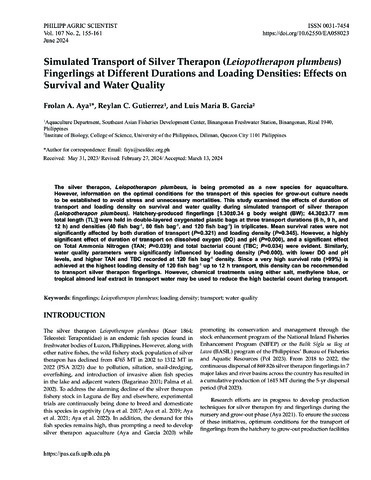
Simulated transport of silver therapon (Leiopotherapon plumbeus) fingerlings at different durations and loading densities: Effects on survival and water quality
Aya, Frolan; ; Garcia, Luis Maria (College of Agriculture and Food Science, University of the Philippines Los Baños, 2024-06)
The silver therapon, Leiopotherapon plumbeus, is being promoted as a new species for aquaculture. However, information on the optimal conditions for the transport of this species for grow-out culture needs to be established to avoid stress and unnecessary mortalities. This study examined the effects of duration of transport and loading density on survival and water quality during simulated transport of silver therapon (Leiopotherapon plumbeus). Hatchery-produced fingerlings [1.30±0.34 g body weight (BW); 44.30±3.77 mm total length (TL)] were held in double-layered oxygenated plastic bags at three transport durations (6 h, 9 h, and 12 h) and densities (40 fish bag-1, 80 fish bag-1, and 120 fish bag-1) in triplicates. Mean survival rates were not significantly affected by both duration of transport (P=0.321) and loading density (P=0.345). However, a highly significant effect of duration of transport on dissolved oxygen (DO) and pH (P=0.000), and a significant effect on Total Ammonia Nitrogen (TAN; P=0.039) and total bacterial count (TBC; P=0.034) were evident. Similarly, water quality parameters were significantly influenced by loading density (P=0.000), with lower DO and pH levels, and higher TAN and TBC recorded at 120 fish bag-1 density. Since a very high survival rate (>99%) is achieved at the highest loading density of 120 fish bag-1 up to 12 h transport, this density can be recommended to transport silver therapon fingerlings. However, chemical treatments using either salt, methylene blue, or tropical almond leaf extract in transport water may be used to reduce the high bacterial count during transport. -
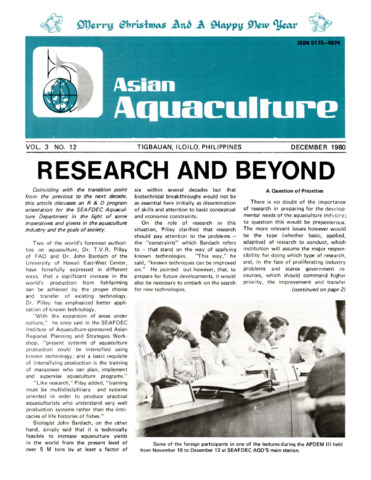
Asian Aquaculture Volume 3(12) December 1980
(Aquaculture Department, Southeast Asian Fisheries Development Center, 1980-12)In this issue: 1) Research and beyond; 2) Training at AQD; 3) Cage culture of Nile tilapia; 4) Edible crustaceans in the Philippines; 5) Third Aquabusiness Management Course; 6) Notes from readers -
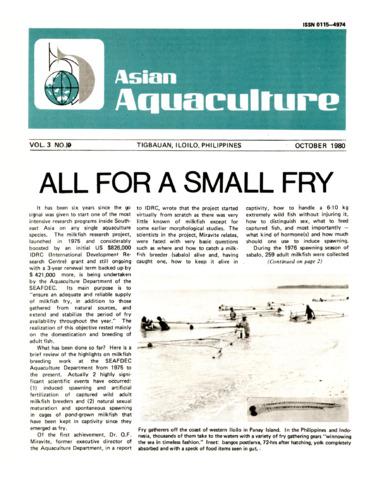
Asian Aquaculture Volume 3(10) October 1980
(Aquaculture Department, Southeast Asian Fisheries Development Center, 1980-10)In this issue: 1) All for a small fry; 2) Requirements for the design layout and construction of a prawn hatchery; 3) Rice-fish culture research in Asia; 4) Edible crustaceans in the Philippines; 5) Notes from our readers -
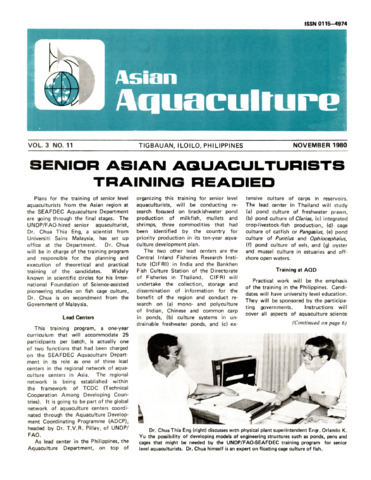
Asian Aquaculture Volume 3(11) November 1980
(Aquaculture Department, Southeast Asian Fisheries Development Center, 1980-11)In this issue: 1) Senior Asian aquaculturists training readied; 2) $38-M WB loan to develop RP's fishery training system; 3) Requirements for the design layout and construction of a prawn hatchery; 4) Pond culture of Nile ... -
Temporal variation in the incidence of seaweed health problems affecting farmed Kappaphycus striatus in relation to environmental conditions in shallow waters
Faisan, Jr., Joseph; Sibonga, Rema ; Mateo, Jonalyn ; Luhan, Maria Rovilla ; Ferriols, Victor Marco Emmanuel ; ; Brakel, Janina ; ; ; ; Brodie, Juliet ; ; (Springer, 2024-04-18)
A fixed off-bottom Kappaphycus striatus var. sacol farm was monitored for 12 months (June 2019 to May 2020) and the monthly incidence of disease and pests was recorded. Meteorological information in situ, from the nearest synoptic station and online data were collected to determine the relationships between temporal environmental changes and the incidence of seaweed health problems. The results showed that “ice-ice” disease (IID) was observed in dry months (i.e., from February to April 2020) and was significantly influenced by increased irradiance, salinity, sea surface temperature, and wind speed (p=0.004‒0.030). Also, the IID incidence was positively affected by reduced precipitation, storm surface run-off, water current speed, and inorganic nutrient (nitrite and ammonia) levels (p=0.002‒0.019). In comparison, epiphytic filamentous algae (EFA) were observed in wet months (i.e., from September to December 2019), with incidence varying from low to very high (≤25–100%) as the culture progressed. EFA incidence was significantly influenced by reduced salinity and increased storm surface run-off and inorganic nutrient (nitrate and ammonia) levels (p=0.006‒0.040). An intense tropical cyclone struck the farming area in December 2019, resulting in partial die-offs of farmed seaweed. Such seaweed health problems are expected to become more prevalent in the coming years as weather disturbances brought about by changing weather patterns become more frequent and intense. Hence, mitigation and preventative approaches must be fully considered to sustain the industry’s growth while protecting the livelihoods of many coastal communities dependent on seaweed farming. -
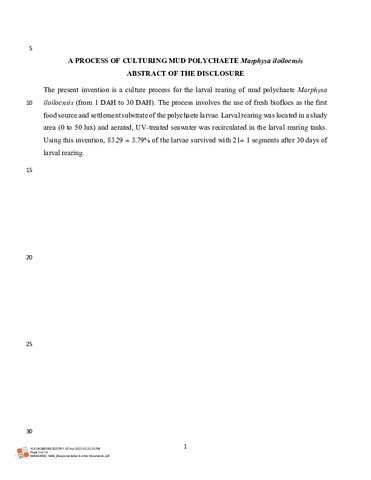
A process of culturing mud polychaete Marphysa iloiloensis
(Intellectual Property Office of the Philippines, 2021-09-20)The present invention is a culture process for the larval rearing of mud polychaete Marphysa iloiloensis (from 1 DAH to 30 DAH). The process involves the use of fresh bioflocs as the first food source and settlement substrate of the polychaete larvae. Larval rearing was located in a shady area (0 to 50 lux) and aerated, UV-treated seawater was recirculated in the larval rearing tanks. Using this invention, 83.29 ± 3.79% of the larvae survived with 21± 1 segments after 30 days of larval rearing. -
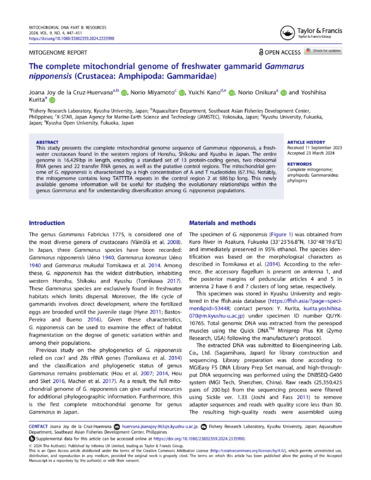
The complete mitochondrial genome of freshwater gammarid Gammarus nipponensis (Crustacea: Amphipoda: Gammaridae)
Huervana, Joana Joy; Miyamoto, Norio ; Kano, Yuichi ; Onikura, Norio ; (Taylor and Francis, 2024-04-02)
This study presents the complete mitochondrial genome sequence of Gammarus nipponensis, a freshwater crustacean found in the western regions of Honshu, Shikoku and Kyushu in Japan. The entire genome is 16,429 bp in length, encoding a standard set of 13 protein-coding genes, two ribosomal RNA genes and 22 transfer RNA genes, as well as the putative control regions. The mitochondrial genome of G. nipponensis is characterized by a high concentration of A and T nucleotides (67.1%). Notably, the mitogenome contains long TATTTTA repeats in the control region 2 at 686 bp long. This newly available genome information will be useful for studying the evolutionary relationships within the genus Gammarus and for understanding diversification among G. nipponensis populations. -
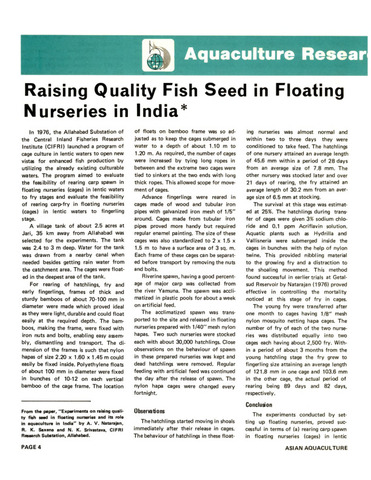
Raising quality fish seed in floating nurseries in India
(Aquaculture Department, Southeast Asian Fisheries Development Center, 1979-08)From the paper, "Experiments on raising quality fish seed in floating nurseries and its role in aquaculture in India" by A. V. Natarajan, R. K. Saxena and N. K. Srivastava, CIFRI Research Substation, Allahabad. -
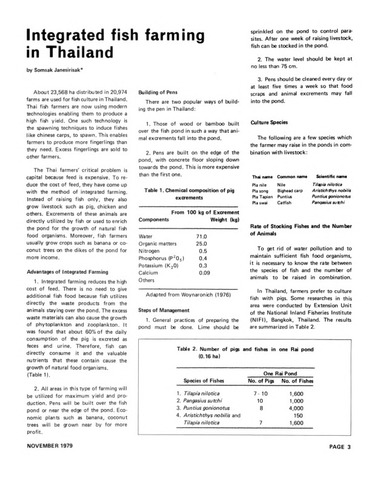
Integrated fish farming in Thailand
(Aquaculture Department, Southeast Asian Fisheries Development Center, 1979-11) -
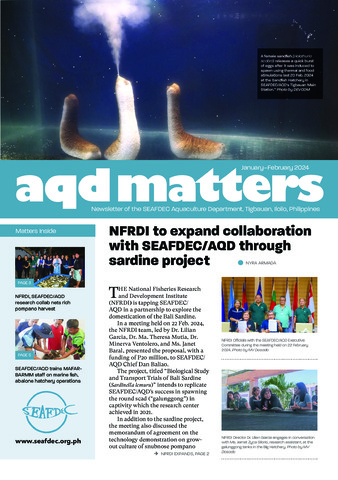
AQD Matters 2024 January - February
(Aquaculture Department, Southeast Asian Fisheries Development Center, 2024-03)In this issue: 1) NFRDI to expand collaboration with SEAFDEC/AQD through sardine project; 2) SEAFDEC/AQD starts intensive training for fisheries graduates; 3) NFRDI, SEAFDEC/AQD research collab nets rich pompano harvest; ... -
Sandfish (Holothuria scabra) as potential reservoir of white spot syndrome virus (WSSV) when co-cultured with black tiger prawn (Penaeus monodon)
; ; ; ; ; ; Nava, Joseph Keith Paulo; (European Association of Fish Pathologists, 2024-03-08)
Since the first occurrence of White Spot Disease (WSD) in 1992, it is still listed as one of the crustacean diseases by the World Organisation for Animal Health in 2022. Horizontal transmission in co-culture systems is one of the usual modes in the spread of the disease. WSD outbreak was recorded during the experimental run of the co-culture of black tiger prawn (Penaeus monodon) and sandfish (Holothuria scabra) in the grow-out phase. In this study, artificial infection through two cohabitation experiments were conducted to determine if H. scabra is a potential non-crustacean vector or reservoir of WSSV. Samples were checked using one-step and nested PCR for increased readout sensitivity of virus infection to investigate the horizontal transmission between prawn and sandfish. During the first cohabitation (5 days) where WSSV (+) prawn were cohabited with WSSV (-) sandfish, 100% of the prawn were one-step PCR positive for WSSV while 100% of the sandfish were nested PCR positive. Subsequently, WSSV (+) sandfish from the first cohabitation were transferred to another tank to be cohabited with WSSV (-) prawn. Sampling of both prawn and sandfish was done every 6 days post-infection (dpi). At 6 to 18 dpi, prawn and sandfish were nested PCR positive. At 25 dpi, there were no prawns left due to mortality and 1 of the 3 remaining sandfish was nested PCR positive. Based on the results, it elucidates the ability of sandfish to bioaccumulate the viral particles when cohabited with WSSV (+) prawn. Results suggest that WSSV is viable in the sandfish confirming its potential as a vector or reservoir due to the consistent nested PCR positive results of the prawn during the second cohabitation. Hence, it can be inferred that sandfish can be a potential non-crustacean vector or reservoir of WSSV for a limited period of time. -
In vitro and in vivo evaluation of the efficacies of commercial probiotics and disinfectant against acute hepatopancreatic necrosis disease and luminescent vibriosis in Litopenaeus vannamei
; ; Amar, Edgar; ; ; ; Nava, Joseph Keith Paulo ; ; (Elsevier, 2024-05)
The bioactivities of two commercially available probiotics and one chemical disinfectant were tested against strains of Vibrio parahaemolyticus (VPAHPND) and V. harveyi. This study aimed to determine shrimp pathogenic Vibrios' in vitro and in vivo sensitivities to commercial probiotics and a chemical disinfectant. The probiotics and disinfectant were tested first in vitro, followed by the in vivo trials. Results showed that upon administration of probiotics either through diet or adding into the tank water, the survivability of shrimp was increased during challenge with VPAHPND and V. harveyi. Also, the disinfectant was tested against the same pathogens and showed positive bactericidal effects at 2500 ppm and 5000 ppm. The present findings suggest that adding probiotics to the rearing water or the shrimp feeds effectively prevents infection by lowering the load of pathogenic bacteria. In comparison, the effectiveness of the disinfectant (PUR) depends on its appropriate concentration and timing of application. It is not only limited to rearing water but is also applicable for decontaminating pond liners, tanks, and other paraphernalia. -
Complete genome sequence of Vibrio parahaemolyticus strain PH1273, isolated from aquacultured shrimp in the Philippines
; ; ; Yen, Hsi-Ching; ; ; Amar, Edgar ; Lai, Erh-Min ; Kuo, Chih-Horng (American Society for Microbiology, 2023-10-19)
We announce the complete genome sequence of Vibrio parahaemolyticus strain PH1273. This strain was collected from a Penaeus vannamei pond in the Philippines in 2015. Genome analysis revealed that it lacks the gene pirAB responsible for causing acute hepatopancreatic necrosis disease but encode multiple secretion systems and the associated effectors. -
Utilization of a portable glucometer for the measurement of tissue glucose as a stress indicator in ornamental fish
Caipang, Christopher Marlowe; ; ; ; ; Caipang, Christian Le Marjo ; Pakingking, Rolando (Bioflux (Bioflux SRL), 2021)
The stress response in vertebrates is determined by measuring cortisol production following acute or chronic exposure to various environmental stimuli. Cortisol assays as responses to stressful events are done on blood samples using ELISA or radio-immunoassays. However, these procedures require expensive reagents and special equipment that are not available to most fish growers or hobbyists. A portable glucometer, which is a point-of-care (POC) device to monitor blood glucose levels, was assessed in terms of its usefulness in assessing the stress response in vertebrates by quantitating whole body (tissue) glucose. Using ornamental fish as our model species, glucose levels from tissue homogenates were measured in swordtail (Xiphophorus hellerii) following handling stress by exposure to air for 3 min. Tissue glucose was measured before air exposure (control), immediately after air exposure for 3 min, and at 30 min post-air exposure (recovery). There was an increase in tissue glucose immediately after exposure of the fish to air for 3 min. At 30 min post-exposure, the levels of tissue glucose were still elevated, but may be moving towards returning to the pre-air exposure levels (control), which were measured prior to the application of the stressor. Our results have shown that a portable glucometer has good potential in monitoring stress response in vertebrates using ornamental fish as a model by quantifying tissue glucose in lieu of a more expensive cortisol assay.