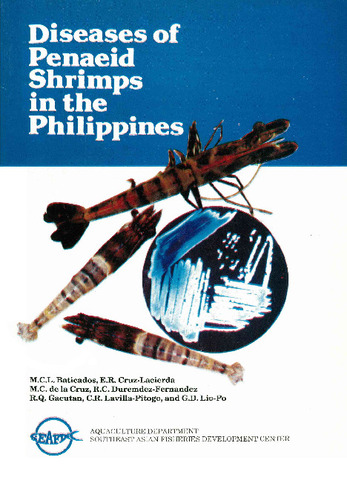
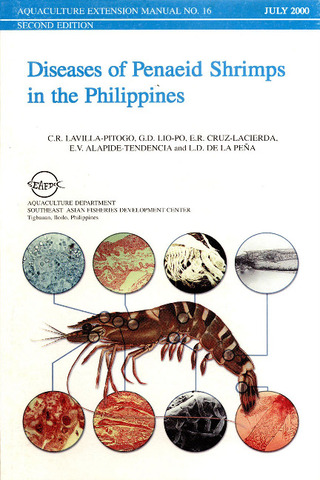
Diseases of penaeid shrimps in the Philippines

Date
2000Author

Page views
9,787ASFA keyword

AGROVOC keyword
Taxonomic term

Metadata
Show full item recordShare
Abstract
The manual provides information on the diseases that affect the 3 major species of shrimps cultured in the Philippines: Penaeus monodon, P. merguiensis and P. indicus. It includes the common name of the disease, causative agent, species affected, stages affected, gross signs, effects on the host and methods of prevention and treatment. This revised edition includes newly discovered diseases. It is hoped that the manual will be of considerable help to shrimp farmers in identifying the disease and lead to prevention or early disease diagnosis and control.
Other versions
1st Ed.Suggested Citation
Lavilla-Pitogo, C. R., Lio-Po, G. D., Cruz-Lacierda, E. R., Alapide-Tendencia, E. V., & De la Peña, L. D. (2000). Diseases of penaeid shrimps in the Philippines. (2nd ed.). Tigbauan, Iloilo, Philippines: Aquaculture Department, Southeast Asian Fisheries Development Center.
Type
BookISBN
9718511431Series
Aquaculture extension manual; No. 16Format
83 p. : ill. (some col.)
Collections
Related items
Showing items related by title, author, creator and subject.
-
Series: Aquaculture extension manual; No. 16
Diseases of penaeid shrimps in the Philippines
(Aquaculture Department, Southeast Asian Fisheries Development Center, 1990)The manual provides information on the diseases that affect the 3 major species of shrimps culture in the Philippines: Penaeus monodon, P. merguiensis and P. indicus. It includes the common name of the disease, causative agent, species affected, stages affected, gross signs, effects on the host and methods of prevention and treatment. -
Viral diseases of shrimp in the Philippines
(Research Signpost, 2015)Shrimp is a high-value commodity and one of the major aquaculture species in the world, including the Philippines. The shrimp farming industry is dominated by the black tiger shrimp Penaeus monodon and the Pacific white shrimp, Penaeus vannamei. Intensification in shrimp aquaculture to meet the global demand resulted to several socio-economic and biophysical production bottlenecks. Consequently, the issues besetting the industry had raised several questions on its sustainability. In particular, viral diseases remain a constant threat and a significant concern in many shrimp producing countries especially in the developing world. In this chapter, current knowledge on major viral pathogens affecting shrimp aquaculture in the Philippines is presented and discussed. The discussion is focused on white spot syndrome virus (WSSV), monodon baculovirus (MBV), infectious hypodermal and hematopoietic necrosis virus (IHHNV), hepatopancreatic parvovirus (HPV). yellow head virus (YHV), and taura syndrome virus (TSV). Updates on their clinical signs, transmission and distribution are presented. Records of incidence in the Philippines are provided as well. The second half of the chapter discusses some of the methods how to control viral diseases in shrimp farming with a particular focus on vaccination, biosecurity and diagnostics. -
Mortalities of pond-cultured juvenile shrimp, Penaeus monodon, associated with dominance of luminescent vibrios in the rearing environment
(Elsevier, 1998)Severe mortalities due to luminescent vibrios occurred in pond-cultured Penaeus monodon juveniles particularly in the first 45 days of culture. Luminescent vibriosis epizootics led to reduced shrimp production due to mortalities and slow growth of affected stocks. Monitoring of bacterial population in the rearing water of several ponds was conducted from the time the ponds were flooded with water until 60 days of culture to understand the course of infection. Results showed that the occurrence of mortalities was preceded by a shift of the bacterial profile of the rearing water in infected ponds, notably the dominance of luminescent vibrios. Comparison of bacterial load in the rearing water and water source (river or open sea) showed elevated luminescent Vibrio counts in the former at 12 days to 3 weeks after initial entry of water. Histopathology of affected shrimps showed the hepatopancreas as the target organ of infection where severe inflammatory responses in the intertubular sinuses were seen.