01 SEAFDEC/AQD Publications
Browse by
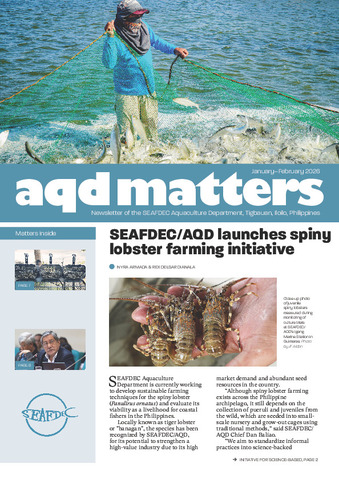
This collection contains the publications of SEAFDEC/AQD and its researchers including books, conference proceedings, aquaculture extension manuals, laboratory manuals, state of the art series, textbooks, monographs, code of practice, regional guidelines, posters, flyers, reports, translations, historical documents, in-house newsletter, and others. To view our new publications, please visit SEAFDEC/AQD Bookstore. To obtain the hard copy edition of a publication, send to bookstore@seafdec.org.ph a completed order form, or mail to AQD Bookstore, SEAFDEC Aquaculture Department, Tigbauan 5021, Iloilo, Philippines or fax it to +63 33 330 7031.
Copyright © 2011-2019 SEAFDEC Aquaculture Department. All Rights Reserved. Materials under this community may be freely quoted as long as acknowledgment to SEAFDEC/AQD is made and a copy of the article where the AQD material appeared is sent to aqdchief@seafdec.org.ph or to any of our contact addresses.
Sub-communities within this community
-
Books [142]
-
Conference Proceedings [771]
-
Journals/Magazines [591]
-
Newsletters [187]
Collections in this community
-
Brochures and flyers [57]
-
Posters [2]
Recent Submissions
-
Promotion of sustainable aquaculture and aquatic animal health in Southeast Asia: Proceedings of the international workshop on the promotion of sustainable aquaculture and aquatic animal health in Southeast Asia, 12–14 March 2025, Iloilo City, Philippines
(Aquaculture Department, Southeast Asian Fisheries Development Center, 2026-07)This volume contains the proceedings of the International Workshop on the Promotion of Sustainable Aquaculture and Aquatic Animal Health in Southeast Asia (SAHSEA). Convened by the Aquaculture Department of the Southeast Asian Fisheries Development Center (SEAFDEC/AQD) with support from the Government of Japan Trust Fund (JTF), the workshop serves as a key milestone reviewing regional progress and mapping future collaborative strategies. The publication compiles country reports from SEAFDEC member nations alongside research presentations detailing status reports, emerging challenges, and technological interventions in tropical aquaculture. Key thematic areas covered include seed supply stabilization, broodstock and larval quality management, cost-efficient aquafeed development, biosecurity protocols, transboundary aquatic animal disease surveillance, and community-based sustainable production systems. Synthesizing regional expert insights and policy recommendations, this document aims to guide scientists, aquaculture practitioners, and policymakers toward building resilient, inclusive, and sustainable aquatic food systems in Southeast Asia. -
Series: Aquaculture Extension Manual; No. 80
On-farm aquafeed production for small-scale freshwater aquaculture
(Aquaculture Department, Southeast Asian Fisheries Development Center, 2026-07)With the increasing demand for food fish as the primary source of dietary protein, some aquaculture practices have shifted from traditional to semi-intensive or intensive system, requiring the use of feeds for successful growth of aquaculture. Alone, feeds are considered as a costly input in aquaculture, comprising over 50 % of the total operating costs. Most, if not all farms in the country, are relying on commercial feeds which are either imported or locally produced. For many years, locally available materials have been studied for their potential as alternative protein sources or feed additives in fish feeds. Utilization of these alternative or non-conventional feed sources with little or no use as human food may provide reasonable options in feed formulation. In the Philippines, there is a potential for fish farmers to develop and utilize local feedstuff resources to manufacture their own feeds. However, limited information on nutrient requirements of fish species, available feed ingredients and their nutritional value, processing techniques, and the preparation of farm-made feeds are available to the small-scale farmers. Given the rising cost of feeds, it is important to provide small scale farm operators, the option to make their own feeds. This manual is written for fish farmers engaged in small-scale freshwater fish culture, particularly during grow-out. It intends to provide information on the components of fish feed, indigenous or locally sourced ingredients for feeds and their processing techniques, and ultimately to assist the small-scale fish farmers in using modest equipment to make farm- made feeds to feed their stocks. -
Series: Aquaculture Extension Manual; No. 16
Diseases of farmed shrimps in the Philippines
(Aquaculture Department, Southeast Asian Fisheries Development Center, 2026-07)The third edition of Diseases of Farmed Shrimps in the Philippines serves as an updated and comprehensive reference manual on the major infectious, parasitic, nutritional, toxic, and environmental diseases affecting farmed shrimps in the Philippines. Building upon the previous editions published by the SEAFDEC Aquaculture Department, this revised edition reflects the significant developments in shrimp aquaculture over the past two decades, including the emergence and spread of new pathogens, evolving disease patterns, and advances in diagnostic and biosecurity approaches. The manual provides practical, science-based information for shrimp farmers, aquaculture technicians, fish health specialists, researchers, extension workers, students, and regulatory agencies involved in shrimp health management and sustainable aquaculture production. It presents updated descriptions of diseases affecting cultured shrimps, including viral, bacterial, fungal, parasitic, and non-infectious conditions observed in hatchery, nursery, and grow-out systems. Each disease chapter contains concise, standardized information on the common and scientific names of the disease agents, susceptible life stages, prevalence, mortality, clinical and gross signs at both the pond and animal levels, histopathological features, and recommended prevention and control measures. The manual also incorporates updated diagnostic images, photomicrographs, and field observations to aid in disease recognition and laboratory confirmation. Through this updated manual, the SEAFDEC Aquaculture Department aims to support the continued development of the Philippine shrimp industry by providing an accessible, practical, and scientifically grounded reference that promotes improved aquatic animal health management, enhanced farm productivity, and responsible aquaculture practices. -
Sustainable aquaculture practices in Cambodia
(Aquaculture Department, Southeast Asian Fisheries Development Center, 2026-07)Cambodia's aquaculture sector plays a vital role in food security, rural livelihoods, and economic development. It contributes significantly to the national GDP and supplies approximately 75% of the animal protein consumed by Cambodians. Historically reliant on wild fisheries, Cambodia has undergone rapid growth in aquaculture, with production increasing from 143,000 tonnes in 2015 to 320,280 tonnes in 2024. This expansion is driven by rising demand and strong government support under the Rectangular Strategy Phase IV. The sector includes inland aquaculture systems (pond, cage, and rice-fish) and emerging mariculture activities (sea cage and shellfish farming). Key species in inland aquaculture include Pangasius catfish, snakeheads, tilapia, and carps, while mariculture focuses on high-value species like groupers and sea bass. Despite its rapid growth, the aquaculture sector faces challenges such as high feed costs (comprising 50–70 % of production expenses), environmental degradation, limited technical knowledge, and regulatory gaps. The reliance on imported feed and pollution from intensive farming are critical concerns. However, opportunities lie in sustainable mariculture expansion, use of alternative protein sources, and investments to improve infrastructure. Strengthening research, capacity building, and policy frameworks is essential for long-term sustainability. With strategic investments and adoption of best practices, Cambodia’s aquaculture sector can improve productivity, enhance rural development, and strengthen its competitiveness in regional markets. -
Sustainable aquaculture in Indonesia
(Aquaculture Department, Southeast Asian Fisheries Development Center, 2026-07)Indonesia, the largest archipelago in the world, has enormous potential for the development of freshwater, brackishwater, and marine aquaculture. Despite its vast resources, only 7.98%, 27.74%, and 1.46% respectively of the freshwater, brackishwater and mariculture areas have been utilized. This paper explores the advances in aquaculture practices, including biofloc technology for freshwater species, innovative strategies for shrimp and saline tilapia in brackish water systems, and seaweed mariculture. Between 2022 and 2023, a notable increase in the production of key commodities such as catfish, shrimp, and seaweed was reported. This growth can be attributed to the adoption of sustainable improvements in practices and technologies. The integration of Good Aquaculture Practices (GAqP), revitalization of idle cultivation areas, and adoption of sustainable strategies aim to enhance productivity, minimize environmental impacts, and ensure food security. With this, Indonesia's aquaculture advancements provide a model for sustainable resource management and global leadership in aquatic food production.