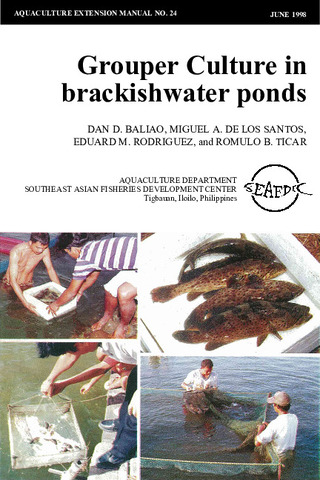
Grouper culture in brackishwater ponds


Share
Abstract
Groupers (Epinephelus) are cultured in the Philippines using tiny fry and juveniles caught from the wild. A SEAFDEC/AQD technology verification study on grouper pond grow-out culture resulted in high productivity and profitability, indicating that grouper culture could become another income source for the country. This aquaculture extension manual is intended as a guide for fishfarmers and aquaculturists, extensionists, and students of aquaculture. It covers the following areas: What are groupers?; Commercially important groupers; Source of fry or fingerlings; Common collection gears for fry/juveniles; Brackishwater pond culture -- pond specifications, site selection, pond preparation, nursery operation, grow-out culture, harvest, post-harvest; Growth, survival and feed efficiency performance of grouper reared in brackishwater pond; Economics; Marketing and transport; and, Diseases.
Suggested Citation
Baliao, D. D., De los Santos, M. A., Rodriguez, E. M., & Ticar, R. B. (1998). Grouper culture in brackishwater ponds. (Aquaculture extension manual No. 24). Tigbauan, Iloilo, Philippines: Aquaculture Department, Southeast Asian Fisheries Development Center.
Type
BookISBN
9718511334Series
Aquaculture extension manual; No. 24Format
17 p. : ill.
Collections
Related items
Showing items related by title, author, creator and subject.
-
Aquaculture in Malaysia
(Aquaculture Department, Southeast Asian Fisheries Development Center, 1995)Aquaculture in Malaysia is experiencing rapid growth. Total production in 1992 amounted to 79,699 tons valued at RM 207.4 million. These figures are 23% and 25% higher than the previous year's. Semi-culture of the cockle Anadara granosa was still predominant, contributing about 70% of the total output. Culture and production of the oyster Crassostrea iredalei is still insignificant. Sea bass Lates calcarifer constituted over 80% of the production from marine cages. Cage culture of grouper Epinephelus sp., snapper Lutjanus sp. and pompano Trachinotus blochii were also done in much smaller scale. The mangrove snapper Lutjanus argentimaculatus was recently spawned in captivity and larvae and juveniles were produced. In 1992, the tiger shrimp Penaeus monodon constituted about 87% of brackishwater pond production. Pond culture of the white shrimp P. merguiensis and the mudcrab Scylla sp. is at the experimental stage. Red tilapia hybrid was the major freshwater species cultured in cages, with 1,486 tons harvested in 1992. Freshwater pond production was valued at RM 100.85 million, 22% of which was due to the eel Anguilla japonica. Production of freshwater ornamental fishes is also becoming significant. Other exotic species recently bred and cultured are the African catfish Clarias gariepinus and the pacu Piaractus brachypomus. The indigenous freshwater catfish Mystus nemurus and carp Probarbus julleini have recently been bred in captivity and cultured experimentally. Lately, there have been attempts to culture non-conventional species such as the bullfrog Rana catesbeiana, the soft-shell turtle Trionyx sinensis, and aquatic ornamental plants. -
Aquaculture development in Thailand
(Aquaculture Department, Southeast Asian Fisheries Development Center, 1988)Aquaculture practised in Thailand is in the form of pond culture and cage culture in freshwater, brackishwater and coastal areas. The main species cultured include freshwater prawns, brackishwater shrimp, cockles, mussels, and various freshwater and marine finfishes. There is good potential for increased production from freshwater, brackishwater and marine aquaculture. However, the 1983 production of 145 000 mt represents only about 6% of Thailand's total fish production and production in this subsector has fluctuated widely. It will be several years before aquaculture production will contribute substantially to total production. Nonetheless, the culture of high value species of shrimp and fish could contribute significantly to export earnings during the next 5 to 10 years. Conducted primarily by government agencies, research and development are along the lines of increasing seed supply, establishing new culture techniques or improving older ones. The Department of Fisheries (DOF) together with some private companies have ventured into the development and testing of artificial diets for the various cultured species using a variety of indigenous feed stuffs. It is estimated that with adequate investments and appropriate support, aquaculture production will increase from 145 000 mt in 1983 to 378 000 mt in 1991, showing an annual increase of about 13% over this period. Major increases would come from bivalve mariculture (131 000 mt), brackishwater ponds (36 000 mt) freshwater ponds (46 000 mt) and brackishwater cage culture (20 000 mt). -
The Philippine aquaculture industry
(Aquaculture Department, Southeast Asian Fisheries Development Center, 1988)The aquaculture sector of the Philippine fishing industry registered the highest growth rate of 12.5% in 1977-1986. The contribution of aquaculture to the total fish production was equivalent to 24% in 1986 compared to only 85 in the early 1970's. In terms of quantity, the mariculture subsector registered the highest growth rate of 10.2% in 1982-1986, whereas in terms of value the brackishwater fishpond subsector showed the highest growth rate of 33%. Meanwhile, freshwater aquaculture production exhibited a negative growth rate due to reduction of activities in Laguna de Bay and the slow expansion in hectarage of the commercial freshwater fishponds. Research by several agencies concentrated heavily on the culture of milkfish (Chanos chanos), tilapia (Oreochromis niloticus), Chinese carps (Aristichthys nobilis and Hypophthalmichthys molitrix), tiger prawn (Penaeus monodon), and sea bass (Lates calcarifer). Innovations in seaweed, oyster, and mussel farming are also discussed. Research directions are presented to assure an ecologically sustainable growth in aquaculture with emphasis on countryside development.