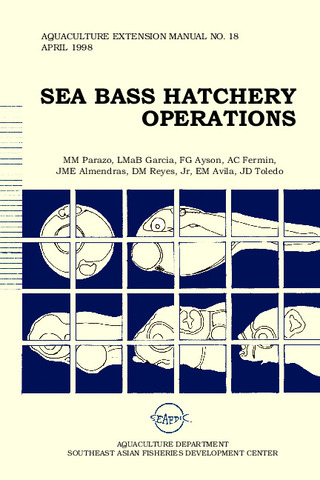
Sea bass hatchery operations

Date
1998Author

Page views
9,613ASFA keyword

AGROVOC keyword
Taxonomic term

Metadata
Show full item recordShare
Abstract
The manual addresses sea bass (Lates calcarifer) fry production in the hatchery. It describes the principles and practical procedures for rearing sea bass - from eggs until metamorphosis - as practiced by the SEAFDEC Aquaculture Department in Tigbauan, Iloilo, Philippines. It is presented under the following main section headings: General principles; biology; Selecting a suitable site; Design - tank systems, seawater supply system, freshwater supply system, aeration system, other facilities; Broodstock - source of breeders, breeding techniques; Egg collection, transport and hatching; Larval rearing - stocking density, feed types and feeding management, water management size-grading of larvae; Harvest and transport of fry; and, Propagation of larval food - Chorella, Brachionus, Artemia, Moina.
Subjects
Hatchery fishes
Description
A 42-page manual updating AQD's 1990 publication of the same title. It details the activities in the seabass hatchery, from breeding until the harvest and transport of fry to fishponds. New section on the propagation of natural food Moina and Diaphanosoma has been added.
Suggested Citation
Parazo, M. M., Garcia, L. M. B., Ayson, F. G., Fermin, A. C., Almendras, J. M. E., Reyes Jr., D. M., Avila, E. M. & Toledo, J. D. (1998). Sea bass hatchery operations (2nd ed.). Tigbauan, Iloilo, Philppines: Aquaculture Department, Southeast Asian Fisheries Development Center.
Type
BookISSN
0115-5369ISBN
9718511296Series
Aquaculture extension manual; No. 18Format
42 p. : figs.
Collections
Related items
Showing items related by title, author, creator and subject.
-
Size- and weight-dependent cannibalism in hatchery-bred sea bass (Lates calcarifer Bloch)
(Blackwell Publishing, 1991)The relationship of predator size to maximum prey size, and predator weight to weight of prey consumed among cannibalistic sea bass (Lates calcarifer Bloch) in a hatchery were assessed. Maximum prey size was computed from morphological measurements (predator mouth width, prey body depth and fish total length), while prey consumption was determined from predators kept in experimental beakers and fed only prey sea bass for a 7-day period. Maximum prey size was 61–67 % of predator total length \((TL_{prey} = 0.5944 TL_{predator} + 0.0724)\). Gut dissection of predators showed that size of ingested prey increased with increasing predator size not exceeding the maximum size limit indicated by the above equation. Daily prey consumption of predators in the beakers was expressed as \(W_{Prey} = -0.2407\; W_{predator^{2}}+ 0.7697W_{predator}-0.1141\). During hatchery rearing of sea bass, fish with length differences of more than 33 % must be separated and food of appropriate size provided to limit cannibalism. -
Use of juvenile instar Diaphanosoma celebensis (Stingelin) in hatchery rearing of Asian sea bass Lates calcarifer (Bloch)
(Society of Israeli Aquaculture and Marine Biotechnology, 2001)The effects of size, dry mass intake and nutritional value of the brackishwater cladoceran, Diaphanosoma celebensis, on the growth and survival of 15-30 day sea bass (Lates calcarifer) larvae reared in a static green water system were determined. The highest specific growth rate (29.4%/day) was attained in larvae fed a 1:1 combination of Artemia nauplii and adult Diaphanosoma but it was not significantly different (p>0.05) from fish fed only adult Diaphanosoma (28.8%/day) or only juvenile instar Diaphanosoma (28.6%/day). Survival rates of larvae (92.4-99.0%) fed the different live diets did not significantly differ (p>0.05). Larvae markedly prefered juvenile instar Diaphanosoma over Artemia nauplii and adult Diaphanosoma. The crude protein contents of juvenile Diaphanosoma (58.7%), adult Diaphanosoma (58.3%) and Artemia (56.7%) were substantially high and satisfied the dietary protein requirements of larvae. The fatty acid profile of the sea bass fry reflected the lipid composition of the live diet. Improved growth, survival and dry mass intake in larvae indicate the potential of juvenile Diaphanosoma in the hatchery rearing of sea bass larvae. -
Hatchery rearing of sea bass Lates calcarifer Bloch
(Science and Technology Information Institute, 1991)A hatchery rearing scheme for sea bass (Lates calcarifer Bloch) is described. Survival rate from hatching (d0) to harvest (d30) was 34%. Feeding sea bass fry with Chlorella-fed or Selco-enriched instar II Artemia from d19 to d23 resulted in similar survival rates (74%), total length (8.2 and 8.9 mm) and weight (8.9 and 12.1 mg) at d30. Although sea bass fry fed 2.5, 5 or 10 Artemia/ml/day from d14 to d20 exhibited similar survival rates (73-93%), fish were significantly larger as feed density increased (7.1, 8.2, 9.8 mm total length and 2.4, 4.3, 9.7 mg wet weight, respectively). The significance of this study lies in providing technical information on artificial production of sea bass fry.