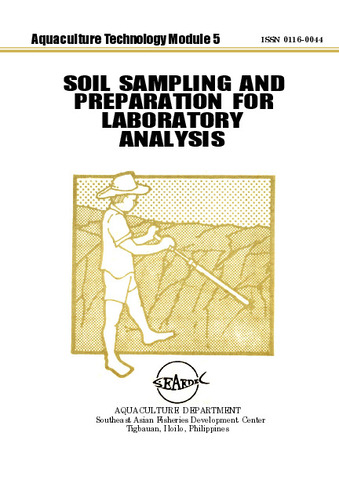
Soil sampling and preparation for laboratory analysis

Share
Subjects
Soils--Sampling Soils--Analysis
Suggested Citation
Tenedero, R. A., & Surtida, M. B. (Eds.). (1986). Soil sampling and preparation for laboratory analysis. Tigbauan, Iloilo, Philippines: SEAFDEC Aquaculture Department.
Type
BookISSN
0116-0044ISBN
9718511105Series
Aquaculture technology module / SEAFDEC Aquaculture Department; No. 5Collections
Related items
Showing items related by title, author, creator and subject.
-
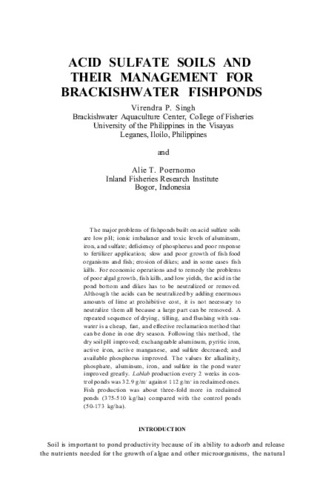
Acid sulfate soils and their management for brackishwater fishponds
(Aquaculture Department, Southeast Asian Fisheries Development Center; International Development Research Centre; Island Publishing House, Inc., 1984)The major problems of fishponds build on acid sulfate soils are low pH; ionic imbalance and toxic levels of aluminum, iron, and sulfate; deficiency of phosphorus and poor response to fertilizer application; slow and poor growth of fish food organisms and fish; erosion of dikes; and in some cases fish kills. For economic operations and to remedy the problems of poor algal growth, fish kills and low yields, the acid in the pond bottom and dikes has to be neutralized or removed. A repeated sequence of drying, tilling, and flushing with seawater is a cheap, fast, and effective reclamation method that can be done in one dry season. Following this method, the dry soil pH improved; exchangeable aluminum, pyritic iron, active iron, active manganese, and sulfate decreased; and available phorphorus improved. The values for alkalinity, phosphate, aluminum, iron, and sulfate in the pond water improved greatly. Fish production was about three-fold more in reclaimed ponds (375-510 kg/ha) compared with the control ponds (50-173 kg/ha). -
Initial assessment of the bacterial population of Guimaras waters and soil after the Solar I oil spill
(University of the Philippines Visayas, 2009)A massive oil spill occurred near the shores of Guimaras Island, Philippines in 11 Aug 2006 caused by the Sunken MT Solar I vessel. The oil spill spread to neighboring towns of Guimaras damaging the marine coastal environment, consequently,causing health and economic problems, particularly, by affecting local fisheries, wildlife and tourism. Hence, this study was conducted to assess, quantify and isolate indigenous bacteria with potential petroleum hydrocarbon-degrading properties that could be used for bioremediation of oil spill contaminated areas in Guimaras and nearby provinces. -
Effect of burning of rice straw on snails and soil in a brackishwater pond
(Serials Publications, 1993)The effects of burning the varying amounts of dried rice straw on snails and soil properties in brackishwater ponds in the Philippines were evaluated. Cerithium tenellum, Telescopium telescopium and other unidentified snail species present in a drained brackishwater ponds were exposed to heat by burning 1.3, 2.7, and 4.0 kg dried rice straw piled 5, 10, and 15 cm thick in nine 1 m2-plot. While T. telescopium and the unidentified snail species were killed (100%) in all the treatments, C. telellum mortality ranged fro 83±3.75 percent in plots with 1.3 kg straw. The chemical properties of the soil after burning the straw revealed a decrease in the organic matter and available phosphorous and increase in the available iron and potassium. There was no effect of burning on soil pH. The acetate soluble sulfate decreased with 1.3 kg of straw and increased with the higher amounts of straw.