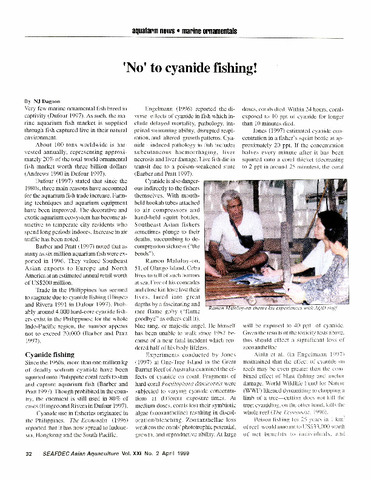
'No' to cyanide fishing!

Date
1999Page views
3,400ASFA keyword
zooxanthellae 
marine environment
biodiversity
nature conservation
coral reefs
cyanides
fish poisoning
fishery regulations
fishing
fishing barriers
food fish
lethal effects
livelihoods
marine fish
marketing
mortality
ornamental fishes
policies
resource management
stunting
sustainable fishing
toxicity tests
trade
marine environment
biodiversity
nature conservation
coral reefs
cyanides
fish poisoning
fishery regulations
fishing
fishing barriers
food fish
lethal effects
livelihoods
marine fish
marketing
mortality
ornamental fishes
policies
resource management
stunting
sustainable fishing
toxicity tests
trade
AGROVOC keyword
Metadata
Show full item recordShare
Suggested Citation
Dagoon, N. J. (1999). 'No' to cyanide fishing!. SEAFDEC Asian Aquaculture , 21(2), 32-33, 37-39. http://hdl.handle.net/10862/2756
Type
magazineArticleISSN
0115-4974Collections
Related items
Showing items related by title, author, creator and subject.
-
The Philippine industry: Marine tropical fish
(Aquaculture Department, Southeast Asian Fisheries Development Center, 1992) -
CRM in the Philippines: Lessons learned
(Aquaculture Department, Southeast Asian Fisheries Development Center, 1996)Philippine coastal communities can become capable fishery resource managers and that their management practices can become largely self-sustaining if the project approach focuses on assisting fishermen to learn how to help themselves. Community organization is an essential part of the process and should not be viewed as an end product in itself. There are also no quick fixes, and projects require a complex array of activities if large numbers of coastal residents are to be assisted. In some of these projects, the control of illegal fishing combined with limiting of commercial fishing to offshore areas and good coastal habitat management resulted in a doubling of daily fish catch and income for small-scale fishermen. However, even with the best of management, the total fishery harvest is limited and further increases in individual fishing income can only come from reducing total fishing effort. This will require a system of control on access to the resource to limit the number and kind of fishing gears and to divide the resource equitably. Assisting coastal communities to devise and implement realistic equitable access controls is the major challenge facing coastal resource co-management. -
Larval and early juvenile development of silver therapon, Leiopotherapon plumbeus (Actinopterygii: Perciformes: Terapontidae), reared in mesocosms
Aya, Frolan ; ; ; Garcia, Luis Maria (Szczecińskie Towarzystwo Naukowe, 2017)
The silver therapon, Leiopotherapon plumbeus (Kner, 1864), is an endemic and economically important freshwater food fish in the Philippines. The natural populations of this species have been declining during the past years, mainly due to intense fishing pressure, habitat degradation, and introduction of invasive alien species. At present, it is considered a target species for domestication and conservation efforts. Despite several attempts of artificial reproduction and larval rearing, little is known on larval and early juvenile development of silver therapon. The presently reported study was therefore intended to fill this gap in the knowledge by determining the growth and describing body proportions, pigmentation, and fin formation of this fish. Newly hatched larvae were reared in mesocosm tanks at a mean temperature of 29.5°C. Larvae up to 30 days after hatching were sampled at irregular intervals and preserved in 5% buffered formalin. Early development stages for 245 preserved specimens were described in detail with reference to changes in morphology, growth and body proportions, pigmentation, and fin formation. Five developmental stages of silver therapon were identified: yolk sac larva (1.88 mm TL), preflexion (2.51 mm TL), notochord flexion (4.50-8.27 mm TL), postflexion larva (6.90-12.21 mm TL), and early juvenile (>13.40 mm TL). Growth was isometric for eye diameter and gape size whereas positive allometry was observed for body depth, head length, and preanal length. Some body proportions showed abrupt changes from preflexion to postflexion larvae before it stabilized during the early juvenile stage. Pigmentation in the form of stellate and punctate melanophores increased with developmental stage, with larvae becoming heavily pigmented from postflexion to early juvenile stage. These morphological changes, together with the full complement of fin rays and squamation observed in specimens larger than 13.4 mm TL, suggest the attainment of the juvenile stage of this species. These morphological changes may explain the food and feeding habits during the early life stages of silver therapon which is critical to their survival and recruitment in the wild and in a mesocosm hatchery environment.
; ; ; Garcia, Luis Maria (Szczecińskie Towarzystwo Naukowe, 2017)
The silver therapon, Leiopotherapon plumbeus (Kner, 1864), is an endemic and economically important freshwater food fish in the Philippines. The natural populations of this species have been declining during the past years, mainly due to intense fishing pressure, habitat degradation, and introduction of invasive alien species. At present, it is considered a target species for domestication and conservation efforts. Despite several attempts of artificial reproduction and larval rearing, little is known on larval and early juvenile development of silver therapon. The presently reported study was therefore intended to fill this gap in the knowledge by determining the growth and describing body proportions, pigmentation, and fin formation of this fish. Newly hatched larvae were reared in mesocosm tanks at a mean temperature of 29.5°C. Larvae up to 30 days after hatching were sampled at irregular intervals and preserved in 5% buffered formalin. Early development stages for 245 preserved specimens were described in detail with reference to changes in morphology, growth and body proportions, pigmentation, and fin formation. Five developmental stages of silver therapon were identified: yolk sac larva (1.88 mm TL), preflexion (2.51 mm TL), notochord flexion (4.50-8.27 mm TL), postflexion larva (6.90-12.21 mm TL), and early juvenile (>13.40 mm TL). Growth was isometric for eye diameter and gape size whereas positive allometry was observed for body depth, head length, and preanal length. Some body proportions showed abrupt changes from preflexion to postflexion larvae before it stabilized during the early juvenile stage. Pigmentation in the form of stellate and punctate melanophores increased with developmental stage, with larvae becoming heavily pigmented from postflexion to early juvenile stage. These morphological changes, together with the full complement of fin rays and squamation observed in specimens larger than 13.4 mm TL, suggest the attainment of the juvenile stage of this species. These morphological changes may explain the food and feeding habits during the early life stages of silver therapon which is critical to their survival and recruitment in the wild and in a mesocosm hatchery environment.