Hatchery production of snubnose pompano Trachinotus blochii Lacepede

View/
Date
2014Page views
10,285ASFA keyword

AGROVOC keyword
Taxonomic term

Metadata
Show full item recordShare
Abstract
A 26-page extension manual describing the biology, broodstock acquisition & management, larval rearing, harvest & transport and prevention of diseases & parasites in hatchery production of pompano.
Suggested Citation
Reyes, O. S., de Jesus-Ayson, E. G. T., Pedroso, F. L., & Cabanilla, M. I. C. (2014). Hatchery production of snubnose pompano Trachinotus blochii Lacepede. Aquaculture Department, Southeast Asian Fisheries Development Center.
Type
BookISSN
0115-5369Series
Aquaculture extension manual; No. 56Format
24 pages : illustrations (some color) ; 23 cm
Collections
Related items
Showing items related by title, author, creator and subject.
-
Susceptibility of hatchery-reared snubnose pompano Trachinotus blochii to natural betanodavirus infection and their immune responses to the inactivated causative virus
Pakingking, Rolando V., Jr. ; ; ; ; (Elsevier, 2011)
Mass mortality of snubnose pompano Trachinotus blochii fry exhibiting dark coloration, anorexia, and abnormal swimming behavior was recently documented at the hatchery of the Aquaculture Department of the Southeast Asian Fisheries Development Center, Philippines. Samples of brain tissues were collected from affected fish and processed for RT-PCR amplification and virus isolation in cell culture. Infected E-11 cells exhibited cytopathic effect characteristic of betanodavirus. Histopathology of moribund fish showed pronounced vacuolations in the brain, spinal cord, and retina. An RT-PCR product of approximately 430 bp was amplified from the culture supernatant of betanodavirus-infected E-11 cells and sequenced. Sequencing of the T4 region of the coat protein gene (RNA 2) revealed clustering of the isolated virus within the red-spotted grouper nervous necrosis virus type. The pathogenicity of the isolated betanodavirus in healthy pompano juveniles and fry was determined via intramuscular injection and immersion challenges, respectively. Higher mortality rates were obtained in challenged fish compared with the controls. An inactivated vaccine was subsequently prepared by treating the clarified betanodavirus with formalin. Pompano juveniles intraperitoneally injected with the inactivated vaccine exhibited neutralizing antibodies from days 15 (mean titer 1:240) to 125 (1:560) with the highest titer noted at day 64 (1:2240) post-vaccination. Additionally, pompano fry bath-vaccinated and consequently bath-challenged with betanodavirus at day 35 post-vaccination showed higher survival rate compared with the control, indicating the potential of the inactivated betanodavirus vaccine against VNN in pompano fry and juveniles.
; ; ; ; (Elsevier, 2011)
Mass mortality of snubnose pompano Trachinotus blochii fry exhibiting dark coloration, anorexia, and abnormal swimming behavior was recently documented at the hatchery of the Aquaculture Department of the Southeast Asian Fisheries Development Center, Philippines. Samples of brain tissues were collected from affected fish and processed for RT-PCR amplification and virus isolation in cell culture. Infected E-11 cells exhibited cytopathic effect characteristic of betanodavirus. Histopathology of moribund fish showed pronounced vacuolations in the brain, spinal cord, and retina. An RT-PCR product of approximately 430 bp was amplified from the culture supernatant of betanodavirus-infected E-11 cells and sequenced. Sequencing of the T4 region of the coat protein gene (RNA 2) revealed clustering of the isolated virus within the red-spotted grouper nervous necrosis virus type. The pathogenicity of the isolated betanodavirus in healthy pompano juveniles and fry was determined via intramuscular injection and immersion challenges, respectively. Higher mortality rates were obtained in challenged fish compared with the controls. An inactivated vaccine was subsequently prepared by treating the clarified betanodavirus with formalin. Pompano juveniles intraperitoneally injected with the inactivated vaccine exhibited neutralizing antibodies from days 15 (mean titer 1:240) to 125 (1:560) with the highest titer noted at day 64 (1:2240) post-vaccination. Additionally, pompano fry bath-vaccinated and consequently bath-challenged with betanodavirus at day 35 post-vaccination showed higher survival rate compared with the control, indicating the potential of the inactivated betanodavirus vaccine against VNN in pompano fry and juveniles. -
Characterisation of Vibrio isolates recovered from the eyes of cage-cultured pompano (Trachinotus blochii) infested with caligid parasites (Lepeophtheirus spinifer)
Pakingking, Rolando V., Jr.; ; ; (European Association of Fish Pathologists, 2018)
Exophthalmia was documented among sea cage-cultured pompano (Trachinotus blochii) broodstocks with caligid parasite (Lepeophtheirus spinifer) infestation in the Philippines. Following sequencing, and based on the results of both diagnostic investigations and infection experiments, V. harveyi likely had a role in the reported exophthalmia cases, and this was initiated by L. spinifer infection. -
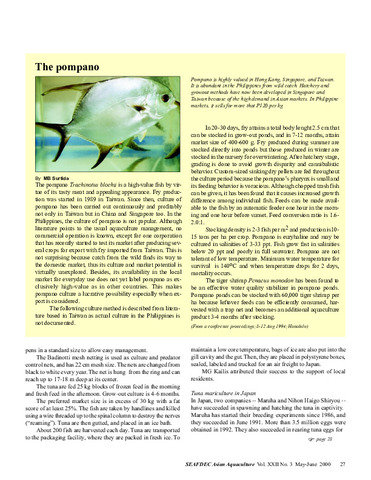
The pompano
(Aquaculture Department, Southeast Asian Fisheries Development Center, 2000)