The Philippines recommends for milkfish
View/
Date
2016Page views
5,110ASFA keyword

AGROVOC keyword
Taxonomic term

Metadata
Show full item recordShare
Subjects
Milkfish Milkfish industry
Description
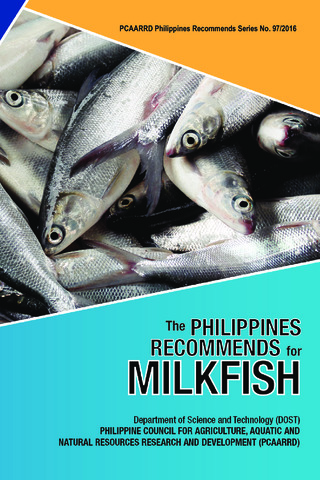
With the aim to provide updated technology for milkfish production, the Philippine Council for Agriculture, Aquatic and Natural Resources Research and Development of the Department of Science and Technology (DOST-PCAARRD) published a new edition of The Philippines Recommends (PR) for Milkfish, which was first published in 1983.
Written by experts on aquaculture from Santeh Aquaculture Science and Technology Foundation, Inc., University of the Philippines (UP) Visayas-College of Fisheries and Ocean Sciences, Southeast Asian Fisheries Development Center-Aquaculture Department (SEAFDEC-AQD), and UP Los Baños-College of Economics and Management, the book consists of up-to-date material on milkfish production from fry and fingerling production, grow-out culture, up to postharvest handling and processing.
It also tackles pond and cage culture in detail and marketing and cost and return analysis in milkfish production. The PR for Milkfish 2016 includes information from PCAARRD-funded National Milkfish R&D Program.
The book hopes to lessen the country’s dependence on imported fry as it encourages sufficient investment in hatcheries and active participation of smallholders in larval rearing and fry production.
Suggested Citation
The Milkfish Technical Committee 2016. (2016). The Philippines recommends for milkfish. Los Baños, Laguna, Philippines: DOST-PCAARRD.
Contents
- Foreword
- Acknowledgment
- The Milkfish Technical Committee
- Glossary of Terms
- List of Abbreviations and Acronyms
- Introduction
- Commodity Profile
- Fry Production
- Broodstock Development and Management
- Hatchery Technology
- Market Outlets and Supply Chain
- Cost and Return
- Fingerling Production
- Nursery/Fingerling Production System
- Pond Preparation
- Fry Sourcing
- Stocking of fry in the Nursery Pond
- Care of Stock in the Nursery
- Nursery Harvest or Transfers
- Counting, Packing, and Transport
- Market Outlets
- Cost and Return
- Pond Culture
- Site Selection
- Pond Layout and Design
- Construction
- Pond Preparation
- Feeds and Feeding
- Water Management
- Health Management
- Preventive Measures against Off-flavor
- Grow-Out System
- Mechanization
- Harvesting and Market Outlets
- Cost and Return
- Cage Culture
- Fingerling Sourcing, Conditioning, and Transport
- Acclimation and Stocking
- Site Selection
- Cage Design and Layout
- Culture Techniques
- Feeds and Feeding
- Health Management
- Precautionary Measures against Fishkill
- Harvesting and Market Outlets
- Cost and Return
- Market Supply Chain
- Pen Culture
- Postharvest Handling and Processing
- Postharvest Handling
- Hygiene and Sanitation among Fish Harvesters and Handlers
- Different Product Forms
- Market Outlets
- Exports
- References
Type
BookISSN
0115-7833Series
Philippines Recommends Series; No. 97/2016Format
xvi, 162 pages : illustrations (chiefly color).
Collections
Related items
Showing items related by title, author, creator and subject.
-
Ration reduction, integrated multitrophic aquaculture (milkfish-seaweed-sea cucumber) and value-added products to improve incomes and reduce the ecological footprint of milkfish culture in the Philippines
(AquaFish Collaborative Research Support Program, Oregon State University, 2012)In the Philippines, cage culture of milkfish in marine environments is increasing. The practice uses high stocking densities, with significantly greater inputs of artificial feeds which more often than not, have led to excessive feeding and consequently excessive nutrient loading in receiving waters, exacerbating problems with pollution. These could have contributed to occurrence of periodic fish kills in areas of marine milkfish culture clusters. In marine cage culture, about 80% of variable expenses are attributable to feed costs. Experiments were conducted to compare production characteristics of milkfish fed on alternate days versus those raised on daily feeding in marine cage culture. Fish were fed either daily or every other day using a reduced feed ration at 7.5% of fish biomass at the start of culture down to 3% of fish biomass towards harvest. We showed this ration level was as effective as the industry standard that begins at a rate of 10% average body weight. Morevover, we had previously found that milkfish reared in brackishwater ponds on an alternate day feeding scheme using the reduced ration level produced a 56% cost savings in feed with little impact on total yield relative to fish raised on a daily feeding protocol. In the present study, survival rates (~ 90%) were comparable between the control fish fed daily and groups fed on alternate days in marine cages. Similarly, total harvested biomass of fish in the alternate day and daily feeding groups was similar as was the harvest value, although fish on the alternate day feeding scheme grew slightly less. The amount of feed and the corresponding cost of feeds consumed were significantly lower in stocks that were fed on alternate days compared with those fed daily (P < 0.05). Feed conversion ratio (FCR) was lower in the alternate-day fed group (FCR = 2.46) relative to stocks fed daily (FCR = 3.59). Overall, the results demonstrate that feed costs can be reduced by around 32% in stocks fed on alternate days, which yields an estimated 20-25% improvement in production efficiency relative to raising animals on a daily feeding protocol. Hence, a significant costs savings with reduced impact of nutrient loading in the environment is likely to be realized for farmers who adopt an alternate day feeding scheme in raising milkfish in marine cages. -
Series: Milkfish Podcasts
Milkfish aquaculture: Alternate-day feeding strategy for reducing cost of milkfish culture in brackishwater ponds and marine cages in the Philippines
(AquaFish Collaborative Research Support Program (AquaFish CRSP), 2012-02-02)This podcast provides information on how an alternate-day feeding strategy can be used to reduce costs for culturing milkfish in ponds or marine cages. -
Larviculture of milkfish (Chanos chanos) in outdoor tanks
(Aquaculture Department, Southeast Asian Fisheries Development Center, 1996)In the past, larviculture of milkfish depended entirely on the use of rotifers and brine shrimp nauplii and rearing trials were done under roofed facilities. Since the dietary value of live food varies according to culture and feeding conditions, rotifers were enriched with SELCO, a lipid emulsion containing high levels of highly unsaturated fatty acids (HUFA) prior to feeding the larvae. Alternatively, a microbound larval feed (Nosan R-1) was given as a supplement to rotifers during the first two weeks of culture. Larval growth was enhanced and survival was significantly improved when rotifers were enriched or supplemented with these diets. All rearing trials were conducted in 5-10 tons concrete circular/rectangular outdoor tanks. Verification runs on the use of HUFA-enriched rotifers to milkfish larvae were tried in two nearby private hatcheries. Results from mis collaborative work are presented.