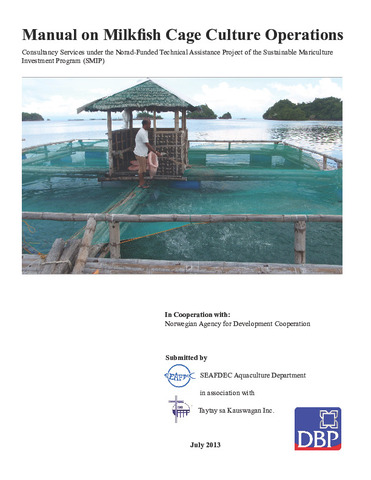
Manual on milkfish cage culture operations
| dc.date.accessioned | 2020-06-22T07:18:19Z | |
| dc.date.available | 2020-06-22T07:18:19Z | |
| dc.date.issued | 2013-07 | |
| dc.identifier.citation | SEAFDEC/AQD. (2013). Manual on milkfish cage culture operations. Aquaculture Department, Southeast Asian Fisheries Development Center. | en |
| dc.identifier.uri | http://hdl.handle.net/10862/5886 | |
| dc.description.abstract | Milkfish (Chanos chanos, or bangus) culture is the largest finfish aquaculture industry in the Philippines and continues to be a top aquaculture commodity primarily because it is easy to culture and can be grown in a wide range of environments. Milkfish thrives in freshwater, brackishwater, marine, and even hypersaline habitats. Milkfish production is increasing rapidly with much of the production moving away from the traditional culture in brackishwater ponds to fish cages in coastal marine waters. To provide a general view of the milkfish culture industry, brief descriptions on breeding, hatchery production, and nursery operation are included in this manual. This manual is meant to serve as a guide for those interested to venture into marine cage farming of milkfish. Milkfish culture has been practiced in the Philippines, Indonesia, and Taiwan for centuries and has been the focus of aquaculture research in a number of institutions for several decades. Innovations in culture practices as a result of information from research data and from farmer’s experiences have been adopted by industry practitioners and these are documented in the recently published book entitled Milkfish Aquaculture in Asia (Liao and Leano, 2010). The recent concern about the rapid growth of aquaculture and its possible environmental impacts, and risks that can threaten the sustainability of this expanding industry has also been the subject of many conferences to develop good management practices in aquaculture. Principles and guidelines on better management practices in marine finfish culture had been drafted and included in this manual. | en |
| dc.language.iso | en | en |
| dc.publisher | Aquaculture Department, Southeast Asian Fisheries Development Center | en |
| dc.subject | Chanos chanos | en |
| dc.title | Manual on milkfish cage culture operations | en |
| dc.type | Book | en |
| dc.subject.asfa | milkfish culture | en |
| dc.subject.asfa | cage culture | en |
| dc.subject.asfa | fish culture | en |
| dc.subject.asfa | aquaculture | en |
| dc.subject.asfa | induced ovulation | en |
| dc.subject.asfa | nursery ponds | en |
| dc.subject.asfa | fingerlings | en |
| dc.subject.asfa | site selection | en |
| dc.subject.asfa | fish ponds | en |
| dc.subject.asfa | transport | en |
| dc.subject.asfa | water quality control | en |
| dc.subject.asfa | water quality | en |
| dc.subject.asfa | sediment | en |
| dc.subject.asfa | evaluation | en |
| dc.subject.asfa | fishery biology | en |
| dc.subject.asfa | cages | en |
| dc.subject.asfa | investment | en |
| dc.subject.asfa | floating cages | en |
| dc.subject.asfa | feeding | en |
| dc.subject.asfa | dissolved oxygen | en |
| dc.subject.asfa | pH | en |
| dc.subject.asfa | water temperature | en |
| dc.subject.asfa | salinity | en |
| dc.subject.asfa | Secchi discs | en |
| dc.subject.asfa | organic matter | en |
| dc.contributor.corporateauthor | Southeast Asian Fisheries Development Center, Aquaculture Department | en |
| dc.contributor.corporateauthor | Taytay sa Kauswagan Inc. | en |
| dc.contributor.corporateauthor | Development Bank of the Philippines (DBP) | en |
| dc.contributor.corporateauthor | Norwegian Agency for Development Cooperation | en |
| dc.subject.scientificName | Chanos chanos |
Files in this item
- ชื่อ:
- milkfish cage culture_final.pdf
- ขนาด:
- 9.429Mb
- รูป:
- Downloads:
- 6
- Access Status:
-
 Restricted Access

รายการนี้ปรากฏใน (s)
Related items
Showing items related by title, author, creator and subject.
-
Series: Summary of Proceedings No. 1/2013;
Primary productivity, chlorophyll, phytoplankton and the development to eutrophic state of Taal Lake, southern Luzon, Philippines
(PCAARRD-DOST, 2013)Physico-chemical properties and biological components such as primary productivity, chlorophyll-a and phytoplankton were measured from January to October of 2008. This study aimed to determine the present trophic state and to provide information needed by policy makers for the management, conservation and sustainable use of Taal Lake. Primary productivity was measured using the Light and Dark Bottle Method, chlorophyll-a by fluorescence using SD204 Instrument, phytoplankton using Haemacytometer Method, and identification keys. All the parameters except pH have no significant differences on the type (cage or open water areas). However, all the parameters except net primary productivity and chlorophyll had significant differences between cages and open water areas. There are significant differences with respect to water temperature, water transparency, and dissolved oxygen among stations and months. Dissolved oxygen, nitrate and net primary productivity in the cages and open water areas displayed interaction effects on the months. Moreover, all parameters except Gross Primary Productivity (GPP) and chlorophyll-a in the stations had significant interaction effects also on the months. Nitrate is positively correlated with primary productivity, dissolved oxygen and pH, while total phosphorus has direct association with chlorophyll. Based on transparency readings, Taal Lake is mesotrophic. Both nitrates and total phosphorus exceeded the prescription of USEPA 1976a and UNEP-IETC-ILEC 2001 of 0.30 mg/L and 84.4 mg/L, respectively. On the other hand, chlorophyll-a peak concentration obtained in the study was fivefolds higher than the standard set by USEPA (1974) as cited by Novotny and Olem (1994) and UNEP-IETC-ILEC (2001). The cyanobacterial dominance and high chlorophyll, reduced transparency, off-flavor, and odor problems are symptoms of eutrophication, indicating that Taal Lake has developed into eutrophic status. It is recommended that continuous monitoring of water quality be carried out to determine if there is improvement or conditions remain the same or further deterioration occurs. Likewise, the carrying capacity of the lake and the causes of off-flavor must also be determined. -
Series: JIRCAS Working Report; No. 56
Comparative analysis of pattern of fishcage culture using marine/brackish water in three Southeast Asian countries
(Japan International Research Center for Agricultural Sciences, 2007)Production by fishcage culture using marine/brackish water has increased drastically since the mid-1980s, when the technology for developing sea bass hatchery fry was established. In the 1990s, it grew further, due to the start of production of grouper and snapper hatchery fry. We conducted a comparative analysis of production by fishcage culture and patterns of fishcage culture in the Philippines, Thailand, and Malaysia, all of which are major producer of fish by fishcage culture using marine/brackish water in the Southeast Asian countries. We compared of fishcage culture management between the reference and current year and analyzes the average of the reference year (the year when fishcage culture started; the same hereinafter) and current year (2004). In terms of production of cultured fish by kind, sea bass showed a more than 50% decrease - from 67% to 32%, whereas grouper saw a nearly doubled ratio from 20% to 39%. Snapper remained almost the same, at 29% to 28%. Other fish (mainly rabbitfish, threadfin bream and grunter) saw an increased ratio from 5% to 16%. We compared the management of fishcage culture between the reference year and 2004. We looked into the ratio of production by type of fish and found that sea bass showed a decreased ratio to less than half from 67% to 32%; while grouper showed a near doubling of its ratio from 20% to 39%. Snapper remained almost unchanged, at 28% to 29%; and other kinds of fish increased their ratios from 5% to 16%. In terms of operating cost per kilogram for farming groupers, fishcage culture costs more than fishpond culture. Fishcage culture, however, is more convenient and productive than fishpond culture, and requires lower initial cost than fishpond culture, since the former does not require an initial outlay for constructing a pond or management of water quality. Accordingly, fishcage culture shows overwhelmingly higher production than fishpond culture. -
Polyculture of milkfish Chanos chanos (Forsskal) and the red seaweed Gracilariopsis bailinae (Zhang et Xia) in brackish water earthen ponds
(Wiley-Blackwell, 2004)Growth, net production, and survival rates of milkfish cultured with Gracilariopsis bailinae at two stocking density combinations (T1– 30 fingerlings 100-m−2 pond+1-kg G. bailinae 4-m−2 net cage, T2– 30 fingerlings 100-m−2 pond+2-kg G. bailinae 4-m−2 net cage) in brackish water earthen ponds over four culture periods were determined. The control (T3) was stocked at 30 fingerlings 100-m−2 pond. Specific growth and production rates of G. bailinae were also calculated. There were no significant differences in mean growth, survival, and net production rates of milkfish between the three treatments. Irrespective of stocking singly or in combination with G. bailinae, significantly higher mean growth and mean production rates for milkfish were obtained during the third culture period of year 1 than those obtained from the other culture periods. Survival rates were not significantly different among the four culture periods. There were no significant differences in mean specific growth and mean net production rates between the two stocking densities of G. bailinae. Significantly higher mean specific growth and mean net production rates of red seaweed were also obtained during the third culture period of year 1 than those obtained from other culture periods. The production of milkfish and red seaweed was higher during the dry season. Growth rates of milkfish was positively correlated with temperature and salinity, while net production rates were positively correlated with temperature and total rainfall, but was inversely correlated with dissolved oxygen. G. bailinae growth and net production rates were positively correlated with water temperature and salinity. Results show that milkfish can be polycultured with G. bailinae grown in net cages in brackish water ponds at stocking density combination of 30 fingerlings 100-m−2 pond+1-kg G. bailinae 4-m−2 net cage.