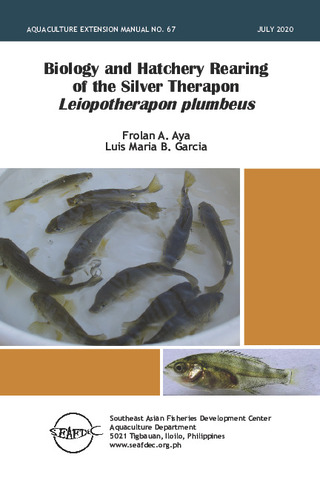
Biology and hatchery rearing of the silver therapon Leiopotherapon plumbeus
 AQD Access
Date
2020-07Page views
15,111ASFA keyword
biology 
distribution records
growth
size
diet
feeding
nutritional requirements
reproduction
breeding stock
breeding
selection
hormones
larval stage
rearing techniques
fish hatcheries
incubation period
culture tanks
economic analysis
cost benefit analysis
fish culture
freshwater aquaculture
aquaculture
aquaculture development
aquaculture techniques
distribution records
growth
size
diet
feeding
nutritional requirements
reproduction
breeding stock
breeding
selection
hormones
larval stage
rearing techniques
fish hatcheries
incubation period
culture tanks
economic analysis
cost benefit analysis
fish culture
freshwater aquaculture
aquaculture
aquaculture development
aquaculture techniques
AGROVOC keyword
Taxonomic term

Metadata
Show full item recordShare
Contributes to SDGs


Keywords
Silver perch Silver therapon AyunginSubjects
Freshwater fishes--Breeding Freshwater fishes--Growth Freshwater fishes--Feeding and feeds Freshwater fishes--Reproduction Fish culture Handbooks and manuals
Description
Known for its tasty flesh, silver therapon, locally known as ayungin, has been regarded to be one of the most valuable edible native freshwater species in the Philippines. Demands for this fish species remain high which caused the wild stock supply to decline. According to the Philippine Statistics Authority, catch for this fish has deteriorated from 4,765 metric tons in 2002 to only 1,408 metric tons in 2018.
Due to this growing concern, a hatchery technique was devised by an AQD scientist to aid the deteriorating population of the species in the Philippine waters. This protocol, just like other technologies developed by SEAFDEC/AQD, will be for free and open to fish farmers interested to venture into ayungin culture. This new system of growing ayungin larvae in captivity was granted a patent by the Intellectual Property Office of the Philippines (IPOPHIL) in 2019, published in Volume 22, Number 124 of the office’s official gazette.
This manual contains the patented technique which will provide current knowledge on the biology, breeding, and seed production of ayungin. It aims to serve as a useful reference for students, aquaculturists, researchers, government fishery agency personnel who are interested in the breeding and culture of the native fish species.
Refinements on the technology for seed production and rearing of this specific species are still being continued. SEAFDEC/AQD is aiming to conduct more research in the development of nursery and grow-out technology. The Department is also gearing towards developing techniques for bigger culture systems which will be fit for commercial production. This is to help stakeholders and the industry boosts the economy through the production of this endemic species.
Suggested Citation
Aya, F. A., & Garcia, L. M. B. (2020). Biology and hatchery rearing of the silver therapon Leiopotherapon plumbeus. Tigbauan, Iloilo, Philippines: Aquaculture Department, Southeast Asian Fisheries Development Center.
Type
BookISSN
0115-5369Series
Aquaculture extension manual; No. 67Format
[ii], 32 pages : color illustrations.
Collections
Related items
Showing items related by title, author, creator and subject.
-
Effects of weaning on survival and growth of silver therapon (Leiopotherapon plumbeus) larvae fed live and artificial diet
Aya, Frolan ; ; Garcia, Luis Maria (Wiley, 2021-10)
This study examined the effects of early weaning strategies on growth and survival of the silver therapon Leiopotherapon plumbeus larvae. In Trial 1, four larval age groups (8, 14, 20 and 26 days post‐hatch (dph)) were abruptly weaned to commercial powdered tilapia diet and compared with wild copepod‐fed group as the control. In Trial 2, another batch of three weaning age groups were subjected to gradual weaning (8 dph larvae with 8 days co‐feeding, 14 dph larvae with 6 days co‐feeding and 20 dph larvae with 4 days co‐feeding) with Artemia nauplii prior to weaning on commercial powdered prawn diet and compared with a control group consisted of larvae fed exclusively on Artemia nauplii. Both weaning trials were conducted for 21 days. A gradual weaning strategy promoted better survival (22.2%–40.0%) among weaning age groups than the abrupt weaning strategy (2.2%–36.7%). Except for those weaned at 26 dph, abrupt weaning resulted in significantly poor growth and survival among all weaning age groups compared with the wild copepod‐fed control group. The highest survival and growth were observed in 20 dph larvae with 4 days live food co‐feeding, although the values were significantly lower than the Artemia‐fed control group. These results suggest that abrupt weaning at 26 dph, and gradual weaning for 4 days from 20 dph promote successful rearing of silver therapon larvae and that a microparticulate diet specifically formulated for this species needs to be developed.
; ; Garcia, Luis Maria (Wiley, 2021-10)
This study examined the effects of early weaning strategies on growth and survival of the silver therapon Leiopotherapon plumbeus larvae. In Trial 1, four larval age groups (8, 14, 20 and 26 days post‐hatch (dph)) were abruptly weaned to commercial powdered tilapia diet and compared with wild copepod‐fed group as the control. In Trial 2, another batch of three weaning age groups were subjected to gradual weaning (8 dph larvae with 8 days co‐feeding, 14 dph larvae with 6 days co‐feeding and 20 dph larvae with 4 days co‐feeding) with Artemia nauplii prior to weaning on commercial powdered prawn diet and compared with a control group consisted of larvae fed exclusively on Artemia nauplii. Both weaning trials were conducted for 21 days. A gradual weaning strategy promoted better survival (22.2%–40.0%) among weaning age groups than the abrupt weaning strategy (2.2%–36.7%). Except for those weaned at 26 dph, abrupt weaning resulted in significantly poor growth and survival among all weaning age groups compared with the wild copepod‐fed control group. The highest survival and growth were observed in 20 dph larvae with 4 days live food co‐feeding, although the values were significantly lower than the Artemia‐fed control group. These results suggest that abrupt weaning at 26 dph, and gradual weaning for 4 days from 20 dph promote successful rearing of silver therapon larvae and that a microparticulate diet specifically formulated for this species needs to be developed. -
Aquaculture development in Malaysia
(Aquaculture Department, Southeast Asian Fisheries Development Center, 1988)Malaysia is a fish-consuming country with fish representing 60% of a total animal protein intake. At an annual per capita consumption of 32 kg some 560 000 mt of fish is required for the projected of 17.5 million people in year 2000. Coastal marine capture fisheries, the mainstay of Malaysia's fishsupply, has not shown any increase in landings over the last few years. In fact in 1985 there was a decline of 3.7% compared to 1984 fish landings. This declining contribution of marine fisheries is compensated by an increase in aquaculture production. In 1985, aquaculture contributed 51 709 mt to the total fish supply. This represents 10% of the total fish landings of 514 570 mt or 13% of total table (edible) fish landings. Malaysia does not have a long standing aquaculture tradition unlike its neighbours in the Indo-Pacific. Even then, the industry has seen rapid growth in the last few years. Today there are 19 species of finfishes, crustaceans and shellfish cultured in the country. The main freshwater fish species bred and cultured are bighead carp (Aristichthys nobilis), grass carp (Ctenopharyngodon idella), common carp (Cyprinus carpio), Indonesian carp (Punctius gonionotus), catfish (Clarias macrocephalus and Pangasius spp), snakefish gourami (Trichogaster pectoralis) and tilapia (mainly Oreochromis niloticus). Marine finfishes bred and cultured are sea bass (Lates calcarifer), grouper (Epinephelus sp.) and snapper (Lutjanus johni). Penaeus monodon is the dominant marine prawn species bred and cultured but culture of P. merguiensis is receiving considerable interest. Macrobrachium rosenbergii is the only freshwater prawn cultured commercially. Molluscs cultured are the blood clam (Anadara granosa) and the green mussel (Perna viridis). In 1985, blood clam and mussel culture accounted for 87% of all aquaculture production of Malaysia, freshwater fish 12%, floating cage culture of marine fish 0.7% and brackishwater pond culture 0.3%. In terms of value blood clam and mussels represented 30% (M$15M) of total value (M$49.5M), freshwater fish 57% (M$28M),cage culture of marine fin fishes 7% (M$3.4M),and brackishwater pond production 6% (M$2.1M). Aquaculture in Malaysia has considerable growth potential. It is projected that 22 000 ha of mangrove will be opened by the year 2000 for shrimp culture. Some 330 000 m2 of protected coastal waters have been identified for cage culture. Some 6500 rafts can considerably expand the present capacity. In freshwater culture about 8000 ha of land and 17 500 ha of mining pools can be developed while 200 000 ha of artificial lakes and impoundments for freshwater fish cage culture are available. Yet such development is not without constraints. Freshwater finfish culture is hampered by lack of good quality broodstock. There is also a limited market for freshwater finfishes. Marine finfish culture is limited by lack of fingerlings and good quality compounded diet to replace trash fish which is deteriorating in quality and quantity. Marine prawn culture is heavily dependent on wild spawners, the supply unpredictable and inadequate. Acid sulfate soil continues to cause the deterioration of brackishwater ponds. Cockles and mussels can be sold to export markets only if they meet specific quality standards. -
Catfish aquaculture
(Aquaculture Department, Southeast Asian Fisheries Development Center, 2003)This article deals with the biology, broodstock management, seed production techniques and grow-out culture practices in C. macrocephalus.