Development of immunological indices for monitoring health status in shrimp (Penaeus monodon)
 AQD Access
Date
2005-03Author

Page views
2,215ASFA keyword

AGROVOC keyword
Taxonomic term

Metadata
Show full item recordShare
Abstract
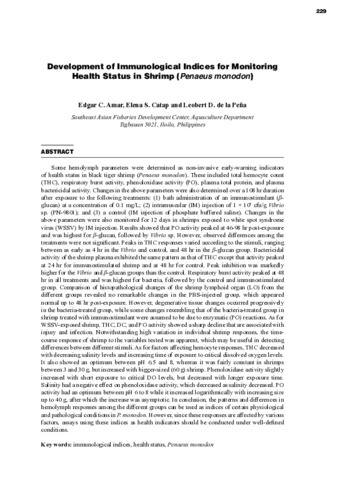
Some hemolymph parameters were determined as non-invasive early-warning indicators of health status in black tiger shrimp (Penaeus monodon). These included total hemocyte count (THC), respiratory burst activity, phenoloxidase activity (PO), plasma total protein, and plasma bactericidal activity. Changes in the above parameters were also determined over a 108 hr duration after exposure to the following treatments: (1) bath administration of an immunostimulant (β-glucan) at a concentration of 0.1 mg/L; (2) intramuscular (IM) injection of 1 × 10⁶ cfu/g Vibrio sp. (PN-9801); and (3) a control (IM injection of phosphate buffered saline). Changes in the above parameters were also monitored for 12 days in shrimps exposed to white spot syndrome virus (WSSV) by IM injection. Results showed that PO activity peaked at 46-98 hr post-exposure and was highest for β-glucan, followed by Vibrio sp. However, observed differences among the treatments were not significant. Peaks in THC responses varied according to the stimuli, ranging between as early as 4 hr in the Vibrio and control, and 48 hr in the β-glucan group. Bactericidal activity of the shrimp plasma exhibited the same pattern as that of THC except that activity peaked at 24 hr for immunostimulated shrimp and at 48 hr for control. Peak inhibition was markedly higher for the Vibrio and β-glucan groups than the control. Respiratory burst activity peaked at 48 hr in all treatments and was highest for bacteria, followed by the control and immunostimulated group. Comparison of histopathological changes of the shrimp lymphoid organ (LO) from the different groups revealed no remarkable changes in the PBS-injected group, which appeared normal up to 48 hr post-exposure. However, degenerative tissue changes occurred progressively in the bacteria-treated group, while some changes resembling that of the bacteria-treated group in shrimp treated with immunostimulant were assumed to be due to enzymatic (PO) reactions. As for WSSV-exposed shrimp, THC, DC, and PO activity showed a sharp decline that are associated with injury and infection. Notwithstanding high variation in individual shrimp responses, the time-course response of shrimp to the variables tested was apparent, which may be useful in detecting differences between different stimuli. As for factors affecting hemocyte responses, THC decreased with decreasing salinity levels and increasing time of exposure to critical dissolved oxygen levels. It also showed an optimum between pH 6.5 and 8, whereas it was fairly constant in shrimps between 3 and 30 g, but increased with bigger-sized (60 g) shrimp. Phenoloxidase activity slightly increased with short exposure to critical DO levels, but decreased with longer exposure time. Salinity had a negative effect on phenoloxidase activity, which decreased as salinity decreased. PO activity had an optimum between pH 6 to 8 while it increased logarithmically with increasing size up to 40 g, after which the increase was asymptotic. In conclusion, the patterns and differences in hemolymph responses among the different groups can be used as indices of certain physiological and pathological conditions in P. monodon. However, since these responses are affected by various factors, assays using these indices as health indicators should be conducted under well-defined conditions.
Suggested Citation
Amar, E. C., Catap, E. S., & de la Peña, L. D. (2005). Development of immunological indices for monitoring health status in shrimp (Penaeus monodon). In K. Nagasawa (Ed.), Recent Advances in Diagnosis and Prevention of Fish and Shrimp Diseases in Southeast Asia (pp. 229–243). Tigbauan, Iloilo, Philippines: Aquaculture Department, Southeast Asian Fisheries Development Center.
Type
Book chapterISBN
9718511732Related items
Showing items related by title, author, creator and subject.
-
An overview of the nutrition, feed and feeding techniques of prawn penaeid/shrimps
(Philippine Council for Aquatic and Marine Research and Development, 1989)This paper echoes what transpired during the first International Conference of Penaeid Prawns/Shrimps held in Iloilo City in December 4-7, 1984, particularly on the Nutrition nd Feed Development. Around 25 papers were presented during the conference. The nutrient requirements of P. japonicus and to some extent, P. monodon have been studied quite extensively compared to other penaeid species. Requirements for protein, carbohydrates fats, amino acids and essential fatty acids for juveniles and larvae have been defined compared to those of the broodstock. Optimum protein levels for prawn juveniles vary from 28-38% for P. kerathurus, 40-46% for P. monodon, 43% for P. indicus and 50-54% for P. japonicus. Dissacharides like sucrose and trehalose have been found to be good source of carbohydrates at 20-25% in the diet. Crustacean diets require around 0.5% cholesterol. There are few studies on vitamine and mineral requirements. There are artificial diets for juveniles and microencapsulated diets that can completely replace live organisms as larval feed. Microencapsulated diets have been field-tested for P. vannamei, P. stylirostris, P. monodon, P. indicus and P. merguiensis in Ecuador, Taiwan, Malaysia, Thailand and the Philippines. When a commercial diet for the broodstock becomes available ther will be an artificial diet for athe life cycle of tha prawn. -
Series: Actes de Colloque 9
Mineral requirements of Penaeids
(Institut Francais de Recherche pour l'Exploitation de la Mer, 1990)Marine shrimps absorb minerals from their aquatic environment aside from the minerals that come from the food they eat. Thus, the dietary requirement of shrimps for certain minerals will depend on the amounts and availability of these minerals in the aquatic environment. Dietary sources for growth may be necessary due to losses during moltings. Most of the dietary studies for mineral requirements have been done under laboratory conditions with purified or semi-purified diets and hardly any information is available under practical culture conditions. Most published data for mineral requirements are for juvenile Penaeus japonicus. There are few data for P. monodon, P. californiensis, P. merguiensis, P. aztecus. Calcium and phosphorus are the minerals that have been studied the most. These two have been found to be related to problems of soft-shelling in P. monodon. Apparently calcium and phosphorus requirements are within the range of 1 to 2%. The ratio of calcium to phosphorus in the diet is also an important factor in the efficient utilization of both minerals. It seems that a 1 :1 ratio provides for good growth. Phosphorus deficiency results in reduced growth while lack of magnesium brings about decreased growth, poor survival and reduced feed efficiency in P. japonicus. Iron toxicity has also been observed in P. japonicus. It might not be necessary to include some minerals in the diet of penaeids. -
Requirements of juvenile marine shrimp, Penaeus monodon (Fabricius) for lysine and arginine
(Elsevier, 1998)Feeding experiments were conducted using amino acid test diets to determine the dietary requirements of juvenile Penaeus monodon for lysine and arginine. Two sets of the test diets were prepared. The natural protein was supplied by casein and gelatin. Crystalline l-amino acids were added to provide an amino acid profile similar to shrimp muscle protein except for the test amino acid. One set of experimental diets contained graded levels of lysine at 1.18–3.28% of the diet and another set contained arginine at 0.6–3.0% of the diet. The amino acid mixture was pre-coated with carboxymethylcellulose (CMC) and diets were further bound with CMC, cornstarch, and K–carrageenan to prevent leaching losses of amino acids. Shrimp postlarvae, PL20, with mean weight of 21±0.5 mg, were randomly distributed at 10 shrimp per tank in 40-l fiberglass tanks and reared on the diets for 50–56 days. Growth, survival and feed conversion efficiency were determined at termination of feeding trials and signs of nutritional deficiency noted. Lysine and arginine requirements were determined from relationships between weight gains and dietary lysine and arginine levels as analyzed by the broken-line regression method. The requirement of juvenile P. monodon for lysine was estimated to be 2.08% of the diet or 5.2% of dietary protein while the requirement for arginine was 1.85% of the diet or 5.3% of dietary protein. This information is crucial in formulating cost-effective practical diets for juvenile tiger shrimp.