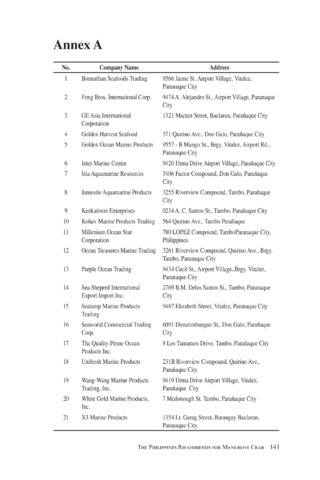
[The Philippines recommends for mangrove crab:] Mangrove crab holding facilities registered under BFAR-NCR in 2018
View/
Date
2021Page views
2,006ASFA keyword
AGROVOC keyword
committees 
Bonnathan Seafoods Trading
Fong Bros. International Corp.
GE Asia International Corporation
Golden Harvest Seafood
Golden Ocean Marine Products
Inter Marine Center
Isla Aquamarine Resources
Jamesrie Aquamarine Products
Kenkaitwin Enterprises
Kohav Marine Products Trading
Millenium Ocean Star Corporation
Ocean Treasures Marine Trading
Purple Ocean Trading
Sea Shepherd International Export Import Inc.
Sealamp Marine Products Trading
Seaworld Commercial Trading Corp.
The Quality Prime Ocean Products Inc.
Unifresh Marine Products
Wang-Wang Marine Products Trading, Inc.
White Gold Marine Products, Inc.
X3 Marine Products
Xinhe Seafood Enterprises
Yeung Marine Products
Harbour View Corporation
Orient Fresh Enterprises
Bonnathan Seafoods Trading
Fong Bros. International Corp.
GE Asia International Corporation
Golden Harvest Seafood
Golden Ocean Marine Products
Inter Marine Center
Isla Aquamarine Resources
Jamesrie Aquamarine Products
Kenkaitwin Enterprises
Kohav Marine Products Trading
Millenium Ocean Star Corporation
Ocean Treasures Marine Trading
Purple Ocean Trading
Sea Shepherd International Export Import Inc.
Sealamp Marine Products Trading
Seaworld Commercial Trading Corp.
The Quality Prime Ocean Products Inc.
Unifresh Marine Products
Wang-Wang Marine Products Trading, Inc.
White Gold Marine Products, Inc.
X3 Marine Products
Xinhe Seafood Enterprises
Yeung Marine Products
Harbour View Corporation
Orient Fresh Enterprises
Metadata
Show full item recordShare
Suggested Citation
The Mangrove Crab Technical Committee 2018. (2021). Mangrove crab holding facilities registered under BFAR-NCR in 2018. In The Philippines Recommends for Mangrove Crab (pp. 141-142). Los Baños, Laguna, Philippines: DOST-PCAARRD.
Type
Book chapterISSN
0115-7833Collections
Related items
Showing items related by title, author, creator and subject.
-
OIE international standards on aquatic animals
(Aquaculture Department, Southeast Asian Fisheries Development Center, 2019)The World Organisation for Animal Health (OIE) is the intergovernmental organisation responsible for improving animal health worldwide. It is recognised as a reference organisation by the World Trade Organization (WTO) to develop international standards for animal health and zoonoses; as of May 2018, it counts a total of 182 Members. As the global leader for animal health and welfare standards, the OIE plays an influential role in the prevention, control and information sharing of animal diseases including aquatic animal diseases. The objectives of OIE are to: (1) Ensure transparency in the global animal disease situation; (2) Collect, analyse and disseminate veterinary scientific information; (3) Encourage international solidarity in the control of animal diseases; (4) Safeguard World trade by publishing health standards for international, trade in animals and animal products; (5) Improve the legal framework and resources, national veterinary services and aquatic animal health services; and (6) to provide a better guarantee of food of animal origin and to promote animal welfare. As an international standard setting organisation, the OIE Aquatic Animal Health Code (the Aquatic Code) provides standards for the improvement of aquatic animal health worldwide. It also includes standards for the welfare of farmed fish and use of antimicrobial agents in aquatic animals. The sanitary measures in the Aquatic Code provide international standards on importing and exporting countries for early detection, reporting and control of pathogenic agents in aquatic animals (amphibians, crustaceans, fish and molluscs) and to prevent their spread via international trade in aquatic animals and their products, while avoiding unjustified sanitary barriers to trade. In addition, to provide a standardised approach to the diagnosis of the diseases listed in the Aquatic Code and to facilitate health certification for trade in aquatic animals and aquatic animal products, the OIE also developed the OIE Manual of Diagnostic Tests for Aquatic Animals. OIE Aquatic Animal Code chapter 2.1 Import Risk Analysis provide recommendations and principles for conducting transparent, objective and defensible risk for importing aquatic animals and aquatic animal products. The components of risk analysis are 1) hazard identification, 2) risk assessment, 3) risk management and 4) risk communication. Additionally, the OIE international standards (Code and Manual), World Animal Health Information System, and OIE Tool for the Evaluation of Performance of Aquatic Animal Health Services also provide scientific evidence to the MCs on import risk analysis. -
The international trade in marine ornamental fish
(Aquaculture Department, Southeast Asian Fisheries Development Center, 1999) -
Competitive and comparative advantages of brackishwater aquaculture of tiger shrimp, mud crab, and milkfish in the Philippines in 1985-1995
(Bureau of Agricultural Research, Department of Agriculture, 2007)The brackishwater aquaculture sector contributes considerably to the growth of the fisheries sector. Tiger shrimp Penaeus monodon, mud crab Scylla serrata, and milkfish Chanos chanos, in particular are efficient users of domestic resources and earners of foreign exchange. These three commodity sectors have not been fully developed because of inadequate policies in research, technology generation, and extension, and in public investment and support services in production, marketing, and post-harvest processing. Our analysis used the domestic resource cost approach. The average resource cost ratios for the Philippines were 0.44 for tiger shrimp, 0.66 for mud crab, and 0.35 for milkfish. If the peso overvaluation is corrected, the comparative advantage can be dramatically enhanced with respective resource cost ratios of 0.36 and 0.55, and 0.28. Given the current international market and production technologies for these commodities, competitive and comparative advantage can be sustained above the breakeven border price per kilogram of US$6–7 for tiger shrimp, US$5–6 for mud crab, and about US$1 for milkfish. The actual border prices per kilogram during the past five years have been higher at US$12.34 for tiger shrimp, US$8.39 for mud crab, and US$2.39 for milkfish. At current domestic costs and border prices of the these commodities, the advantage in exports may be sustained at yields per hectare greater than about 2 mt tiger shrimp, 100 kg mud crabs, and 500 kg milkfish. To enhance the efficiency of production of these commodities, the following areas of intervention are needed:- Technology improvements in seed production from the hatchery of tiger shrimp, mud crab, and milkfish
- Research and technologies for diagnosis, prevention, and control of diseases of tiger shrimp (e.g. luminous bacteria)
- Training in farm management to enhance the skills of small-scale pond operators
- Public investments in infrastructures and support services including credit access to enhance efficient flow of goods and services from the farm to strategic market outlets
- Market development to ensure sustainable outlets for brackishwater pond production
- Reforms in trade and exchange rate policies to enhance global competitiveness