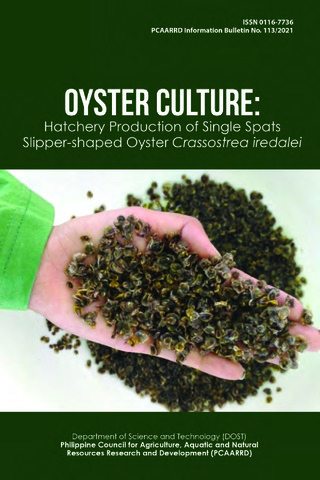
Oyster culture: Hatchery production of single spats slipper-shaped oyster Crassostrea iredalei
View/
Date
2021Page views
4,297ASFA keyword

AGROVOC keyword
Taxonomic term

Metadata
Show full item recordShare
Description
This manual intends to provide information on the techniques, processes, and recommend practices on hatchery production of single spats slipper-shaped oyster Crassostrea iredalei. This will serve as a guide for hatchery operators and shellfish farmers on the production and profitability of safe and quality single spats oyster for grow-out culture.
Suggested Citation
Philippine Council for Agriculture, Aquatic and Natural Resources Research and Development. (2021). Oyster culture: Hatchery production of single spats slipper-shaped oyster Crassostrea iredalei. Los Baños, Laguna, Philippines: DOST-PCAARRD.
Type
BookISSN
0116-7736Series
PCAARRD Information Bulletin; No. 113/2021Collections
- Manuals [1]
Related items
Showing items related by title, author, creator and subject.
-
A method of culturing/ growing high-quality edible oysters (Crassostrea spp. and Magallana bilineata)
(Intellectual Property Office of the Philippines, 2024-11-18)This utility model discloses a process of culturing/ growing high-quality edible oysters (Crassostrea spp. and Magallana bilineata) comprising the steps: selecting grow-out culture sites, deploying substrates for competent larvae of oysters to settle and grow, making oyster pouches while waiting for the availability of oyster spat, harvesting and stocking the oyster spat in the said pouches, hanging the pouches from rafts, and harvesting the oysters when they attain at least 80 grams of body weight. Traditional processes of producing edible oysters allow them to grow on top of each other, producing clumped oysters of varying sizes. This utility model produces larger, individual oysters of almost uniform sizes with harvest size attainable at a shorter period compared to those oysters cultured using traditional methods. -
Wise use of important mollusc species in mangrove areas: Malaysia
(Aquaculture Department, Southeast Asian Fisheries Development Center, 2000)For centuries, several edible mollusc species are being collected for food by coastal communities from these mangrove ecosystems. The most common molluscs collected are cockles, various species of oysters, clams and cerithids. This paper attempts to discuss the most practical culture technologies that have been developed for some of the more important mollusc species that are cultured in Malaysia. In order of priority, these are Anadara granosa (blood cockle), Crassostrea iredalei (brackishwater slipper oyster), Crassostrea belcheri (mangrove oyster), and Cerithidia obtusa (horn shells). -
Molluscan aquaculture in the Philippines: A review
Lebata-Ramos, Ma. Junemie Hazel (Springer, 2023-04-25)
Molluscs are among the most valuable resources of the Philippines, an archipelagic country of 7,107 islands bounded by 36,000 km of coastline and 26.6 million ha of coastal waters. In 2020, production from mussels and oysters alone valued at PhP1.552 billion. As primary sources of food and livelihood for marginalized fisherfolk, they are considered important in food security, nutrition, and poverty alleviation. Nevertheless, for almost a century, mollusc culture remained small-scale, with most fish farmers investing in non-fed species, like mussels and oysters. Moreover, mollusc culture in the country is still dependent on wild sources of seed stocks, making production unsustainable and unreliable. This dependence on the wild seed stocks will continue until the issue of the lack of commercial-scale hatcheries or the limited capacity of existing hatcheries to produce seeds, both for top and emerging mollusc aquaculture species, is resolved. Although technologies from broodstock management to post-harvest are available in some species, the lack of capital and the limited government support limit these artisanal fishers from doing large commercial-scale culture. This paper summarizes what has been done and published on the leading mollusc species cultured in the Philippines. Future research activities may be designed based on the research gaps to refine available technologies and develop new ones to improve culture production. The lack of or limited relevant information on the viable economics of the different culture techniques at different culture phases, the limited availability of post-harvest technologies, and the sparse or lack of genetic information for these leading mollusc species are among the gaps that need to be addressed.
(Springer, 2023-04-25)
Molluscs are among the most valuable resources of the Philippines, an archipelagic country of 7,107 islands bounded by 36,000 km of coastline and 26.6 million ha of coastal waters. In 2020, production from mussels and oysters alone valued at PhP1.552 billion. As primary sources of food and livelihood for marginalized fisherfolk, they are considered important in food security, nutrition, and poverty alleviation. Nevertheless, for almost a century, mollusc culture remained small-scale, with most fish farmers investing in non-fed species, like mussels and oysters. Moreover, mollusc culture in the country is still dependent on wild sources of seed stocks, making production unsustainable and unreliable. This dependence on the wild seed stocks will continue until the issue of the lack of commercial-scale hatcheries or the limited capacity of existing hatcheries to produce seeds, both for top and emerging mollusc aquaculture species, is resolved. Although technologies from broodstock management to post-harvest are available in some species, the lack of capital and the limited government support limit these artisanal fishers from doing large commercial-scale culture. This paper summarizes what has been done and published on the leading mollusc species cultured in the Philippines. Future research activities may be designed based on the research gaps to refine available technologies and develop new ones to improve culture production. The lack of or limited relevant information on the viable economics of the different culture techniques at different culture phases, the limited availability of post-harvest technologies, and the sparse or lack of genetic information for these leading mollusc species are among the gaps that need to be addressed.