Phosphorus budget in mangrove woods and ecosystems to which are added artificial nutrients and wastewater from shrimp aquaculture ponds

View/
Date
2003Page views
703ASFA keyword

AGROVOC keyword
Taxonomic term

Metadata
Show full item recordShare
Abstract
In this paper, a model experiment was conducted in Thailand to investigate the water purification ability of mangrove swamps using mangrove forests ecosystem by means of elucidation of the phosphorus budget. Sonneratia caseolaris were planted on tanks of shrimp culture waste water. Results obtained suggest that phosphate is rapidly processed under natural environmental conditions.
Suggested Citation
Shimoda, T., Aryuthaka, C., & Srithong, C. (2003). Phosphorus budget in mangrove woods and ecosystems to which are added artificial nutrients and wastewater from shrimp aquaculture ponds. In Y. Ogawa, H. Y. Ogata, Y. Maeno, T. Shimoda, Y. Fujioka, & Y. Fukuda (Eds.), Proceedings of the 2nd Workshop of the JIRCAS International Collaborative Research: Studies on Sustainable Production Systems of Aquatic Animals in Brackish Mangrove Areas , December 2-3, 2002, Penang, Malaysia (pp. 95-102). Japan International Research Center for Agricultural Sciences.
Type
Conference paperISSN
1341-710XSeries
JIRCAS Working Report;No. 35Related items
Showing items related by title, author, creator and subject.
-
The growth, survival and production of shrimp (Penaeus monodon) cultured with green mussel (Perna viridis) in semi-intensive ponds
(University of Philippines in the Visayas, 1997)The culture of tiger shrimps (Penaeus monodon) with and without green mussels (Perna viridis) was compared in terms of animal growth, survival, production, and pond water quality. Tiger shrimps (2.6 g) were stocked at 50,000/ha in six 1,000 m2 earthen ponds. Green mussels (mean shell-on weight of 11 g) were stocked at 100,000/ha on ropes suspended from bamboo rafts in three of these ponds. The growth and survival of tiger shrimps were not significantly different when cultured with or without mussels. Higher shrimp production (1,528.2 kg/ha) was obtained when these were cultured with mussels than without (1,327.5 kg/ha). Water quality did not vary significantly between treatments but ponds with both shrimp and mussel had lesser algae, lower biological oxygen demand and particulate organic matter levels, and generally higher morning dissolved oxygen concentrations compared with ponds without mussels. Results show the potential of green mussels as biological filters in shrimp ponds. -
Integrating effluent management
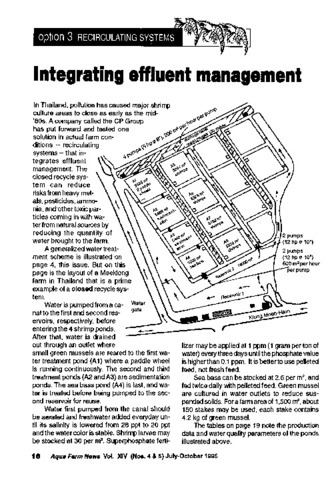
(Aquaculture Department, Southeast Asian Fisheries Development Center, 1996)The paper discusses a closed recycle shrimp farm in Thailand which integrates effluent management. The closed recycle system can reduce risk of heavy metals, pesticides, ammonia, and other toxic particles coming in with water from natural sources by reducing the quantity of water brought to the farm. -
Bacterial microbiota of hatchery-reared freshwater prawn Macrobrachium rosenbergii (De Man, 1879) and their pathogenicity
Monghit-Camarin, Ma-ann ; ; Pakingking, Rolando V., Jr. ; Cuvin-Aralar, Maria Lourdes ; Traifalgar, Rex Ferdinand ; ; ; (University of the Philippines Visayas, 2022)
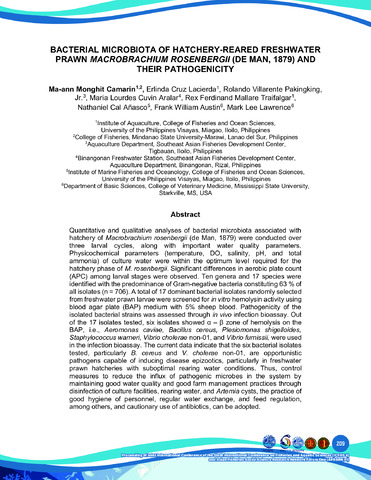
Quantitative and qualitative analyses of bacterial microbiota associated with hatchery of Macrobrachium rosenbergii (de Man, 1879) were conducted over three larval cycles, along with important water quality parameters. Physicochemical parameters (temperature, DO, salinity, pH, and total ammonia) of culture water were within the optimum level required for the hatchery phase of M. rosenbergii. Significant differences in aerobic plate count (APC) among larval stages were observed. Ten genera and 17 species were identified with the predominance of Gram-negative bacteria constituting 63 % of all isolates (n = 706). A total of 17 dominant bacterial isolates randomly selected from freshwater prawn larvae were screened for in vitro hemolysin activity using blood agar plate (BAP) medium with 5% sheep blood. Pathogenicity of the isolated bacterial strains was assessed through in vivo infection bioassay. Out of the 17 isolates tested, six isolates showed α – β zone of hemolysis on the BAP, i.e., Aeromonas caviae, Bacillus cereus, Plesiomonas shigelloides, Staphylococcus warneri, Vibrio cholerae non-01, and Vibrio furnissii, were used in the infection bioassay. The current data indicate that the six bacterial isolates tested, particularly B. cereus and V. cholerae non-01, are opportunistic pathogens capable of inducing disease epizootics, particularly in freshwater prawn hatcheries with suboptimal rearing water conditions. Thus, control measures to reduce the influx of pathogenic microbes in the system by maintaining good water quality and good farm management practices through disinfection of culture facilities, rearing water, and Artemia cysts, the practice of good hygiene of personnel, regular water exchange, and feed regulation, among others, and cautionary use of antibiotics, can be adopted.
; ; Pakingking, Rolando V., Jr. ; Cuvin-Aralar, Maria Lourdes ; Traifalgar, Rex Ferdinand ; ; ; (University of the Philippines Visayas, 2022)
Quantitative and qualitative analyses of bacterial microbiota associated with hatchery of Macrobrachium rosenbergii (de Man, 1879) were conducted over three larval cycles, along with important water quality parameters. Physicochemical parameters (temperature, DO, salinity, pH, and total ammonia) of culture water were within the optimum level required for the hatchery phase of M. rosenbergii. Significant differences in aerobic plate count (APC) among larval stages were observed. Ten genera and 17 species were identified with the predominance of Gram-negative bacteria constituting 63 % of all isolates (n = 706). A total of 17 dominant bacterial isolates randomly selected from freshwater prawn larvae were screened for in vitro hemolysin activity using blood agar plate (BAP) medium with 5% sheep blood. Pathogenicity of the isolated bacterial strains was assessed through in vivo infection bioassay. Out of the 17 isolates tested, six isolates showed α – β zone of hemolysis on the BAP, i.e., Aeromonas caviae, Bacillus cereus, Plesiomonas shigelloides, Staphylococcus warneri, Vibrio cholerae non-01, and Vibrio furnissii, were used in the infection bioassay. The current data indicate that the six bacterial isolates tested, particularly B. cereus and V. cholerae non-01, are opportunistic pathogens capable of inducing disease epizootics, particularly in freshwater prawn hatcheries with suboptimal rearing water conditions. Thus, control measures to reduce the influx of pathogenic microbes in the system by maintaining good water quality and good farm management practices through disinfection of culture facilities, rearing water, and Artemia cysts, the practice of good hygiene of personnel, regular water exchange, and feed regulation, among others, and cautionary use of antibiotics, can be adopted.