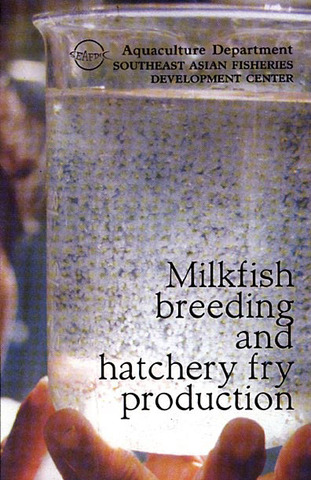
Milkfish breeding and hatchery fry production


Share
Description
Summarizes the integrated milkfish broodstock and hatchery operation technology developed by SEAFDEC/AQD.
Type
BrochureCollections
- Brochures and flyers [57]
Related items
Showing items related by title, author, creator and subject.
-
Milkfish breeding and hatchery technology at SEAFDEC/AQD
(Aquaculture Department, Southeast Asian Fisheries Development Center, 1999)Describes the techniques already adopted by the private sector: broodstock management, broodstock diet, commercial fry production, live transport, and larval diet. A list of AQD research publications on milkfish is included. -
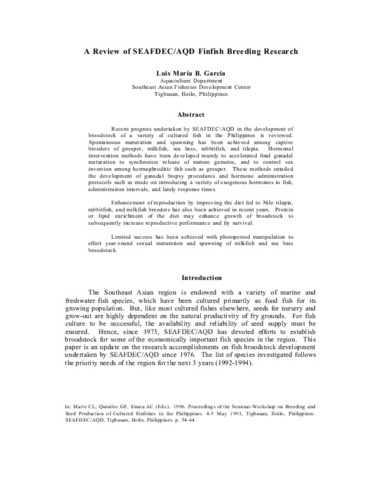
A review of SEAFDEC/AQD finfish breeding research
Garcia, Luis Maria (Aquaculture Department, Southeast Asian Fisheries Development Center, 1996)
Recent progress undertaken by SEAFDEC/AQD in the development of broodstock of a variety of cultured fish in the Philippines is reviewed. Spontaneous maturation and spawning has been achieved among captive breeders of grouper, milkfish, sea bass, rabbitfish, and tilapia. Hormonal intervention methods have been developed mainly to accelerated final gonadal maturation to synchronize release of mature gametes, and to control sex inversion among hermaphroditic fish such as grouper. These methods entailed the development of gonadal biopsy procedures and hormone administration protocols such as mode on introducing a variety of exogenous hormones to fish, administration intervals, and lately response times.Enhancement of reproduction by improving the diet fed to Nile tilapia, rabbitfish, and milkfish breeders has also been achieved in recent years. Protein or lipid enrichment of the diet may enhance growth of broodstock to subsequently increase reproductive performance and fry survival.Limited success has been achieved with photoperiod manipulation to effect year-round sexual maturation and spawning of milkfish and sea bass broodstock.
(Aquaculture Department, Southeast Asian Fisheries Development Center, 1996)
Recent progress undertaken by SEAFDEC/AQD in the development of broodstock of a variety of cultured fish in the Philippines is reviewed. Spontaneous maturation and spawning has been achieved among captive breeders of grouper, milkfish, sea bass, rabbitfish, and tilapia. Hormonal intervention methods have been developed mainly to accelerated final gonadal maturation to synchronize release of mature gametes, and to control sex inversion among hermaphroditic fish such as grouper. These methods entailed the development of gonadal biopsy procedures and hormone administration protocols such as mode on introducing a variety of exogenous hormones to fish, administration intervals, and lately response times.Enhancement of reproduction by improving the diet fed to Nile tilapia, rabbitfish, and milkfish breeders has also been achieved in recent years. Protein or lipid enrichment of the diet may enhance growth of broodstock to subsequently increase reproductive performance and fry survival.Limited success has been achieved with photoperiod manipulation to effect year-round sexual maturation and spawning of milkfish and sea bass broodstock. -
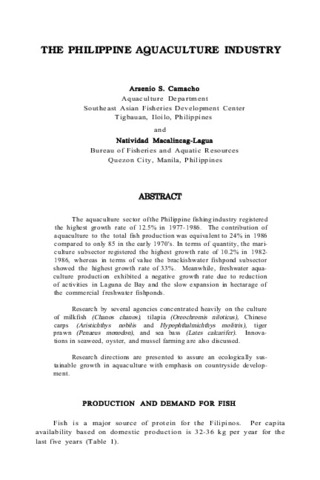
The Philippine aquaculture industry
(Aquaculture Department, Southeast Asian Fisheries Development Center, 1988)The aquaculture sector of the Philippine fishing industry registered the highest growth rate of 12.5% in 1977-1986. The contribution of aquaculture to the total fish production was equivalent to 24% in 1986 compared to only 85 in the early 1970's. In terms of quantity, the mariculture subsector registered the highest growth rate of 10.2% in 1982-1986, whereas in terms of value the brackishwater fishpond subsector showed the highest growth rate of 33%. Meanwhile, freshwater aquaculture production exhibited a negative growth rate due to reduction of activities in Laguna de Bay and the slow expansion in hectarage of the commercial freshwater fishponds. Research by several agencies concentrated heavily on the culture of milkfish (Chanos chanos), tilapia (Oreochromis niloticus), Chinese carps (Aristichthys nobilis and Hypophthalmichthys molitrix), tiger prawn (Penaeus monodon), and sea bass (Lates calcarifer). Innovations in seaweed, oyster, and mussel farming are also discussed. Research directions are presented to assure an ecologically sustainable growth in aquaculture with emphasis on countryside development.