Journals/Magazines: Recent submissions
Now showing items 421-440 of 591
-
Modifications in bangus culture
(Aquaculture Department, Southeast Asian Fisheries Development Center, 1995)The article presents the milkfish aquaculture techniques in the Philippines modified from the traditional method. These are modular method and silo method, methods on eliminating snails, fertilizer-water replenishment scheme, supplemental feeding and the stunting of fingerlings are also presented. -
Traditional bangus culture
(Aquaculture Department, Southeast Asian Fisheries Development Center, 1995)The article presents the traditional milkfish culture practices. The different types of culture ponds are classified according to their uses. Pond preparation, stocking density, pond management and harvesting practices are also discussed. -
Milkfish culture in the Philippines
(Aquaculture Department, Southeast Asian Fisheries Development Center, 1995)The article discusses the development of milkfish aquaculture industry in the Philippines. The impact of milkfish aquaculture to the environment, the different farming techniques and its economic aspects are also discussed. -
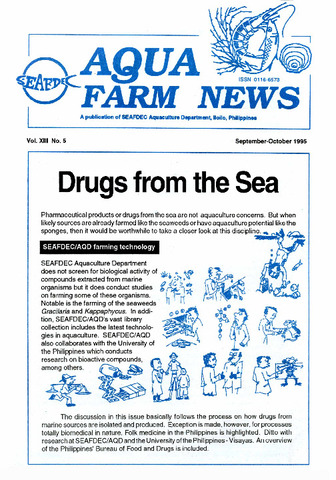
Aqua Farm News Volume 13(05) September - October 1995
(Aquaculture Department, Southeast Asian Fisheries Development Center, 1995)The discussion in this issue basically follows the process on how drugs from marine sources are isolated and produced. Exception is made, however, for processes totally biomedical in nature. Folk medicine in the Philippines ... -
Future drugs from the sea
(Aquaculture Department, Southeast Asian Fisheries Development Center, 1995)The article presents several marine chemicals that are likely candidates for future drugs. There sources and applications were also discussed. -
Nereistoxin
(Aquaculture Department, Southeast Asian Fisheries Development Center, 1995)The article discusses Nereistoxin, a toxin isolated from marine annelids, its pharmacological and agricultural applications are discussed in the article. -
Some marine toxins
(Aquaculture Department, Southeast Asian Fisheries Development Center, 1995)The article presents some toxins of marine origin. These are tetrodotoxin from pufferfish, saxitoxins from red microalgae that mussels and shellfish ingest, and palitoxin the most toxic marine product isolated from zoonthurian Palythoa toxica. -
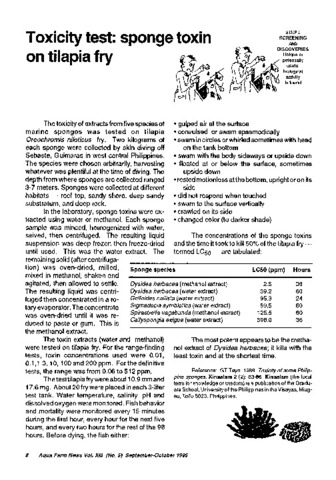
Toxicity test: Sponge toxin on tilapia fry
(Aquaculture Department, Southeast Asian Fisheries Development Center, 1995)The research was conducted to determine the toxicity of extracts from five Philippine species of marine sponges on tilapia Oreochromis niloticus fry. It was found out that the most potent was the methanol extract of Dysidea herbacea, it kills with the least toxin and at the shortest time. -
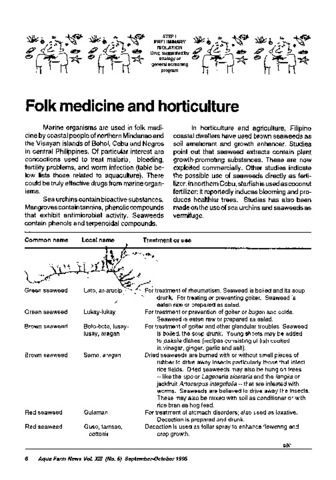
Folk medicine and horticulture
(Aquaculture Department, Southeast Asian Fisheries Development Center, 1995)The article discusses the uses of marine organisms in folk medicine and in horticulture in the Philippines. Commonly used marine organisms are the different varieties of seaweeds, sea urchin, sea cucumber, turtle, crocodile and fishes such as grouper and rabbitfish. -
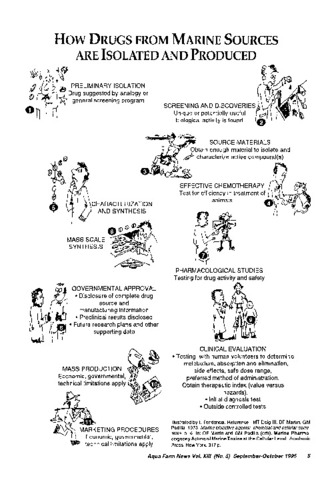
How drugs from marine sources are isolated and produced
(Aquaculture Department, Southeast Asian Fisheries Development Center, 1995)The document illustrates the processes on the isolation of bioactive compounds from marine organisms and the production of marine drugs. -
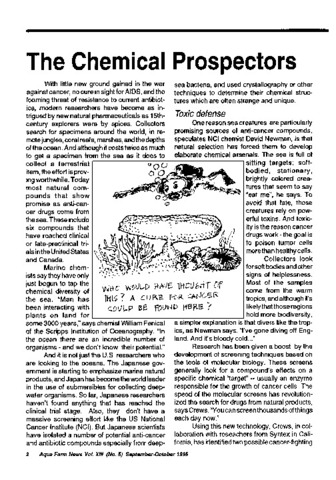
The chemical prospectors
(Aquaculture Department, Southeast Asian Fisheries Development Center, 1995)The article discusses the results of researches on chemical prospecting of marine organisms containing compounds that show promise as anti-cancer drugs. -
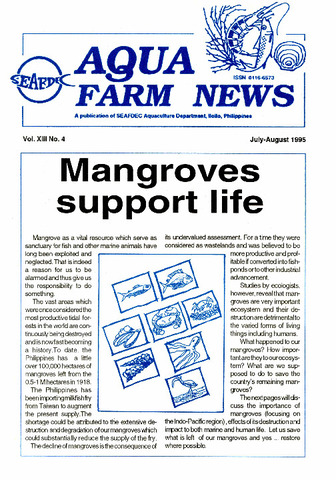
Aqua Farm News Volume 13(04) July - August 1995
(Aquaculture Department, Southeast Asian Fisheries Development Center, 1995)What are mangroves? How important are they to our ecosystem? Just two of the questions this issue answers. This issue also includes the state of mangrove resources in the Indo-Pacific region, valuation of mangroves, their ... -
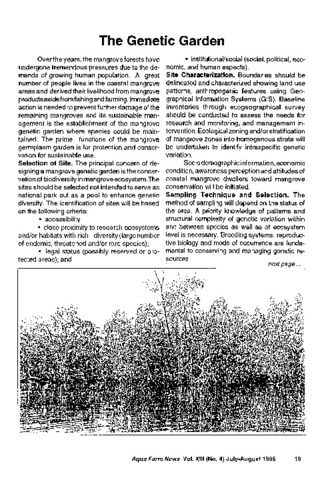
The genetic garden
(Aquaculture Department, Southeast Asian Fisheries Development Center, 1995)The article discusses some strategies in the establishment of a mangrove genetic garden where species could be maintained. The genetic garden is a sustainable way to prevent further damage of the remaining mangroves. Its prime function is the protection and conservation of mangroves for sustainable use. -
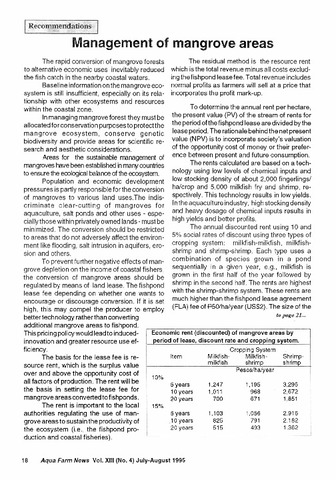
Management of mangrove areas
(Aquaculture Department, Southeast Asian Fisheries Development Center, 1995)The article discusses the management of mangrove areas in the Philippines to prevent further negative effects of mangrove depletion on the income of coastal fishers. The article suggests that the conversion of mangrove areas should be regulated by means of land lease. -
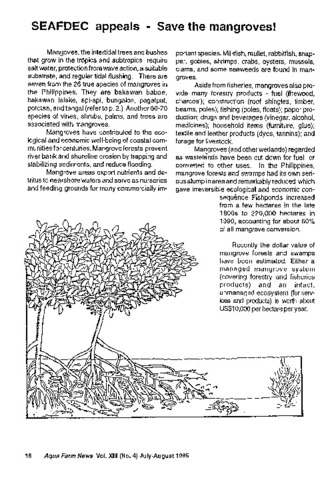
SEAFDEC appeals - Save the mangroves!
(Aquaculture Department, Southeast Asian Fisheries Development Center, 1995)The article presents action plans that could be done to stop and prevent further degradation of the mangrove ecosystem. These action plans are: conservation, mangrove reforestation and the practice of ecologically sound aquaculture. -
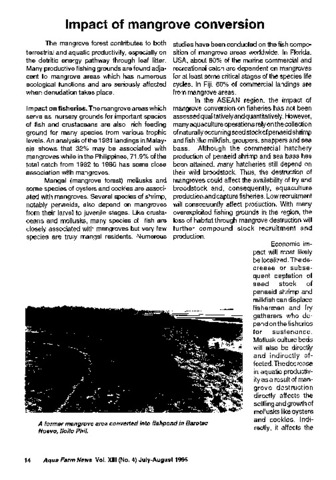
Impacts of mangrove conversion
(Aquaculture Department, Southeast Asian Fisheries Development Center, 1995)The article presents the impact of mangrove conversion on fisheries and on coastal areas. The mangrove areas which serve as nursery grounds for important species of fish and crustaceans are also rich feeding ground for many species from various trophic levels. Thus, the destruction of mangroves could affect the availability of fry and broodstock and, consequently, aquaculture production and fisheries. While in coastal areas, the destruction of mangroves increased the risk of coastal erosion from storm surges and winds, accelerates the erosion of riverbanks, exposes acid sulfate soils, leading to poor production and mass mortality of stocks, and affects the freshwater supply through salt intrusion upstream among others. -
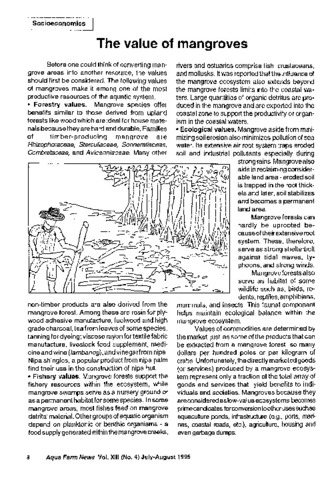
The value of mangroves
(Aquaculture Department, Southeast Asian Fisheries Development Center, 1995)The article presents the forestry, fishery and ecological values of mangroves. Studies on the measurement of the economic value of mangroves that were conducted in Thailand, Indonesia and Ecuador are also presented. -
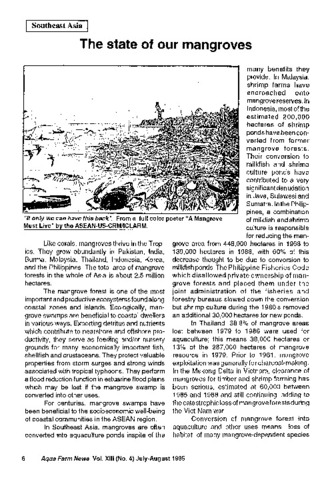
The state of our mangroves
(Aquaculture Department, Southeast Asian Fisheries Development Center, 1995)The article presents the current state of mangroves in Southeast Asia. In several countries lost mangrove areas were due to the conversion of mangrove forest into aquaculture and other uses. The ecological and socioeconomic effects of mangrove destruction are also presented. -
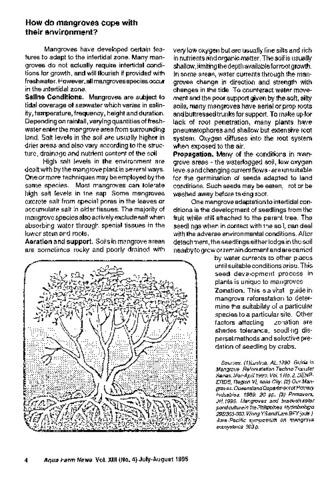
How do mangroves cope with their environment?
(Aquaculture Department, Southeast Asian Fisheries Development Center, 1995) -
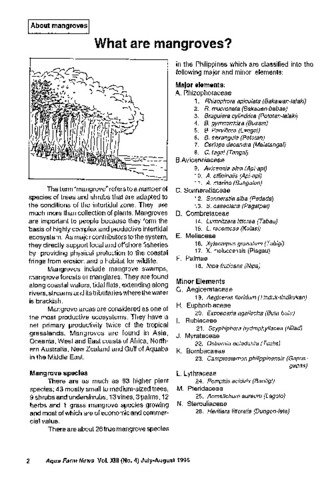
What are mangroves?
(Aquaculture Department, Southeast Asian Fisheries Development Center, 1995)The article presents about mangroves and its value to the ecosystem. The different species in the Philippines and mangroves coping mechanisms to the environment are also presented.